Cryptoporticus of Arles and Forum of Arelate
Leaving the Ancient Theatre (Théâtre Antique), the Rue de la Calade led us down the gentle slope of the hill, known as Colline de l’Hauture, to the Arles Town Hall. In the 17th century, Jules Hardouin-Mansart, the architect of the Grand Trianon at the Château de Versailles, constructed this imposing building on the site of the former Roman forum.
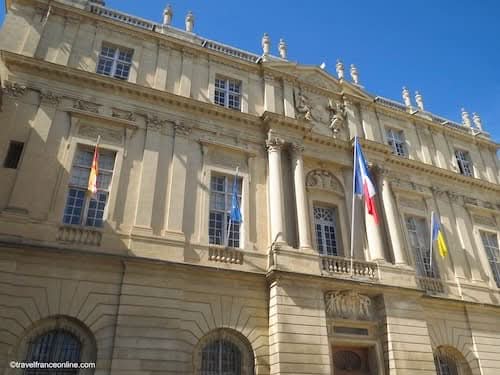
All traces of that forum vanished centuries ago, save for its remarkable foundations. Known as the Cryptoporticus of Arles, they are one of eight of the city’s monuments inscribed as UNESCO World Heritage Sites in 1981, along with the Cathedral and Cloister of Saint-Trophime, the Alyscamps necropolis, the Church of Saint-Honorat, the Roman obelisk, the Baths of Constantine, the Ancient Theatre, and the Amphitheatre.
The Cryptoporticus of Arles was the third stop on our day of exploring Arles, the city my friend and I had chosen as the starting point for our six-day hike along a section of the French Camino. We had arrived the day before and set aside a full day to visit these exceptional sites, and the cryptoporticus certainly didn’t disappoint!
And if you wonder: cryptoporticus is a Latin word meaning covered gallery or passage, and that is exactly what the Cryptoporticus of Arles is!
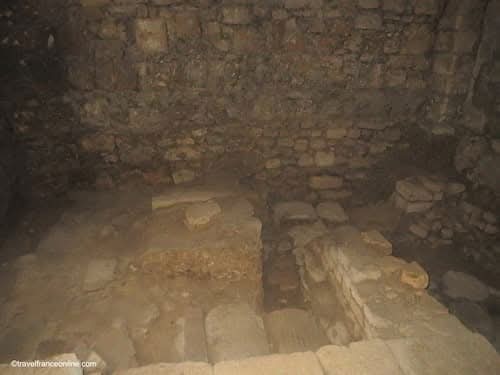
But first, let’s take a quick look at Roman forums: they began as simple marketplaces where farmers sold their produce to city dwellers, much like today’s farmers’ markets. As cities grew, they evolved, making way for permanent merchant stalls; as cities became more sophisticated and attracted large crowds, their forums transformed into meeting places where people from diverse backgrounds could interact. They became true public hubs where not only commercial matters, but also political, economic, judicial, and religious affairs were conducted. They were the heart of the city!
This led to the appearance of numerous structures, such as temples, basilicas, schools, libraries, and porticoes housing shops, as well as political buildings like curiae, which also turned the forums into the centres of power!
Some forums thus specialised in political or religious activities, while others focused on commerce. Originally open areas, they evolved into enclosed, rectangular spaces defined by their surrounding porticoes. Thus, Roman forums were massive structures that required solid foundations for support. The Forum of Arelate, as Roman Arles was called, was no exception!
Creation of the Cryptoporticus of Arles
As Arelate’s most important public square, the forum was built shortly after the foundation of the colony, in the late 1st century BC during the reign of Emperor Augustus. It spread on the slope of the Colline de l’Hauture, slightly below the Ancient Theatre and the Amphitheatre. Roman architects thus designed impressive foundations, a vast cryptoporticus consisting of galleries buried six metres underground, to compensate for the slope of the hill and ensure the forum was level! There was certainly no risk of the Forum of Arelate tipping over or collapsing!
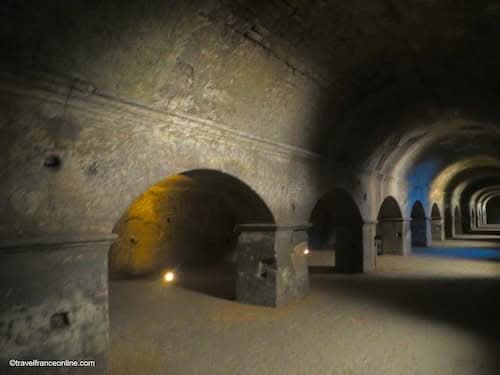
Indeed, the Cryptoporticus of Arles consists of three galleries, each about 10 metres wide, arranged in a U-shape opening towards the east. The two parallel galleries are 90 metres long, while the perpendicular gallery measures 60 metres. Each gallery is double-sided: massive rectangular pillars support a series of arches that separate two vaulted corridors. Due to their depth, ventilation was provided by a series of openings, much like a massive crawl space.
Although these underground galleries could be accessed via two service entrances, they were designed to remain hidden from view and were thus not open to the public; they served a purely utilitarian function. Strangely, only the north gallery opened onto the outside, connecting to a row of shops.
The Forum of Arelate was demolished in the 5th century, and the cryptoporticus was partitioned to create private cellars. Not only did the structure deteriorate over time, but it was also walled off in the 10th century. Certain sections were occasionally reopened, serving as catacombs and prisons, but the underground structure eventually fell into oblivion for centuries.
The rediscovered Cryptoporticus of Arles
It was not until the 20th century that the Cryptoporticus of Arles emerged from the earth and obscurity!
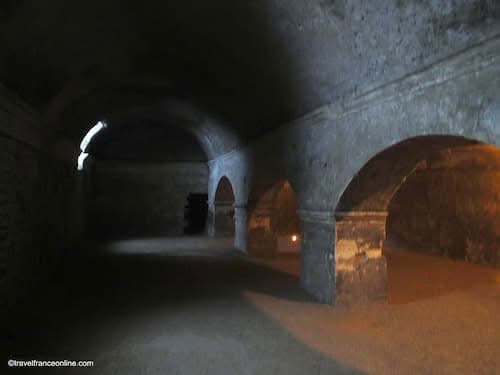
Excavations began in 1935; it was a painstaking process, carried out cellar by cellar, involving the demolition of partition walls and the necessary restoration and reinforcement of the masonry. However, the structure’s original purpose remained unknown until 1951, when fragments of statues and inscriptions, including one dedicated to Emperor Augustus, were unearthed, revealing the link between the forum and the imperial cult.
Once cleared and made safe, the Cryptoporticus of Arles finally opened to the public in 1966. At the time, access was via the Chapelle des Jésuites on the nearby Rue Balze. Since 2008, the entrance has been in the vestibule of the magnificent Town Hall.
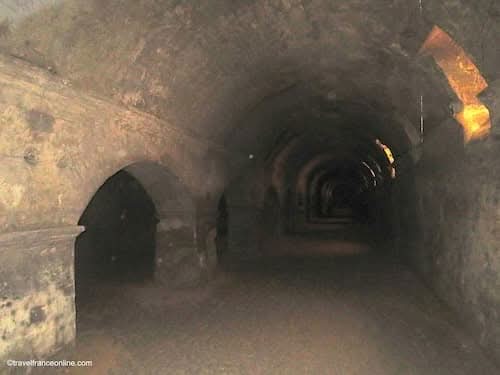
The Cryptoporticus of Arles is one of the most unusual tours imaginable and a must-do during the summer heat. As soon as you descend the small staircase leading to the galleries, you are indeed instantly enveloped by welcome coolness and soothing silence. The dim light doesn’t hinder your view of the sturdy pillars and arcades as you stroll through the vaulted corridors; as your eyes adjust to the semi-darkness, you discover here and there stone remnants bearing ancient inscriptions, traces of a bygone era revealed as you make your way through the corridors.
Needless to say, it was hard to leave this amazing site and cool haven and return to the heat of the street above. But the next monument on our list of “must-see”, right next to the town hall, also promised us coolness: the magnificent Basilica Saint-Trophime and its Cloister.
N.B. You can discover the exceptional artefacts excavated in the Arles ancient history museum, near the former Roman circus.