The two-span Pont-Neuf
The Pont-Neuf spans the western part of the Ile de la Cité, between the Place Dauphine and the Square du Vert-Galant, connecting the island to the Right and Left Banks.

It thus boasts breathtaking views of the Louvre Palace and former La Samaritaine department store.
The architect Jacques Androuet du Cerceau designed this magnificent stone bridge with twelve arches, arranged in two spans. The five-arch span connects the island to the Left Bank, and the seven-arch span connects it to the Right Bank.
Despite its name, which means “New Bridge,” it is the oldest bridge in Paris that has not been rebuilt since its construction. Its name was originally chosen to distinguish it from the other bridges in the city.
Over the centuries, the Pont-Neuf has undergone several restorations; the most recent took place between 1994 and 2007, on the occasion of its 400th anniversary.
Pont-Neuf , the first Paris bridge with no houses

Don’t think for a moment that traffic jams are a modern woe!
They already existed in the 1550s, and the construction of the Pont Neuf was decided upon to relieve congestion on the old Pont Notre-Dame.
Thus, on May 31, 1578, King Henry III laid the first stone of the bridge.
Construction was later slowed down to widen it and allow for a double row of houses, and its bastion-like pillars were thus reinforced in the following years to support the new structure.
Works were also interrupted during the Wars of Religion, but resumed in 1599 under the reign of Henri IV. However, the houses were never built, making the Pont Neuf the first Parisian bridge without any dwellings.
In 1607, Henry IV officially inaugurated the Pont Neuf, three years before his assassination.
Equestrian statue of Henri IV
In 1614, the widowed Marie de Medici commissioned the sculptor Giambologna to create a bronze equestrian statue in honour of her husband. Giambologna died before completing the work, and his assistant, Pietro Tacca, took over the project. The statue was finished and placed on its pedestal in 1618.
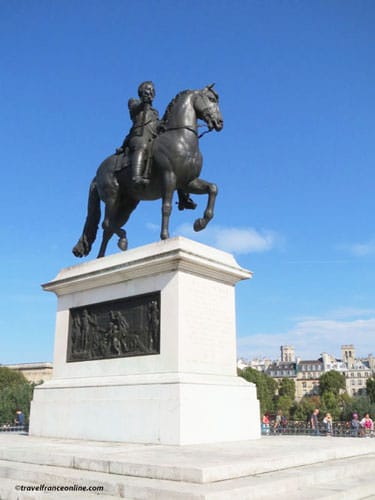
Unfortunately, this original statue was destroyed during the French Revolution, but a public subscription was launched during the Bourbon Restoration to replace it. In 1818, sculptor Lemot was entrusted with the creation of an identical replica that was cast from the original mould.
Lemot also placed four sealed caskets in the statue’s base. These caskets contain historical documents detailing the life of King Henry IV, the commissioning process, the patrons’ names, and a 17th-century document certifying the replica’s authenticity.
The equestrian statue of Henry IV stands on the Place du Pont-Neuf, at the junction of the bridge’s two spans. Facing east, towards the Île de la Cité, the king gazes fixedly at Notre-Dame, while his horse’s head is slightly inclined.
The king is depicted in armour, crowned with laurel, and holding in his right hand a sceptre adorned with the fleur-de-lys, the emblem of the kings of France. Bas-reliefs decorate the sides of the pedestal, and a Latin inscription appears on the front. This statue was listed as a historical monument in 1992.
La Samaritaine Pump under the Pont-Neuf

A water pump, known as the Pompe de la Samaritaine, was installed in 1608 on the Pont-Neuf to supply water to the nearby Louvre Palace.
Dismantled in 1813, it nevertheless lent its name to the iconic department store founded in 1870 by Ernest Cognacq-Jay on the Right Bank.
The Pont des Arts, the pedestrian bridge spanning the Seine between the Louvre and the Institut de France, offers the best overall view of the two spans of the Pont Neuf.