La Samaritaine, a World Heritage Site

La Samaritaine was one of Paris’s most iconic department stores.
It closed its doors in 2005 after 135 years of operation. Renowned for its spectacular Art Nouveau and Art Deco decor, the store was designated a UNESCO World Heritage Site in 1991, following a restoration campaign that took place between 1984 and 1989.
Magasin No. 2 (store), as well as the facades and roofs of Magasin No. 3, were listed as historical monuments on July 25, 1990.
The LVMH group acquired the buildings in 2001 and embarked on a four-year modernisation project to bring them up to current safety standards.
However, despite these efforts, the buildings did not meet fire safety standards and were closed on June 15, 2005, by the Paris Prefecture. At that time, La Samaritaine employed 1,506 people.
Who’s involved in the store redevelopment?
The renovation of La Samaritaine by LVMH represented an investment of about €450 million. The project, launched in December 2012 with the granting of the building permit, aimed to revitalise this iconic department store.

The renowned architects Kazuyo Sejima and Ryue Nishizawa, of the Japanese firm SANAA, winners of the prestigious Pritzker Prize in 2010, were commissioned to design the architecture. The interior design was overseen by Peter Marino, known for his work with Louis Vuitton, and Edouard François, the architect of the Hôtel Fouquet‘s. The project suffered delays due to the complexity of the building permit applications and a heated controversy, and only reopened in June 2021.
The situation was further complicated by the fact that 80% of the buildings, including their Art Nouveau and Art Deco features, are listed as historical monuments. Therefore, the renovations were closely supervised by the Historic Monuments Service to ensure the preservation of the site’s heritage. The redevelopment project thus brought together a team of skilled artisans, including master ceramicists, stonemasons, blacksmiths, and sculptors, tasked with preserving and enhancing the historical and architectural integrity of La Samaritaine.
The new look of La Samaritaine
La Samaritaine shopping centre still spans two city blocks and covers an impressive 70,000 square metres. Of this space, 26,000 square metres are dedicated to retail; 21,000 square metres are allocated to offices; and 7,000 square metres have been reserved for the creation of 96 social housing units, accommodating approximately 250 residents, as well as an 80-place daycare centre and the Cheval Blanc Hotel on the Seine side.

The buildings located between Rue de Rivoli and Rue Baillet were not classified as historical monuments and have been renovated. Interior courtyards bring natural light into the retail and office spaces, improving the ambience and functionality of the area. Rue Baillet, which provides access to the daycare centre and offices, has been covered with a glass roof.
A contemporary building with an undulating glass facade, affectionately nicknamed the Rideau de douche – Shower curtain by some critics, dominates the Rue de Rivoli. It houses a luxury department store, traditional shops including food stalls, and a vast space for cultural exhibitions. These facilities unfold beneath the magnificent historic glass roof, meticulously restored to its original state. The shopping centre is expected to attract between 20,000 and 30,000 visitors per day and create approximately 4,400 jobs.
La Samaritaine named after a water pump!
Let’s return to the creation of La Samaritaine.

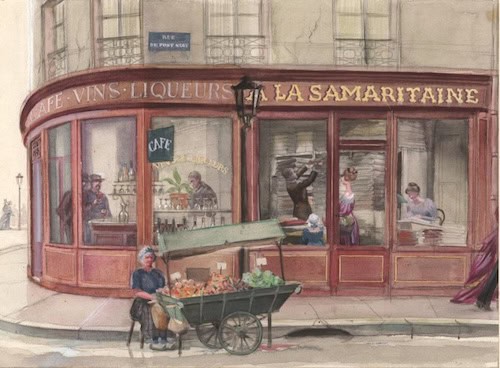
On March 21, 1870, Ernest Cognacq and Louise Jay, who had previously worked at the famous department store Le Bon Marché, opened a “department store of novelties” in the modest 48-square-metre back room of the Café de la Samaritaine.
This bistro was located at the corner of Rue du Pont-Neuf and Rue de la Monnaie.
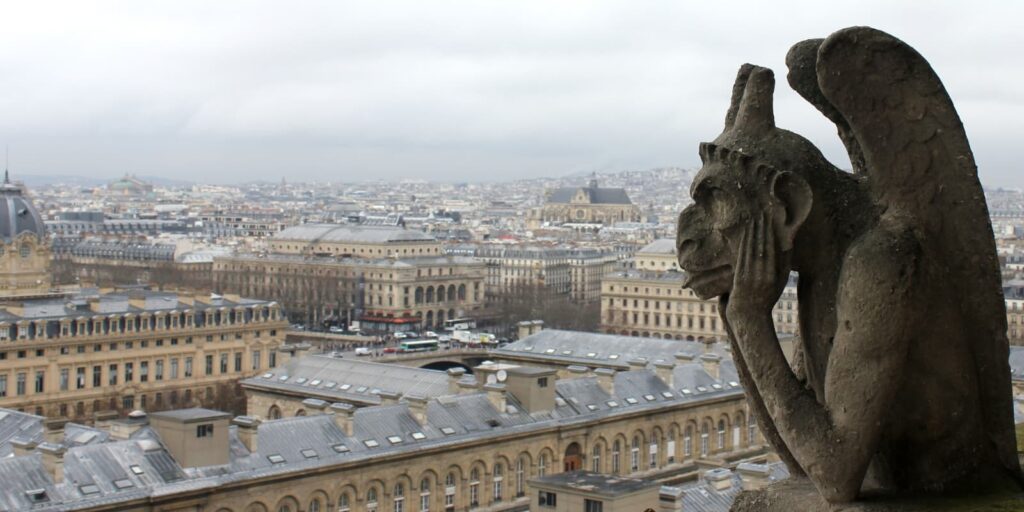
They chose to name their store after La Samaritaine, the water pump located on the Pont-Neuf (bridge) that had supplied the Louvre with water from 1608 to 1813.
La Samaritaine, Paris’ most successful department store
The meteoric rise of La Samaritaine is closely linked to the evolution of social habits that emerged after the French Revolution. The sale of goods not manufactured by individuals was officially authorised, thus paving the way for a new era of commerce.
The Industrial Revolution then generated a sharp increase in demand, thus a proliferation of shops offering affordable goods.
La Samaritaine had the advantage over all other stores of a prime location, near the Saint-Germain-l’Auxerrois Church and the Louvre Palace, which attracted a constant flow of visitors and customers.
However, it was the business acumen of its founders that truly distinguished La Samaritaine.
By implementing innovative business strategies and adapting to the changing needs of consumers, Ernest Cognacq and Louise Jay indeed transformed their modest establishment into the most successful department store in Paris.

Ernest Cognacq adopted revolutionary marketing techniques, breaking with the traditional business practices of the time, such as reduced profit margins, price displays, and daily promotions.
These strategies not only attracted crowds of customers eager for the “bargain of the day,” but also created an atmosphere of excitement and anticipation around the store.
Inspired by the winning formula of Aristide Boucicaut, founder of Le Bon Marché, Eenest and Louise understood the importance of selling more to sell for less and selling for less to sell more.
By prioritising accessibility and affordability, La Samaritaine quickly established itself as the leading department store in Paris, a position it maintained for much of the 20th century.
Ernest Cognacq’s success story began during the Franco-Prussian War of 1870-1871. He secured the contract to manufacture uniforms for the French army.
Wisely reinvesting his considerable profits, Cognacq embarked on an expansion plan for La Samaritaine.
In 1874, he leased the neighbouring building to meet the growing demand for his products and services. In 1883, he purchased it, and in 1895, he added a floor. Over the following decades, La Samaritaine expanded, eventually encompassing four adjacent buildings.
These interconnected buildings gave rise to a store with an impressive retail space of 80,000 square metres, between the Rue de Rivoli, the Quai du Louvre, and the Rue Baillet.
La Samaritaine’s Magasin no1, a masterpiece of Art Nouveau
We are now in 1905, a new century, a new venture!

Ernest Cognacq commissioned the renowned architect Frantz Jourdain to design a new building at the corner of Rue du Pont-Neuf and Rue de la Monnaie. The spectacular Art Nouveau Magasin No. 1 was completed in 1910.
The four-story Immeuble Jourdain (building) is structured around a central hall crowned by a magnificent glass roof adorned with sculptures and painted friezes. A remarkable, monumental cast-iron staircase leads to the open galleries on the upper floors.
Francis Jourdain, the architect’s son, added the superb Art Nouveau facade facing Rue de la Monnaie. He commissioned the greatest artists of the era: the painter Eugène Grasser and the master blacksmith Édouard Schenck, and François Gillet and Alexandre Bigot, renowned ceramists of their time, to adorn the magnificent facade with metal scrolls, mullioned windows, and arcades covered with polished and enamelled lava panels, embellished with floral mosaics and inscriptions.
Originally painted a vibrant blue, the facade has acquired a rich green hue over the years. The Jourdain building is a remarkable example of Art Nouveau architecture.
La Samaritaine’s Art Deco Magasin no2
The architectural evolution of La Samaritaine continued with the construction of Magasin 2 by architect Francis Gourdin between 1904 and 1907. Henri Sauvage redesigned this second building during its expansion between 1922 and 1928 and built the iconic Art Deco facade overlooking the Seine.

With its massive, square stone structure framed by woodwork painted in a lustrous bronze, adorned with balconies and awnings, but devoid of mosaic ornamentation, this facade exudes a modernity and sophistication characteristic of the Art Deco movement.
La Samaritaine was expanded once again in the early 1930s along the Rue de Rivoli with the 10-floor Magasin No. 3, located between the Rue de Rivoli, the Rue du Pont-Neuf, and the Rue Boucher. Magasin 4, housed in a group of early 19th-century buildings, was gradually converted into offices, shops, and workshops between 1889 and 1911. Its original facade was destroyed during the Second World War.
Decline of the iconic department store
The deaths of Louise and Ernest Cognacq-Jay in the late 1920s marked the end of an era for La Samaritaine. Their nephew took over the management, but his tenure was marred by controversies related to his collaboration with the Germans during the war, which forced him to withdraw from the business.

The Renant family resumed the management of La Samaritaine. Renowned for their innovative spirit, they were behind the famous slogan On trouve tout à la Samaritaine – You can find everything at La Samaritaine, reflecting the store’s commitment to offering a diverse range of products and services to its customers.
However, despite its popularity, La Samaritaine had to face the challenges posed by the evolution of retail in the 20th century. The emergence of new purchasing trends and consumer preferences, combined with the store’s inability to adapt to these changes, contributed to its gradual decline beginning in the early 1970s.
But, a new era began when the LVMH group acquired the store!
Directions: 1st District
Metro: Pont-Neuf on Line 7
Coordinates: Lat 48.858638 – Long 2.342342
Photos via Wikimedia Commons: Pump in 1777 by Nicolas Raguenet Source Musée Carnavalet Public domain – Initial shop in Café circa 1870 Public domain