
Tapisserie de la Reine Mathilde
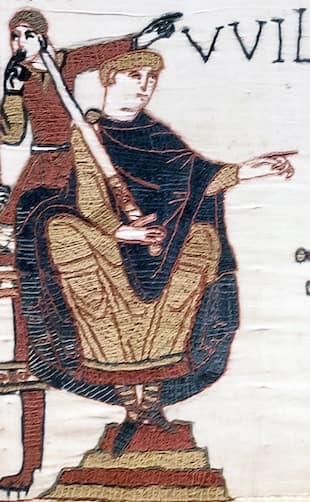
The Bayeux Tapestry offers a striking account of William the Conqueror’s conquest of England in 1066!
Composed of about fifty scenes accompanied by descriptive captions, this long linen canvas is considered a unique work of art.
Despite its importance, the origins of the tapestry remain a subject of controversy.
It was first mentioned in 1476 in the inventory of Bayeux Cathedral.
Some attribute its creation to Queen Matilda, wife of William the Conqueror, a theory disputed by many.
Indeed, in France, the Bayeux tapestry is commonly called the Tapisserie de la Reine Mathilde – Tapestry of Queen Matilda.
We also wrongly refer to it as a ‘tapestry’; however, this priceless piece is an ’embroidery’! So we should be talking about the Bayeux Embroidery!
Who commissioned the Bayeux Tapestry?
The hypothesis that Bishop Odo, half-brother of William the Conqueror, commissioned the Bayeux tapestry is gaining credibility.
The arguments in favor are numerous and quite explicit:
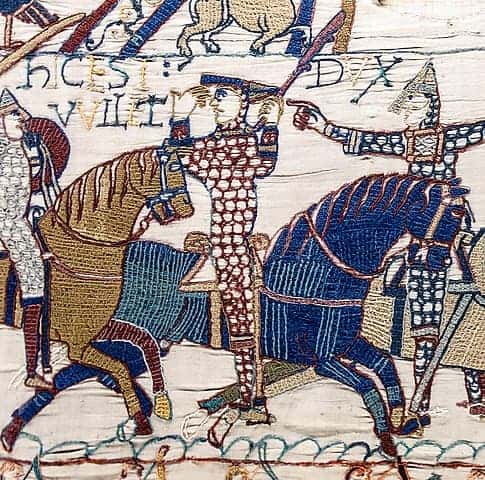
1-The tapestry was discovered within Bayeux Cathedral, which was built and consecrated by Odo in 1077
2- three companions of Odo, mentioned in the Domesday Book, are depicted in some of the scenes.
3-The Latin legends show the presence of Anglo-Saxon linguistic constructions, and the embroidery resemble the Anglo-Saxon techniques, suggesting a possible origin in England.
4-If the tapestry was embroidered in the monastery founded by Odo in Kent, this would correspond to the historical context and production methods of the time. Scientific analysis dated its creation with certainty to the 1070s, shortly after the Battle of Hasting.
5-Finally, the tapestry, despite its Norman perspective, intriguingly depicts the bravery of King Harold and his soldiers. This nuanced portrayal suggests a complex mix of historical and political message that could serve as propaganda.
The Bayeux Tapestry miraculously traversed the centuries

The Bayeux Tapestry has survived the centuries, enduring wars, revolutions, and displacements since 1476.
It narrowly escaped destruction during periods of conflict, in particular the Wars of Religion. It was confiscated and even reused to cover military equipment during the French Revolution.
Fortunately, a lawyer intervened to save and preserve it, and the Fine Arts Commission quickly classified it as a “National Treasure”.
It was transported to Paris to be exhibited at the newly opened Musée Napoléon, then brought back to Bayeux and presented at the Municipal Library, where it remained from 1842 until the outbreak of the Franco-Prussian of 1870-1871, when it was taken to a safe place.
Similar measures were taken to preserve the tapestry during both world wars.
The Bayeux Tapestry was later exhibited in the Louvre Museum before being permanently returned to Bayeux in August 1945.
Although partially repaired, it is remarkable that it has survived the centuries in such good condition.
Since 1983, it has been on display at the Bayeux Tapestry Museum, housed in the former Grand Seminary of Bayeux.
A special place for a special tapestry
A specially designed room was created to house and display the tapestry. This long, slightly curved corridor was custom-designed to accommodate the 70-metre-long by 0.5-metre-wide tapestry in a single strip.
The tapestry is protected in a glass case and illuminated by expertly positioned lighting to showcase the details of its embroidery. The corridor’s subdued lighting creates an atmosphere that enhances the beauty and complexity of the embroidered scenes.
Characteristics of the embroidery

- The Bayeux Tapestry is composed of nine panels of varying lengths, embroidered separately before being assembled. Additional embroidery was added to conceal the seams.
- Two decorative borders adorn the tapestry, one at the top and the other at the bottom. These borders feature a variety of motifs: animals, religious symbols, agricultural and hunting scenes, and depictions of battlefield carnage, such as severed limbs or heads.
- Between these two borders, the space is filled with various scenes, often separated by a stylised tree motif.
- Two distinct embroidery techniques were used to achieve different effects. Stem stitch was used for the legends and characters’ outlines, while flat stitch was used to fill in the characters.
- The main colours of the wool used for tapestry are terracotta or russet, blue-green, matte gold, olive green and blue, complemented by darker shades of blue, black and sage green, as well as natural and earthy tones. This colour palette contributes to an impression of simplicity and elegance that emanates from the entire work.
Bayeux Tapestry, listed as Memory of the World by UNESCO
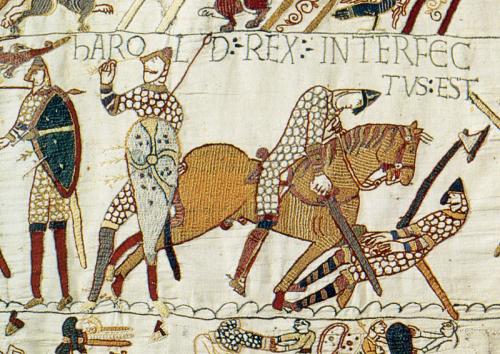
The Bayeux Tapestry recounts the conquest of England, from the moment William the Conqueror and his fleet set off from Normandy. Among its most famous scenes is the Battle of Hastings, where King Harold was killed by an arrow. Unfortunately, the last part of the Bayeux Tapestry has disappeared. However, at the beginning of the 19th century, efforts were made to recreate it using the same dyeing and embroidery techniques.
The Bayeux Tapestry is listed as a UNESCO “Memory of the World” item, and therefore protected and recognised as a document of universal significance.
Bayeux Embroidery in London
Do not despair if you do not have the opportunity to admire the tapestry at the Bayeux Museum, as it will be exhibited at the British Museum between September 2026 and June 2027.
The goal? To strengthen the friendship between France and the United Kingdom!
However, this move raises many questions because the tapestry’s structural condition is very fragile, making any handling extremely delicate. Preparations have been underway since 2025, and everyone is worried. But alas, politics always prevails over conservation!
N.B. It is not allowed to take photos of the tapestry as it would obviously damage it.
Department of Calvados
Coordinates Bayeux Tapestry Museum: Lat 49.274161 – Long 0.700398
Photos via Wikimedia Commons are in the Public domain – William on his horse and Duke William and Harold dead by Myrabella – laid work detail – Raven banner – Norsemen fleet


