
Chinese Labour Corps during WWI
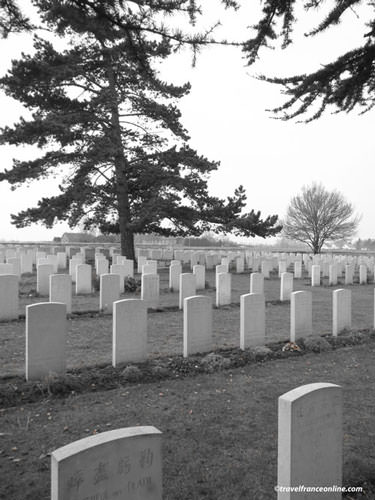
The Nolette Chinese Cemetery contains the graves of 841 Chinese labourers (coolies) who were placed under British authority during the First World War. The intensification of the conflict indeed created a critical demand for labour, especially as French women struggled to replace the thousands of men sent to the front, many of whom never returned.
Recognising this need, France thus concluded an agreement with China on May 14, 1916, followed by a similar agreement signed by the British government on December 30 of the same year. By the end of 1917, some 54,000 Chinese labourers had been trained within the Chinese Labour Corps. These civilians were placed under the supervision of the British authorities and were not directly involved in military operations.
Once in the Somme department, they began at the British military camp in the village of Noyelles-sur-Mer, which served as their main base and from which they were deployed to various locations.
This contingent of 3,000 men was assigned to essential tasks, including unloading munitions, agricultural work in the surrounding area, and maintenance of the Paris-Calais railway line.
Under three- to five-year contracts, they received a daily wage of 5 francs, the standard rate for labourers at the time.
But, as the conflict intensified, their work became increasingly perilous. They were soon tasked with dangerous jobs such as clearing mines and recovering the dead and wounded on the battlefields of northern France and Belgium. Their responsibilities also extended to exhuming soldiers hastily buried in field cemeteries to ensure their identification and a proper burial.
At the end of the war, nearly 96,000 Chinese labourers had contributed to the war effort in France. After the armistice, approximately 80,000 remained in France to participate in the country’s reconstruction.
Tragically, about 2,000 of these workers lost their lives during the war, in addition to those who succumbed to the 1920 Spanish flu epidemic. There are six other Chinese cemeteries in the Somme department, but the Nolette Chinese Cemetery contains 841 graves and is the largest Chinese cemetery in France and in Europe.
Nolette Chinese Cemetery
The Nolette Chinese Cemetery was inaugurated in 1921 by the Prefect of the Somme department. Managed by the Commonwealth War Graves Commission (CWGC), this cemetery has its unique architecture, which contrasts sharply with the usual CWGC cemeteries. Designed by Sir Edwin Lutyens and Captain Truelove, the cemetery lacks traditional elements such as the Cross of Sacrifice or the Memorial Stone.

Instead, it features a monumental entrance porch, built in the style of a Chinese pagoda. The inscription chosen by the Chinese Ambassador to Great Britain at the time, Shi Zhaoji, is engraved in Chinese characters on the porch:
“This place commemorates the sacrifice of 1,900 Chinese labourers who died during the First World War (1914-1918). They were my friends and colleagues, whose merit is inestimable.”
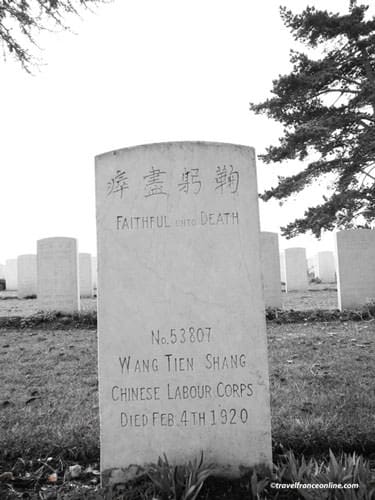
The headstones bear inscriptions in both English and Chinese. The cemetery was planted with native Chinese tree species, creating a timeless link between the Chinese men and their distant homeland. The porch and entrance wall serve a dual purpose: they act as a memorial to the 41 Chinese coolies who died on land or at sea and remain unidentified.
China gifted two statues of Imperial Guardian Lions to the municipality of Noyelles, which now stand at the entrance to the road leading to the cemetery. Since 2002, a Chinese delegation has regularly visited the Nolette Chinese Cemetery to celebrate Qingming. This traditional annual Chinese festival of the dead, a symbol of remembrance and the arrival of spring, is organised by the Council for the Integration of Communities of Chinese Origin in France.
The Nolette Chinese Cemetery was listed as a historical monument by decree of September 14, 2016.
Department of Somme – Nolette Chinese Cemetery in Noyelles-sur-Mer – Picardie
Coordinates: Lat 50.186382 – Long 1.723020


