
Calais, the first passenger port in France
Calais is located on the Opal Coast, a coastline renowned for its enchanting light.

Today, a major coastal port and city, Calais began as a modest fishing village, called Calesium (or Kales in Old Flemish).
At the end of the 10th century, the port’s expansion led to the construction of two imposing towers for its defence. The city was further fortified in the 1220s to protect it from foreign incursions.
Today, Calais is France’s leading passenger port. The opening of the Channel Tunnel in 1994 revolutionised transportation, facilitating the passage of thousands of British tourists by ferry and Eurostar.
The convenience of travel is further enhanced by the arrival of Eurostar in the Coquelle district, near the vast Cité Europe business centre. This strategic location reinforces Calais’s appeal as a gateway to Europe.
The Burghers of Calais – Hundred Years War
Calais was at the heart of the Hundred Years War, a protracted conflict between the French and the English that lasted from the 14th and 15th centuries. For many French people, the city evokes the memory of this fierce struggle against their “dear English neighbours.”
The roots of this conflict go back to the 11th century, with the rise of the Plantagenêts, Counts of Anjou, whose influence extended over Normandy and various counties through strategic marriages and alliances. The situation worsened when Henry II ascended the English throne after his marriage to Eleanor of Aquitaine, whose generous dowry brought him the Duchy of Aquitaine. Under the Plantagenêts, England thus controlled vast territories, including Anjou, Maine, Tours, Aquitaine, Poitiers, Périgord, the Marches, Auvergne, Gascony, and Limoges, and exerted influence over Brittany and Toulouse.
This expansion worried the kings of France, whose domains were limited to a few provinces, and who obviously perceived the Plantagenêts as a significant threat. Tensions thus escalated further when Edward III of England, heir to the House of Anjou, claimed the French crown at the beginning of the Hundred Years’ War.
Edward III’s victory at the Battle of Crécy-in-Ponthieu in 1346 marked a decisive turning point in the Hundred Years’ War. Following this triumph, he set about seizing the port of Calais, which he intended to use as a base for future invasions of France. Arriving at the citadel on September 4, 1346, Edward III began a siege that would last eleven gruelling months, at the end of which the inhabitants of Calais made the difficult decision to surrender on June 1, 1347, to avoid destruction.
In a dramatic and symbolic gesture of submission, Eustache de Saint-Pierre led the Six Burghers of Calais, the city’s leading citizens, barefoot and wearing shirts with ropes around their necks, to present the keys to the city to Edward III.
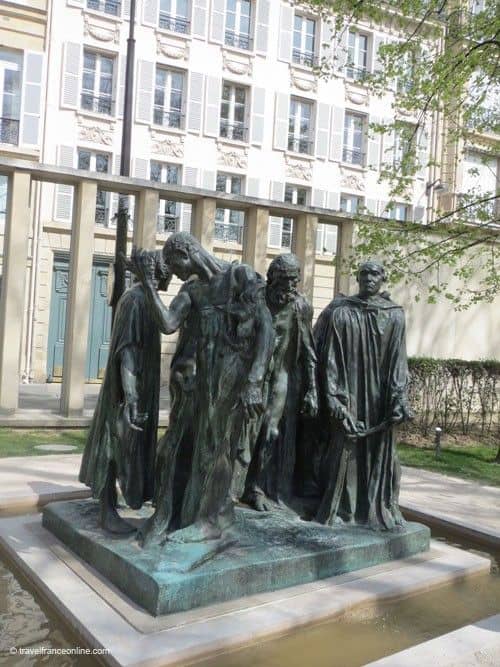
Moved by their courage and the pleas of his wife, Philippa of Hainault, Edward III finally relented and granted them clemency. This remarkable episode was immortalised by the renowned sculptor Rodin in his striking masterpiece, “The Burghers of Calais.” The original sculpture now stands in front of Calais Town Hall, but you can also admire a replica cast in the entrance courtyard of the Musée Rodin in Paris.
The Citadel of Calais
On January 7, 1557, two centuries and ten years after its surrender to Edward III, Calais was recaptured by Duke Francis of Guise under the command of King Henry II of France. In 1560, King Francis II ordered the demolition of the old English quarter to redevelop the area and its fortifications.
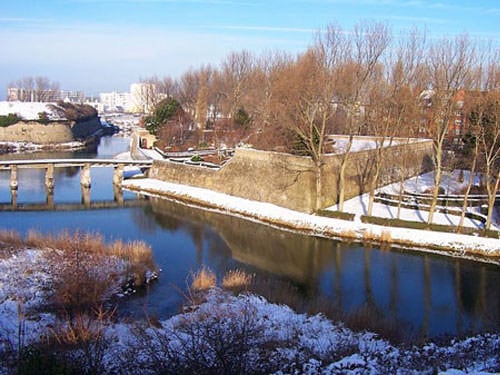
The renowned architects Castriotto and Jean Errard were commissioned to build the citadel, an impregnable fortress intended to protect Calais from future incursions. However, the fortifications were still unfinished when, on April 24, 1596, the Spanish launched a successful attack from neighbouring Flanders. The Spanish occupation lasted until the signing of the Treaty of Vervins in May 1598, which returned Calais to the French crown and definitively incorporated it into the Kingdom of France
During the 17th century, the fortifications were expanded, transforming Calais into a formidable military stronghold with a bustling port.
In the 18th century, major reconstruction work was undertaken under the direction of the renowned military engineer Vauban to strengthen Calais’s defences. In the 19th century, a garrison of 1,000 men was stationed in its citadel.

However, the city and its port suffered significant damage during both World Wars, with many historic buildings being destroyed or damaged, but some were savaged or restored after the conflicts. Among the remarkable buildings saved from destruction are the Porte de Boulogne (a 16th century gate) and the Porte de la Ville (17th century), also known as the Porte de l’Hermitage, which were both classified as historical monuments in 1939.
In 1990, the moat, curtain walls, and the semicircular barbican defending the Porte de Neptune were also listed as historical monuments. Finally, in 1960, the citadel was transformed into a sports complex, the Stade du Souvenir (Remembrance Stadium).
Belfry of Calais
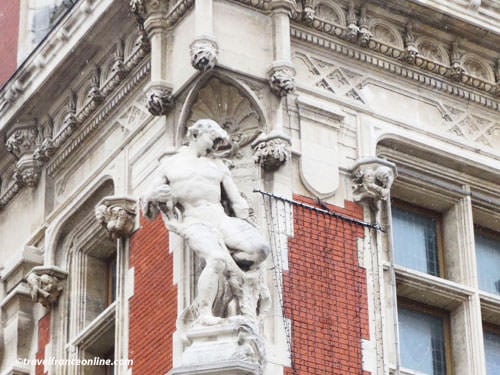
Calais is also known for the magnificent belfry of its historic town hall, which was inscribed on the UNESCO World Heritage List on April 28, 2008. Construction of this iconic building began in 1910 but was interrupted by the outbreak of the First World War before resuming in 1920. Inauguration eventually took place in 1925.

This 75-metre-high belfry is a superb example of Flemish and Renaissance style. Built of red brick supported by a reinforced concrete structure, it was designed by the architect Louis Debrouwer, a pioneer of reinforced concrete architecture. This innovative technique reduced the weight of the masonry and allowed for the addition of stone sculptures.
A 116-step staircase connects the third floor of the town hall to the base of the clock, from where another hundred steps lead to the top. Each clock face is adorned with statues of a knight standing guard, symbolising the victorious capture of the citadel by Duke François de Guise from the English, and the belfry is crowned with a weather-vane in the shape of a dragon.
The belfry also symbolises the merger of Calais and the neighbouring town of Saint-Pierre-lès-Calais in 1881. While Calais’s economy is primarily based on its fishing and passenger ports, Saint-Pierre’s has traditionally been built around lace production, particularly the renowned Calais lace.
Department of Pas-de-Calais
Coordinates: Lat 50.951290 – Long 1.858686
Photos via Wikimedia Creative Commons: Demi-lune Porte de Neptune by Zauctorexy CC BY-SA 3.0 – Entrance Stade du Souvenir by Lionel Allorge CC BY-SA 3.0


