
Saint Martin, patron of the Franks
Saint Martin is one of the patron saints of France, alongside Saint Denis, Saint Rémi, and King Louis IX, canonized as Saint Louis. The Archangel Saint Michael is the protector and defender of France. But France is also protected by women! Thus, in 1922, Pope Pius XI also proclaimed the Virgin Mary and Joan of Arc, heroine of the Hundred Years’ War, as patron saints.
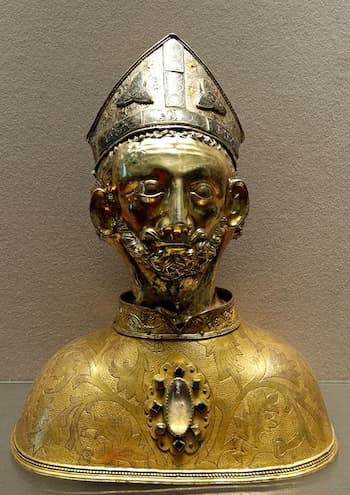
Saint Martin became the patron saint of the Franks in the 3rd century. The Franks were a group of Germanic tribes who migrated from Denmark or Schleswig-Holstein around 500 BC and had already settled in what is now Belgium and the Rhineland (Germany).
Clovis, King of the Franks, and founder of the Kingdom of France, officially adopted Saint Martin as his patron saint in 506 AD, after his victory over the Alamanni at the Battle of Tolbiac (now Zülpich, Germany). During this decisive battle, the Franks, vastly outnumbered by the Alamanni, were initially massacred. In despair, and influenced by his Christian wife, Queen Clotilde, Clovis implored Saint Martin: “God of Clotilde, if you grant me victory, I will believe in you!”
His prayer was answered. The enemy leader was felled by an axe, and his men fled in panic. Clovis emerged victorious and, true to his vow, adopted Saint Martin as his patron saint. Clovis was then baptized in Reims along with many of his warriors. As a reward for his conversion, he obtained the powerful support of the Church of Rome, which allowed him to unify his lands under a single Christian kingdom, which would soon become France.
Who Was Saint Martin?
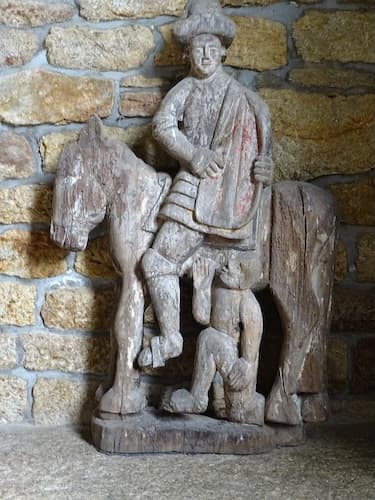
Saint Martin was a Roman aristocrat, born in 316 AD in Pannonia, a Roman province located in present-day Hungary. His father, a military tribune in the Roman army, named him Martin, meaning dedicated to Mars, the Roman God of War.
When his father was transferred to Pavia in northern Italy, young Martin befriended Christian classmates and was drawn to their faith. From the age of ten, despite coming from a pagan family, he felt a profound calling to Christianity.
His father, furious at this betrayal of their traditions, decided to put an end to what he considered madness and forced Martin to enlist in the army at only fifteen years old.
Martin accepted, likely out of respect for his parents and their social standing, and served the Roman Empire for many years.
Martin the Merciful – Martin le Miséricordieux
It was during his time in Gaul (France) that Martin’s act of compassion made him legendary: on a bitterly cold winter day, he encountered a beggar, shivering with cold and dressed in rags. Remembering the words of the Gospel, I was naked, and you clothed me, Martin took his sword, cut the soldier’s cloak in two, and gave half to the poor man. That night, Christ appeared to him in a dream, wearing the half of the cloak that Martin had given, and said to the angels: Behold Martin, still a catechumen, who clothed me with this garment.
The Monk and Bishop
Martin left the army in 356 AD and joined Hilaire, Bishop of Poitiers. A few years later, in 361 AD, he founded the monastery of Ligugé, near Poitiers, the first monastery ever established in Gaul. For ten years, he lived there, performing miracles and gaining the devotion of the local people.

In 371, Martin was appointed Bishop of Tours. He founded another monastery, Marmoutier, north of the city, and spent years travelling the countryside with his monks, spreading Christianity among the pagan rural populations.
Saint Martin died on November 8, 397, in Candès, near Saumur. His renown was such that the monks of Ligugé and Marmoutier disputed his remains. The monks of Marmoutier secretly took his remains, transported them by boat on the Loire River, and buried him in Tours on November 11.
The small chapel built over his tomb later became the magnificent Basilica of Saint Martin of Tours, whose crypt still houses his tomb today. A charming legend recounts that, while the monks were transporting his remains along the Loire River, flowers began to bloom on the banks in mid-November! This unexpected explosion of warmth and color, now well-documented, is still known as Été de la Saint Martin – Saint Martin’s Summer.
Saint Martin of Tours is celebrated every year on November 11, a date that evokes both his military past and his profound compassion. This same day also marks the Armistice of 1918, which ended the First World War.
Wikimedia commons: Header by GO69 is CC BY-SA 4.0 – Reliquary by Jastrow is Public Domain


