
Tours, a 2000 years old city
The city of Tours is over 2,000 years old! The settlement of the Gallic tribe Turones developed into Caesarodunum (Caesar’s Hill), a prosperous Gallo-Roman city that covered more than 40 hectares. Its inhabitants lived peacefully until the barbarian invasions of the late 3rd century, which forced them to demolish their amphitheatre to build a rampart. The remains of this wall are still visible near the cathedral.
Caesarodunum was the centre of the Roman province that included the present-day regions of Touraine, Maine, Anjou and Brittany. It was renamed Turones in 372 AD.
Tours is considered the cradle of French Christianity and remained under the patronage of the kings of France for centuries. It was also at the heart of the territorial disputes between the French and English during the Middle Ages.
Tours became the capital of the historic province of Touraine. It was largely destroyed during the Second World War, but the historic centre, around the Basilica of Saint Martin, was meticulously rebuilt stone by stone.
Tours, the city of Saint-Martin
Saint Martin was a Roman legionary who converted to Christianity and became famous for sharing his cloak with a beggar.
He founded his first monastery in Ligugé, in Poitou, and became Bishop of Tours in 372 AD. Tours became then known as the City of Saint Martin. A gifted preacher, Saint Martin dedicated his life to converting pagan populations and destroying their idols and temples, replacing them with chapels and churches.
He also founded the monastery of Marmoutier near Tours and died in Candé, near Saumur, in November 397 AD. After his death, a dispute arose between the monasteries of Ligugé and Marmoutier, each wanting to recover his relics. The monks of Marmoutier stole his coffin during the night while the monks of Ligugé were asleep and transported it to Tours by boat.
During this journey, an extraordinary event occurred: the trees along the riverbanks miraculously began to bloom in the middle of autumn. This phenomenon, resulting from exceptionally mild temperatures that stimulate very early flowering, has since been known as Été de la Saint- Martin – Saint-Martin’s Summer.
A major religious centre under the patronage of the French kings
The Basilica of Saint Martin was erected in 471 AD over the tomb of Saint Martin.
Around 496 AD, Clovis, the first king of France, came to meditate at the holy man’s grave, where he vowed to convert to Christianity if he won his battle against the Alamanni. Clovis defeated them at the Battle of Tolbiac, then the Visigoths at the Battle of Vouillé, near Poitiers. True to his word, he was baptised in 498 AD.
As a sign of gratitude for his victories, King Clovis ecognised Saint Martin as the patron saint of France and offered financial and material support to the monastery, a tradition faithfully perpetuated by his descendants.
Thus, placed under the patronage of the first kings of France, Tours became a flourishing city and an important religious centre.
Gregory of Tours
The city’s prestige grew with the arrival of Grégoire, a young priest from a Gallo-Roman aristocratic family originally from Auvergne.
Grégoire, suffering from health problems, prayed at the tomb of Saint Martin and was miraculously cured. In gratitude, he dedicated his life to the saint and settled at the Abbey of Tours, becoming its bishop ten years later.
Known as Grégoire de Tours (538-594), he was not only a devout religious man but also a renowned historian.
He indeed wrote several works, the most famous of which is L’Histoire des Francs (History of the Franks).
This seminal text remains to this day the primary source of information on the Merovingian dynasty.
Alcuin of Tours
The abbey’s prestige was further enhanced in 796 when Emperor Charlemagne invited the Anglo-Saxon monk Alcuin to Tours.
Alcuin indeed reformed the monastic school and founded the university, attracting students from all over Europe. Tours, the City of Saint Martin, thus became a major intellectual and artistic centre, which continued to flourish even after Alcuin died in 804. A few years later, a religious council convened in Tours made a historic decision: the Bible should be translated into French rather than Latin to reach a wider audience. This major translation is known as the Alcuin Bible.
Hugues Capet, honorary abbot of Saint-Martin

The Norman invasions of the 9th century brought this prosperous period to an end, as the city was sacked. However, the monks managed to transfer the relics of Saint Martin to Auvergne.
In 987, Hugues Capet, Count of Orléans and honorary abbot of Saint-Martin, was elected King of France. He adopted his name, Capet, from the Latin word cappa, meaning cloak, in reference to the cloak that Saint Martin shared with a poor man.
He and his descendants honoured their role as protectors of the Christian Church by endowing the Abbey of Tours with generous gifts of money and fiefs, thus allowing it to remain an important spiritual and intellectual centre.
In the 10th century, a new town, Martinopolis, which would later become Châteauneuf, grew up next to the cathedral grounds, but, in 997, both the abbey and Martinopolis were destroyed by fire.
A city in the heart of the French-English conflict
The County of Tours came under English control when Henry II Plantagenêt, Count of Anjou, ascended the English throne in 1154.
However, King Philip-Augustus of France recaptured the city in 1205, ushering in a long period of prosperity and peace, during which the Denier Tournois, the coin minted in Tours, became the official currency of the Kingdom of France.
Touraine was officially annexed to the Kingdom of France in 1259.
The 14th and 15th centuries were difficult times for the city, marked by the Black Death and the protracted Hundred Years’ War (1337-1453).
In 1429, Joan of Arc stayed in Tours while her armour was being made. Later, in 1444, the victorious Charles VII signed the Treaty of Tours with Henry VI of England, marking a decisive turning point in resolving the conflict.
Tours from the Wars of Religion to the French Revolution
In the 16th century, Tours embraced Protestantism, attracting intellectuals, artists, and artisans.
However, this led to violent conflicts, culminating in the sacking of the abbey by Protestants and reprisals by Catholics.
After the Wars of Religion, Henry IV took refuge in Tours and made it the capital of the Kingdom of France.
However, the significant population growth and resulting economic prosperity that resulted from the presence of the king ended when he returned to Paris with his court.
By then, the city had expanded beyond its original boundaries, necessitating the construction of a new wall, which has today been replaced by the Heurteloup and Béranger boulevards.
Revival of Tours
In the 1850s, Tours’ local economy experienced considerable commercial and economic growth thanks to the construction of the railway line linking the city to Orléans, and the establishment of the station in Saint-Pierre-des-Corps, in the eastern suburbs.
During the Franco-Prussian War of 1870-1871, Tours briefly regained its political importance by hosting the seat of the Government of National Defence from September 12 to December 9, 1870.
However, the 20th century brought new challenges. Much of the city was indeed heavily bombed during the Second World War, but was rebuilt well beyond its historical boundaries. Today, Tours benefits from a diversified economy, supported by numerous industries, including the Michelin tire manufacturing and the Jacquard weaving industry.
An important university town and a major commercial hub in the Centre-West region, Tours continues to play a significant role in the French economic and cultural landscape.
Place Plumereau, the historic centre of Tours
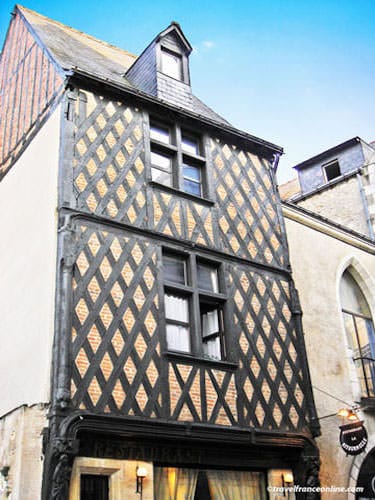
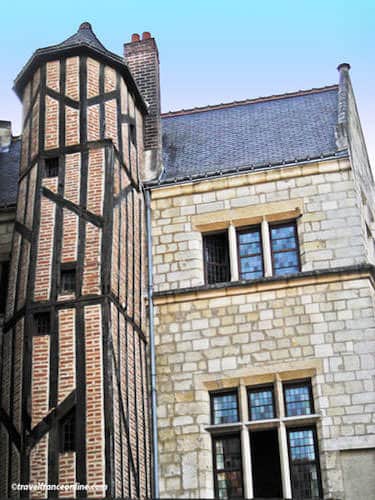
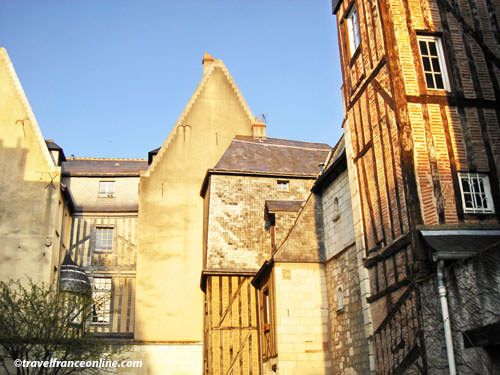
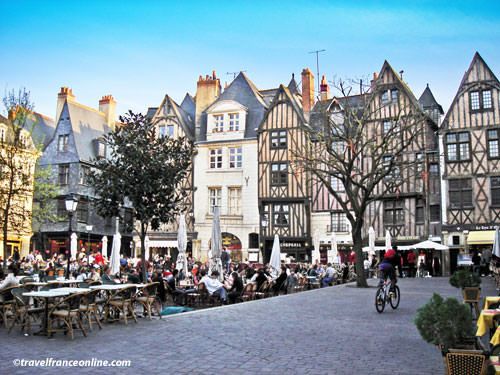
In the 1970s, an ambitious restoration program was launched to recreate the medieval Tours, with its characteristic half-timbered houses, lively markets, and Renaissance mansions.
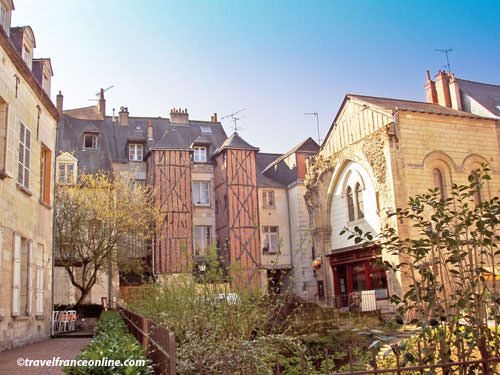
The pedestrianised and bustling Place Plumereau, lined with picturesque half-timbered houses, is famous for its hat market (Carroi aux Chapeaux).
The Place Saint-Pierre-le-Puellier takes its name from the remains of a Romanesque church that once stood there.
Recent excavations have unearthed the ancient foundations of the 1st-century AD Gallo-Roman city walls, as well as those of two cemeteries from the 11th and 13th centuries.
The Gemmail Museum, housed in the 19th-century Hôtel Raimbault, boasts a unique collection of lead-free stained glass.
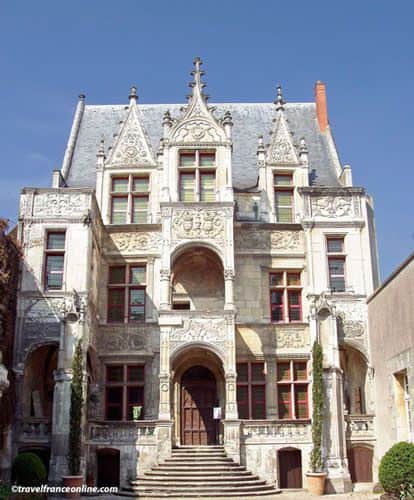
The Maison de Tristan, a superb 15th-century private mansion, remarkable for its openwork gable, now houses the Centre for Modern Language Studies.
The facade of the Hôtel Gouin is a magnificent example of French Renaissance architecture. Built in the 16th century for the wealthy silk merchant Gardette, it became the property of the Gouin family, wealthy bankers, in 1738. It was ravaged by fire and almost destroyed during the Second World War, but it was listed as a national heritage site and restored between 1950 and 1960. Today, it houses the Regional Archaeology Museum, which offers a glimpse into the region’s archaeological treasures.
Saint-Martin Basilica
The Normans destroyed the chapel built over the tomb of Saint Martin during their 9th-century raids.

A basilica was built on its site two centuries later and enlarged in the 13th century. Unfortunately, this church was ransacked by Protestants during the Wars of Religion!
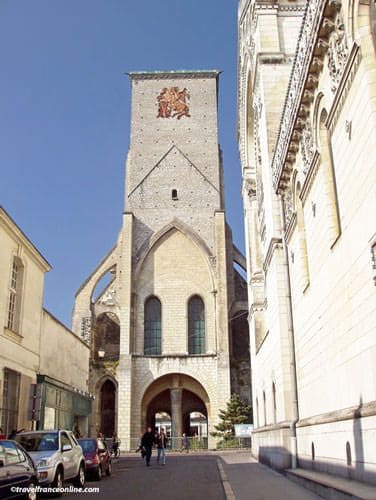
The ruins were demolished in the 19th century to make way for the Rue des Halles, but two imposing towers were preserved: the Charlemagne Tower and the Tour de l’Horloge (Clock Tower).
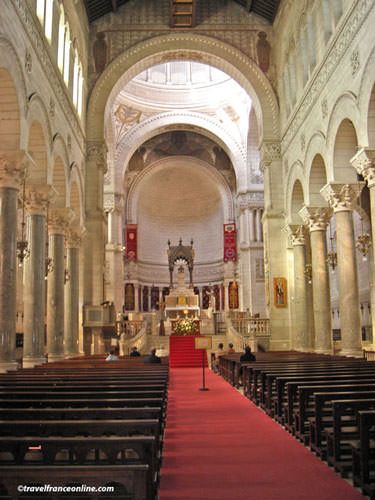
The current Byzantine style Nouvelle Basilique Saint Martin was built between 1886 and 1924 on the transept of the old basilica, and the reliquary of Saint Martin was placed in the crypt.
The adjoining Chapel of Saint-Jean houses the Saint Martin Museum, which recounts the history of the old basilica and the legacy of Saint Martin.
As you can see, you will need a whole day to enjoy Tours!
Department of Indre-et-Loire
Coordinates Tours: Lat 47.393031 – Long 0.683534


