
Legend of Saint-Marcel
Saint-Marcel, the ninth bishop of Paris, is one of the three patron saints of Paris, alongside Sainte-Geneviève and Saint-Denis. Born into a modest family on the Ile de la Cité, near the Petit-Pont, he became one of the most emblematic figures of his time. His extraordinary exploits and miraculous healings earned him a reputation as a miracle worker from a very young age.
His most famous exploit remains the legendary slaying of a terrifying dragon with a single blow of his staff. This dragon, a menacing creature that ravaged the city and devoured women deemed to be of “easy virtue,” naturally symbolised evil.
That said, Saint Marcel’s influence extended far beyond his legendary exploits. He played a pivotal role by presiding over the Council of Paris in 360-361, during which the bishops of Gaul confirmed the decrees of the Council of Nicaea in 325.
Furthermore, Saint-Marcel emerged as a natural leader during the barbarian invasions of the late 3rd century, which plunged society into chaos and vulnerability. He indeed assumed responsibility for crumbling institutions, dedicating himself to teaching and evangelising the poor, mostly pagans, and guiding the Parisians in rebuilding their social structures, offering spiritual guidance, comfort and stability in those troubled times. Saint-Marcel died in 436 AD and was buried along the old Roman road leading south.
Paris’ first Christian necropolis
Bishop Marcel’s burial site, at the southern corner of what is now the intersection of Boulevard Saint-Marcel and Avenue des Gobelins, gave rise to the first Christian necropolis in Paris. The modest oratory built over his tomb indeed quickly became a place of pilgrimage for Parisian Christians, who would say, “We are going to Saint-Marcel,” as they made their way to his grave. This enclave within the city evolved to become the Quartier Saint-Marcel, the core of Paris’s first Christian community. Although initially located away from the city centre, this district had an ideal location, near the ford and bridge spanning the river Bièvre, and close to the Church of Saint-Médard, at the foot of Rue Mouffetard.
The modest oratory built over Saint Marcel’s tomb was replaced in the 6th century by a chapel, which served the growing Christian community of Paris until the French Revolution.
Amazingly, the popularity of Saint-Marcel began to spread among all Parisians during the Norman invasions of the 9th century, when his relics were transferred to the fortified Île de la Cité. The inhabitants indeed attributed the Vikings’ defeat to the holy man’s relics, and naturally adopted him as one of the city’s patron saints.
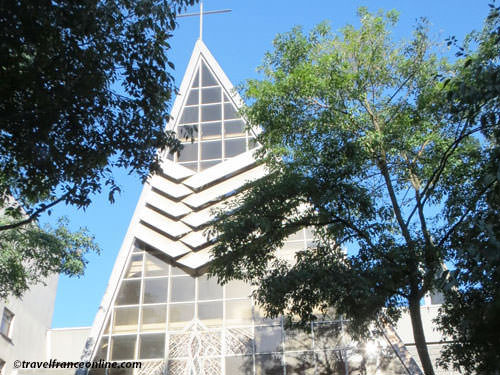
The Church of Saint-Marcel was restored and enlarged over the centuries, but it was demolished in the mid-19th century during Baron Haussmann‘s urban renewal projects. However, a new, larger church was built in 1856 to replace it, at No. 80 Boulevard de l’Hôpital. This church was in turn demolished in 1962 and replaced in 1966 by the current Church of Saint-Marcel at No.82 Boulevard de l’Hôpital.


