
Rue Mouffetard, an old Roman road
Rue Mouffetard, affectionately nicknamed “La Mouffe” by locals, is one of the oldest streets in the capital.
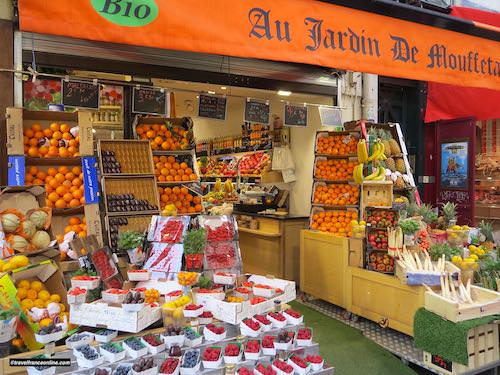
In the 3rd century, it indeed replaced a section of the ancient Roman road that connected Lutetia (ancient Paris) to Rome via Lyon.
This road descended the southern slope of Mont Lucotitius, now called Montagne Sainte-Geneviève, and it crossed the small Bièvre River via the Pont aux Tripes (Tripe Bridge), near the Church of Saint-Médard and the charming village of Bourg-Saint-Médard, before branching off onto another road at the present-day location of Place d’Italie.
Baron Haussmann’s major urban renewal projects in the 19th century truncated it at the level of the Church of Saint-Médard to create Place Saint-Médard, Rue de Bazeilles, and Avenue des Gobelins.
A once trendy village close to the Gobelins workshops

Rue Mouffetard was the then main, bustling street of Bourg-Saint-Médard, a small village of winegrowers.
Indeed, in those bygone days, the village was nestled among the vineyards that adorned the southern slopes of Mont Lucotitius.
Thus, its bucolic charm and its proximity to the city centre soon attracted wealthy Parisians seeking a breath of fresh country air, who built elegant country houses along the picturesque banks of the Bièvre.
In the Middle Ages, the upper part of Rue Mouffetard, then known as Mont Cétard, became the gathering place for students from the nearby universities in the Latin Quarter. Mont Cétard quickly became an enclave associated with student debauchery and revelry, earning the nickname Mont Fétard (partygoers). Over time, Mont Fétard evolved into Mouffetard.
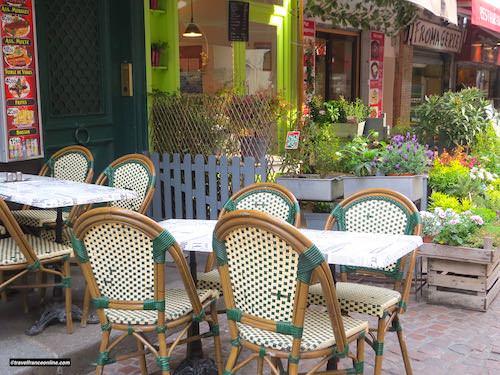
The atmosphere of the neighbourhood and the street changed once again in the 15th century when the Flemish dyer Jean Gobelin established his tapestry workshops (Gobelins manfacture) along the Bièvre. Ancillary trades, such as butchers, butchers, and tanners, soon moved closer and set up along the riverbanks, dumping their waste and offal into the Bièvre, transforming it into a veritable foul-smelling sewer.
The pestilential odour emanating from the polluted river, nicknamed “moffettes,” gave its name to Rue Mouffetard and to the Pont aux Tripes (Tripe Bridge), which at the time spanned the Bièvre.
Fortunately, the remnants of this industrial era have long gone, and the river was sadly channelled underground at the end of the 19th century. Rue Mouffetard is now a lively and picturesque thoroughfare, renowned for its daily market.
One of the oldest market streets in Paris
The ambitious renovation of Paris undertaken by Baron Haussmann in the mid-19th century shortened Rue Mouffetard by half to create Avenue des Gobelins.
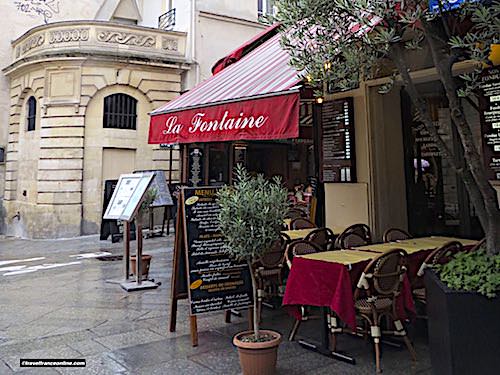
However, despite this alteration, it remains one of the most picturesque, lively, and colourful shopping streets in Paris. The upper section of Rue Mouffetard, on Place de la Contrescarpe, the former student hangout, is renowned for its numerous restaurants, cafés, and bars that come alive in the evenings and on weekends.
The lower section, meanwhile, remains a bustling market street with local shops for the residents of the neighbourhood. But Rue Mouffetard is also lined with historic houses, many of which are listed as historical monuments and boast finely sculpted facades, ornate door lintels, and ornate cornices.
Historical buildings in Rue Mouffetard
Rue Mouffetard is indeed brimming with architectural treasures.
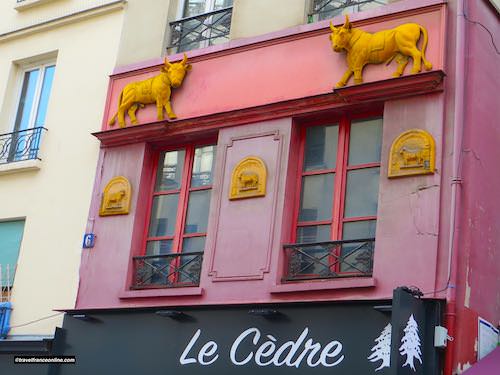
At No. 6, you’ll discover an 18th-century butcher shop with a striking red facade adorned with low-reliefs of oxen.
Legend has it that 3,000 gold coins were discovered at No. 53 during the demolition of a house.
The Fontaine du Pot au Fer, at No. 60, also known as the Fontaine Mouffetard, dates back to 1624. This fountain, with its double facade and rounded corner, is renowned for its understated elegance. Queen Marie de Medici commissioned it to supply water to her Luxembourg Palace and gardens. This elegant and discreet fountain supplied the residents of Bourg-Saint-Médard with water after the district was annexed to Paris in 1724.

You’ll discover the Vieux Chêne (Old Oak) at No. 69. This building once served as the headquarters of a revolutionary committee during the Revolution in 1848, and it was later converted into a ballroom.
During your stroll along Rue Mouffetard, don’t forget to look up at the facade of No. 122 to admire the painted inscription A la Bonne Source – At the Good Source.
However, my favourite house remains the one at No. 134, opposite the Church of Saint-Médard, which boasts a facade entirely painted with animal scenes in the 1930s and restaured in the past years. Unsurprisingly, the ground floor has always housed a delicatessen!
Every corner of Rue Mouffetard reveals a story and a hidden architectural treasure that turn it into a must-visit destination in Paris!
Directions: 5th district
Metro: Place Monge, Censier-Daubenton Line 7
Coordinates: Lat 48.841720 – Long 2.349679


