Statues-Menhirs – The first-life size sculptures of human beings
Statues-menhirs are standing sandstone stones, finely sculpted around 5,000 years ago.

These remarkable monuments, also called anthropomorphic stelae, are the oldest known life-size representations of human beings.
Nearly 100 of these megaliths have been unearthed in the Monts de Lacaune region of southern Aveyron.
However, little is known about the people who inhabited this region between 3000 and 2000 BC. It is clear, though, that they possessed exceptional talent for creating these monumental sculptures.
The most famous of these statues is the Dame de Saint-Sernin (Lady of Saint-Sernin). Discovered in 1888, it is now housed in the Fenaille Museum in Rodez, alongside a collection of 17 other statues-menhirs.
This collection represents the largest and oldest set of its kind in France, offering an invaluable insight into the ancient cultures and artistic practices of the region.
Statues-Menhirs’ characteristics

These statues-menhirs feature remarkable, intricate engravings and bas-reliefs. Carved on both sides, they depict male and female figures adorned with clothing, jewellery, and weapons.
The monoliths that served as bases for these sculptures were carefully selected for their elongated shapes, often with rounded or oval points to create the heads.
While the statues discovered in Aveyron are generally between 1 and 2 metres tall, those unearthed in the Tarn department are usually larger, the tallest reaching an impressive 4.5 metres.
Each statue-menhir has its own unique physical characteristics. The facial features are finely sculpted, particularly the eyes and nose, although many lack a mouth or ears.
Tattoos or scarifications are often present, and hairstyles are depicted on the back of the megalith; women generally with ponytails, and men with loose hair.
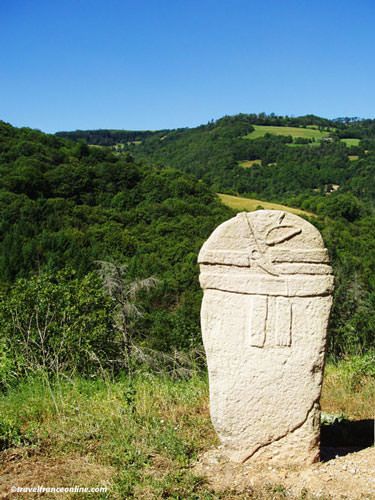
While arms, hands, and fingers are represented to scale with the statues, legs, feet, and toes are usually foreshortened.
Clothing is basically depicted, but the folds of the fabric are stylised with clean lines.
All the figures wear buckled belts, necklaces, and carry weapons such as bows, arrows, or axes.
The female figures have well-defined breasts and necklaces, suggesting a connection to the cult of the Mother Goddess. They often wear an enigmatic Y-shaped object around their necks, perhaps an amulet necklace.
The male statues-menhirs are consistently depicted armed and carrying a distinctive object suspended from a strap across their chest, maybe a flint dagger stored in a long sheath.
Meaning and purpose of the statues-menhirs?
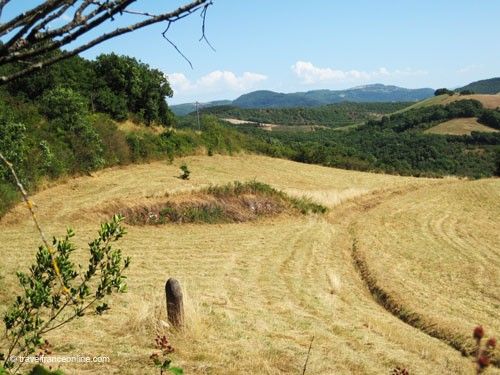
These statues-menhirs were placed in specific and often isolated locations.
This suggest that they might have been linked to religious or funerary rites, or dedicated to ancestor worship.
Unfortunately, in the absence of oral traditions, their purpose has been lost to the mists of time.
But these sculpted monoliths are an integral part of the landscape and heritage of Aveyron.
Aveyron department