Porte Dauphine Metro by Hector Guimard
The Porte Dauphine Metro entrance is the work of Hector Guimard, the great French master of the Art Nouveau artistic movement, and one of several cultural Metro stations in Paris.
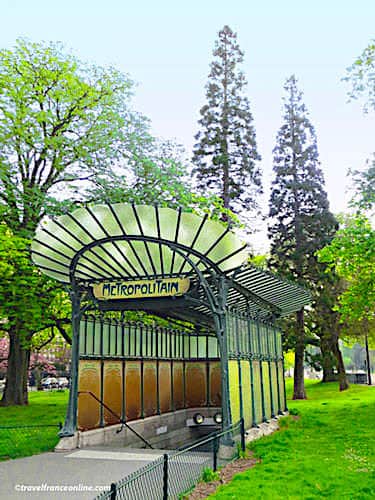
It is also one of only three remaining canopies, along with those at the Châtelet station on Place Sainte-Opportune and the Abbesses station in Montmartre.
In 1899, the Compagnie du Métropolitain de Paris (Paris Metropolitan Company) commissioned Guimard to design the entrances to its stations. These iconic structures, with their sinuous lines and organic forms, would become essential symbols of Parisian metro architecture.
The first metro line, connecting Porte de Vincennes to Porte Maillot, was inaugurated on July 19, 1900, to coincide with the opening of the Universal Exposition.
The Porte Dauphine station was inaugurated on December 13, 1900, and was the western terminus of line 2. It was named after one of the gates in the walls of the Château de la Muette. This castle was demolished during the French Revolution, and its surrounding wall was dismantled in the 1850s to allow for the opening of Avenue Foch.
The station was renamed Porte Dauphine – Maréchal de Lattre de Tassigny in homage to the commander who oversaw the liberation of Marseille in 1944.
Guimard’s Brins de Muguet
Between 1900 and 1912, Guimard designed 141 metro entrances, divided into two distinct styles.
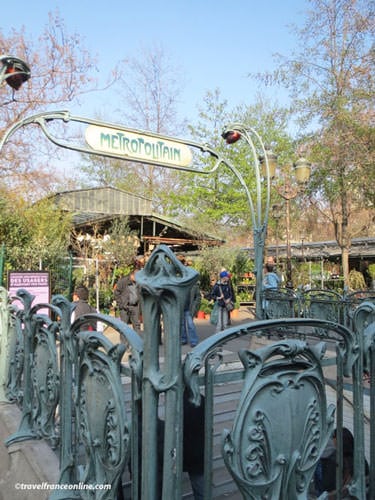
The first and most common style was characterised by simple balustrades and kiosks with canopies (called édicules – aedicules) made of cast iron, many of which still exist today.
They consist of a series of cast iron medallions painted green and adorned with floral garlands forming the initial “M” of “Metropolitain.”
Two cast iron pillars, evoking flower stems and each topped with a leaf sheltering a small orange lamp, flank them.
Two secondary stems, bearing an enamelled lava plaque inscribed with the word “Metropolitain,” emerge halfway up each pillar and are nicknamed Brins de Muguet (Lily of the valley stems”).
Guimard’s Libellules
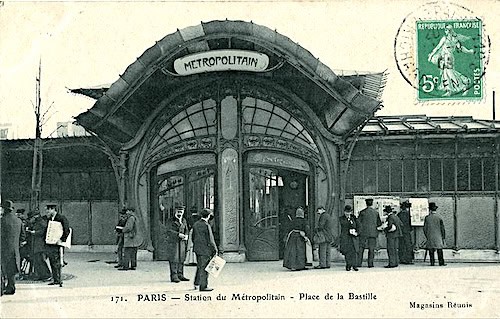
The canopies, or aedicules, came in two sizes: large and small.
The large canopies, once found in stations such as Etoile and Bastille, have now disappeared.
Only three complete small canopies remain today: Porte Dauphine, Abbesses, and Châtelet.
They stand out by their rounded volumes, the predominance of curved forms supported by a metal structure, and their abstract floral and plant motifs.
These entrances exude an impression of lightness and elegance, which led Parisians to quickly nickname them “dragonflies,” a very obvious analogy when you see them.
The Porte Dauphine
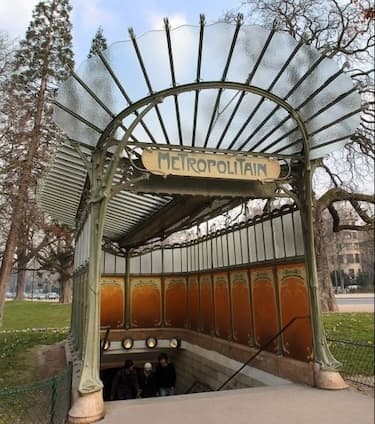
The entrance to the Porte Dauphine Metro station consists of a green-painted metal kiosk topped with an inverted gable roof made of glass panels. These are carefully assembled onto a cast-iron frame, supported by three pillars, two at the front and one at the rear.
This entrance is enclosed on three sides by a balustrade of enamelled lava panels adorned with delicate garlands of white and green foliage on an ochre background. A small, rounded canopy protects the front of the kiosk and the enamelled lava panel bearing the Métropolitain sign.
Art Nouveau, loathed and loved
Art Nouveau, though widely appreciated today, faced considerable criticism in the early 20th century.
Many purists and art critics indeed considered it a radical break with the dominant 19th-century Neoclassical style, a rejection reminiscent of that experienced initially by the Impressionist movement!
Guimard’s Paris Métro entrances, with their avant-garde floral motifs, thus elicited mixed, often negative, reactions. Ultimately, Guimard bowed to the pressure of the critics and broke his contract with the Compagnie du Métropolitain de Paris. However, he had already completed the construction of 141 Métro entrances. Sadly, many of his creations were demolished in 1931, and others were destroyed during and after World War II.
Ironically, Art Nouveau experienced a resurgence in popularity during the 1960s and 1970s, leading to the listing of Guimard’s remaining Metro entrances as historical monuments in 1978.
After admiring this architectural gem, why not stroll through the nearby Bois de Boulogne?
Directions: 16th district – level of no90 Avenue Foch
Metro: Porte Dauphine Line 2
Coordinates: Lat 48.872146 – Long 2.276950
Photo via Wikimedia Commons: Place de la Bastille Metro entrance by Scanné par Claude_Villetaneuse Public domain