Landscaping of the Bois de Boulogne

The vast Bois de Boulogne is nestled in a gentle bend of the Seine, on the west side of Paris and is a remnant of the vast Rouvray Forest, which once covered much of western Paris.
The City of Paris acquired the Bois de Boulogne in 1852.
Impressed by the splendid Hyde Park in London, Emperor Napoleon III entrusted Baron Haussmann with the ambitious project of transforming the Bois de Boulogne into an 845-hectare English-style park within its boundaries.
Haussmann called upon the architects Hittorf and Davioud to lead this project, and the landscape architect Alphand, who oversaw the redesign and layout of the park.
Together, they transformed the Bois de Boulogne into a vast public park open for strolling and relaxation, and laid out with numerous water features, paths and avenues, and various sports facilities, including a racecourse.
Lakes, ponds and brooks
Alphand started by demolishing the park’s perimeter wall to create the Avenue de l’Impératrice, now known as the Avenue de Boulogne. He then transformed the forest into a vast public garden, while respecting its biodiversity and ecological balance.

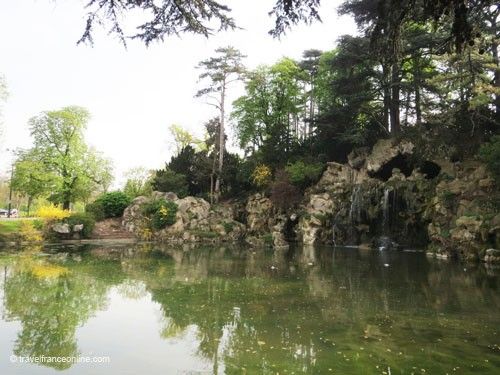
He created a series of water features, including two lakes, Lac Inférieur and Lac Majeur (Lower Lake and Major Lake), as well as eight artificial ponds and a waterfall, adapting them to the natural contours of the land to ensure the proper functioning of the park’s water system while preserving its ecological balance.
This is how the Ruisseau de Longchamps (stream) flows through the Etang du Réservoir (Pond) before cascading into the La Grande Cascade de Longchamps (Waterfall).
He safeguarded the park’s biodiversity by creating the Mare Saint-James (Pond) with two islets that provide refuge for birds and small animals.
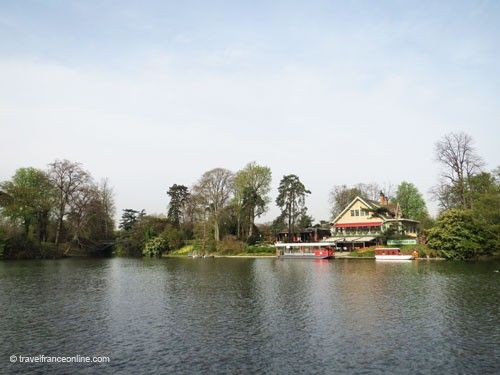
He also imported a chalet from Switzerland, which he had rebuilt on the largest island in Lac Inférieur. Today, this charming chalet houses the restaurant Le Chalet des Îles. The architect Davioud built the Kiosque de l’Empereur at the western end of the island.
Landscape gardens
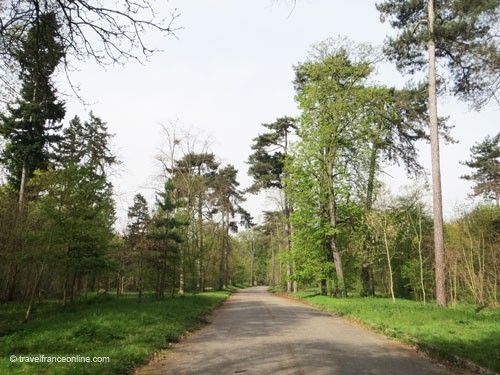
Alphand extended the network of winding paths by an additional 95 kilometres and oversaw the planting of more than 200,000 trees, as well as the creation of lawns, botanical gardens, and nurseries.
Little remains of the original Pré Catalan except for a majestic sequoia and a purple beech, both planted in 1872, and the Grand Restaurant, built in 1905. This garden takes its name from a court minstrel who met a tragic end there in the Middle Ages.
The Shakespeare Garden was laid out in 1953; the Jardins des Serres d’Auteuil are located on the Boulogne-Billancourt side, and the Château de Bagatelle and its magnificent gardens to the north of the Bois de Boulogne.
Racecourses, recreation parks and sport facilities

Davioud enhanced the Bois de Boulogne with several buildings, including two racecourses.
The Hippodrome d’Auteuil primarily hosts steeplechase races, while the Hippodrome de Longchamps is renowned for hosting the prestigious Prix de l’Arc de Triomphe.
A stelae, at the northern end of Longchamp, commemorates the first world aviation record set by the Brazilian aviator Santos-Dumont on November 12, 1906.
Davioud also designed a children’s amusement park, the famous Jardin d’Acclimatation, and its small zoo.
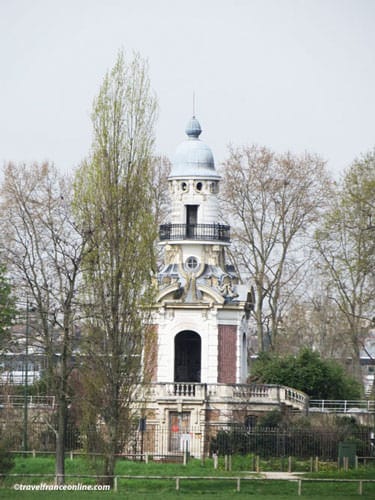
He designed twelve picturesque entrances and their gatehouses, such as the Pavillon de l’Orée du Bois at Porte Maillot, which serves as the official entrance to the Bois de Boulogne.
Several buildings were also built in the 20th and 21st centuries. The Polo de Bagatelle (Polo Club) was founded in 1893. Initially dedicated to polo, it has diversified over time to include various sporting facilities such as golf, tennis, and equestrian sports, managed by the Paris Polo Association.
The Roland-Garros stadium, built in 1928, and the Parc des Princes stadium, built in 1872, have become iconic sporting venues. The most recent addition, the Fondation Louis Vuitton pour la Création opened its doors to the public on October 24, 2014.
Ancient Forêt du Rouvray – Forêt de Boullongne

Today, the Bois de Boulogne is a meticulously maintained and much loved park. It is also the last vestige of the Forêt du Rouvray, an ancient and vast oak forest, once rich in game, that stretched west of Paris.
In the 11th century, this forest was largely uninhabited, except for a small hamlet of woodcutters, first called Mesnuls, then Menus-lez-Saint-Cloud.
In the 13th century, King Philip IV undertook a pilgrimage to the Notre-Dame de Boulogne chapel in Normandy, where he sought solace and prayed before a venerated statue of the Virgin Mary, to whom miraculous powers were attributed.
It is said that the Virgin Mary answered his prayers, for upon his return, King Philip IV had a small chapel built in her honour in the woodcutters’ hamlet, which then became known as Boullongne.
King Philip-Augustus purchased the Forest of Boullongne to establish a royal hunting ground and had the first two roads built.
Despite this, the forest remained largely uninhabited and served as a refuge for vagrants and brigands for much of the Middle Ages.
In 1556, King Henry II had a perimeter wall with eight gates erected around part of the forest, considerably decreasing its size.
The Allée de la Reine-Marguerite was opened in 1610.
In the 18th century, Louis XIV oversaw the maintenance of the forest, including pruning trees, thinning bushes, opening new paths such as the Allée de Longchamp, and installing crosses at key intersections.
The Bois de Boulogne was badly damaged during the French Revolution, but Napoleon I restored it and opened it to the public.
However, in the 1840s, the construction of the Thiers military wall led to a further reduction in its size.
The Bois de Boulogne suffered further losses during the Franco-Prussian of 1870-1871 when the Cossacks established their camp outside the city’s fortifications.
Finally, between 1970 and 1973, an additional 25 hectares were lost and more than 5,000 trees felled during the construction of the A13 motorway.
The Bois de Boulogne was officially annexed to the 16th arrondissement of Paris in 1929.
Directions: 16th district
Metro: Porte Dauphine Line 2 or Porte Maillot, Les Sablons Line 1
Coordinates Bois de Boulogne entrance at Porte Maillot: Lat 48.877522 – Long 2.278982