Villa Seurat, a haven for artists in the heart of Paris
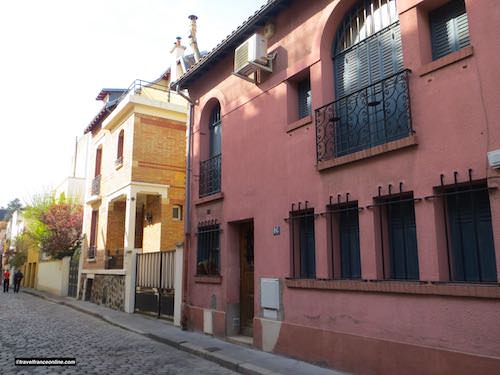
Villa Seurat is not a house; it is a charming private cul-de-sac, 130 meters long. Located a stone’s throw from Parc Montsouris, the Catacombes, and the lively Montparnasse district, it was a hub of Parisian artistic and intellectual life in the early 20th century.
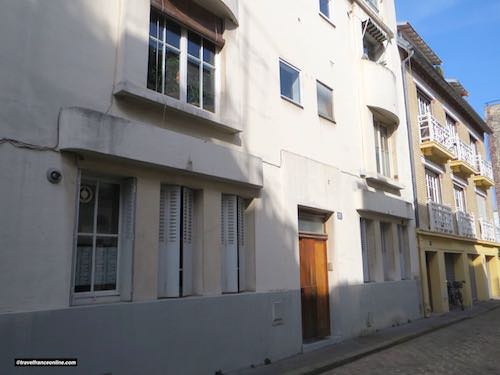
It has retained much of its original charm and character since its creation in 1926, when it was named Cité Seurat in homage to the renowned post-Impressionist painter Georges Seurat. Georges Seurat, a master of Pointillism, achieved worldwide fame with his iconic painting, “A Sunday Afternoon on the Island of La Grande Jatte,” now housed at the Art Institute of Chicago.
Designed by influential figures of 1920s modernist architecture, André Lurçat and the Perret brothers, Villa Seurat boasts a unique architectural style that defied the traditional norms of the time. Their innovative approach indeed favoured ornamental simplicity, clean lines, asymmetrical volumes, and facades stripped of all superfluous ornamentation. Using unconventional materials such as concrete, brick, and cement, Auguste and Gustave Perret challenged the notion of “noble” materials, creating an architectural ensemble of striking originality and charm.
Each building of the Villa Seurat possesses a unique style and character, and all are now listed as Historic Monuments. The Villa Seurat is a true time capsule, offering a glimpse into the vibrant spirit of the Roaring Twenties, when the greatest artists of the Modernist and Art Deco periods lived, worked, and mingled.
André Lurçat’s artist studios-houses at Villa Seurat
André Lurçat (1894-1970) designed a series of eight house-studios located at numbers 1, 3, 4, 5, 8, 9, and 11 of the Villa Seurat. These unique residences bear the imprint of his modernist vision and innovative design.
The first, built in 1924, was intended for his brother, Jean Lurçat, a renowned designer known for reviving the art of tapestry in France. This L-shaped villa, located at number 4, surrounds a charming inner courtyard, illustrating André Lurçat’s architectural ingenuity.
Trained at the École des Beaux-Arts in Nancy, André Lurçat established himself as a major figure in modernist architecture and urban planning. His influence extended far beyond mere design; He played a pivotal role in the reconstruction of Maubeuge, a town in northern France, after World War II. After the war, he taught at the École nationale supérieure des arts décoratifs and the Ecole Nationale Supérieure des Beaux-Arts in Paris, contributing to the training of the next generation of architects and designers.
Each residence in the Villa Seurat had its own history and inhabitants.
The house at No. 1 was notably inhabited by Frank Townsend (1869–1937), a renowned Impressionist painter, famous for his plein air portraits, landscapes, and figure studies. In 1929, the American Surrealist painter Eugene MacCown (1898–1966) stayed there briefly.
No. 1bis housed the sculptor Robert Couturier (1905–2008) before he moved to La Ruche, another renowned artists’ quarter in Montparnasse.
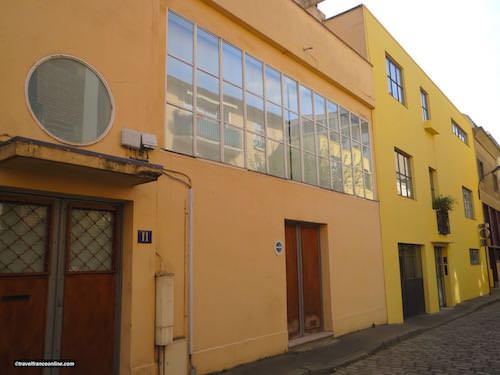
Meanwhile, No. 3 and No. 3bis were home to Marcel Gromaire (1892–1971) and then to his friend Édouard Goeg. Their shared studio featured distinctive architectural elements, such as the unusual convex facade of No. 3.
Gromaire was initially inspired by the great masters of Cubism, Paul Cézanne and Fernand Léger. Although labelled a social realist painter, he is best known for his evocative depictions of social scenes, nudes, interiors, and landscapes.
Édouard Goerg was born to French parents in Sydney, and spent his childhood in England before moving to France at the age of seven. He briefly studied at the Académie Ranson before being mobilised during the First World War. The traumatic experiences he endured during the war profoundly affected him, leading to a shift in his style from Cubism to Expressionism, characterised by dark hues and compositions imbued with anguish.
Gromaire and Goerg collaborated for many years, offering us a profound insight into post-World War I society, capturing the very essence of the Roaring Twenties.
No. 5 was once inhabited by Pierre Bertrand (1884–1975), a painter renowned for his coastal landscapes and poignant lithographs illustrating the consequences of the First World War, which are now held at the War Museum. Bertrand was an official painter of the French Navy from 1935.
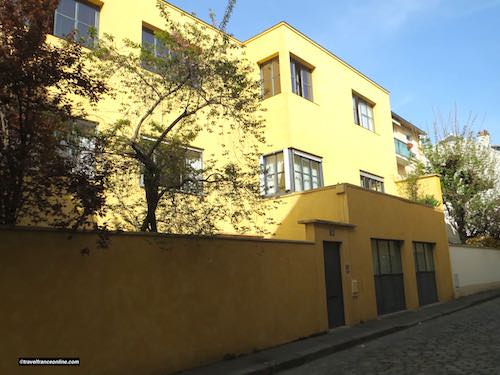
You can’t miss the Villa Quillet, at No. 8, iwith its bright yellow facade, original corner windows, and understated geometric forms.
Finally, No. 11 was the residence of the Swiss sculptor Arnold Huggler (1894–1988).
Auguste and Gustave Perret’s artist houses-studios at Villa Seurat
Auguste Perret (1874-1954) was a visionary architect who, as early as 1900, recognised the potential of reinforced concrete in construction. In collaboration with his brother Gustave, who ran the family masonry business, they used this durable and economical material throughout his career.
One of their most iconic projects is the reconstruction of Le Havre ‘s city centre after the First World War. This monumental project, characterised by its innovative architectural style, has been designated a UNESCO World Heritage Site.
The house at No. 7bis Villa Seurat is a perfect example of their Modernist architecture. The sculptor Chana Orloff lived and worked there from 1926 until 1942, when the house was confiscated as Jewish property. Orloff recovered her house and studio in 1945 and lived there until 1968, dividing her time between Israel and Paris. The use of reinforced concrete, the architectural signature of the Perret brothers, is immediately apparent in the house’s design and is combined with the use of projecting bricks on the upper part of the facade. A listed historical monument, the house is visited by appointment.
Maurice Thiriet (1906-1972), a renowned composer of classical and film scores, who graduated from the Paris Conservatory in 1932, lived a little farther on, at No. 16.
No. 18 holds is very special, as it was there that the American writer Henry Miller wrote his major work, “Tropic of Cancer,” in 1931, while crashing on a fellow artist’s sofa! Affectionately nicknamed Villa Borghese by Miller, this residence also hosted Anaïs Nin (1903-1977), known for her short stories and erotic writings, and the surrealist painter Salvador Dalí (1904-1989).
Finally, No. 20 was home to the Italian modern painter Alberto Magnelli (1888-1971).
No. 15 is not included in our exploration, as it was completely rebuilt in 1963.
As you can see, Villa Seurat is a somewhat off-the-beaten-path destination! However, please remember that it is a private cul-de-sac, so appreciate its charm while respecting the privacy of its residents.
Directions: 14th district
Metro: Denfert-Rocherau, Saint-Jacques on Line 6 – Mouton-Duvernet on Line 4
RER B4: Mouton-Duvernet and Cité Universitaire
Coordinates: Lat 48.826607 – Long 2.332788