
Le Havre, an old maritime tradition
Le Havre is the second-largest port in France after Marseille, and the country’s leading container port.
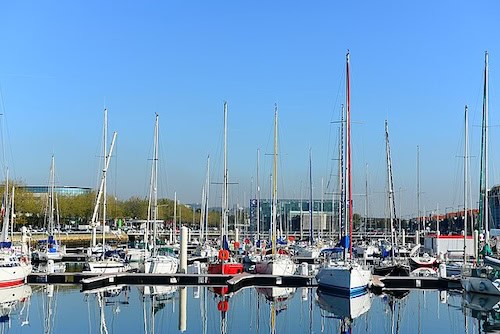
Located on the right bank of the Seine estuary, Le Havre was just a fishing hamlet in the 15th century.
The city began to develop in 1516, when King Francis I laid the first stone of the Notre-Dame-de-Grâce chapel in the small Hable de Grâce, as the area was then known.
The king also authorised the creation of the port on October 8, 1517, to relieve congestion in the ports of Honfleur and Harfleur.
By the end of the 18th century, Le Havre de Grâce had become a prosperous port and city, thanks to a flourishing maritime trade.
Le Havre city centre, a World Heritage Site
During World War II, Le Havre was flattened by bombing raids because the Germans had incorporated it into their Atlantic Wall, a long defensive system composed of batteries and bunkers on the beaches of northern France, Belgium, and beyond.
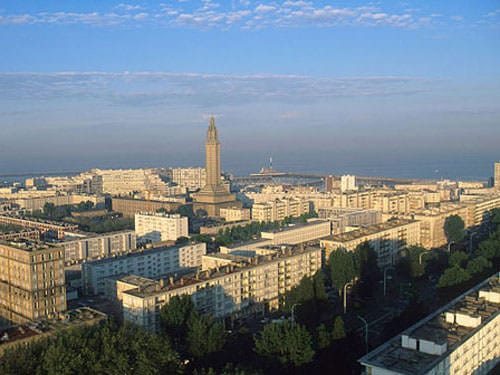
The architect Auguste Perret was commissioned for the reconstruction, which lasted from 1945 and 1964. A pioneer of reinforced concrete architecture, Perret rebuilt the entire city centre using this material.
This audacious architectural undertaking, with its disconcerting modernist aesthetic that defied all conventions, was not to everyone’s liking. Ironically, Perret’s reinforced concrete city centre was designated a UNESCO World Heritage Site on July 15, 2005!
Today, Le Havre is famous for its avant-garde architectural landmarks, which include the impressive Saint-Joseph Church and the iconic Maison de la Culture, designed by the renowned architect Oscar Niemeyer in 1982, and nicknamed “The Volcano” for its conical shape.
The harbour district
While the city centre was destroyed during World War II, the northern and eastern districts were relatively spared and thus retain many architectural gems from the 19th and 20th centuries, such as the imposing shipowners’ houses. Notre-Dame-de-Grâce Cathedral replaced the chapel that Francis I had built in the 16th century.
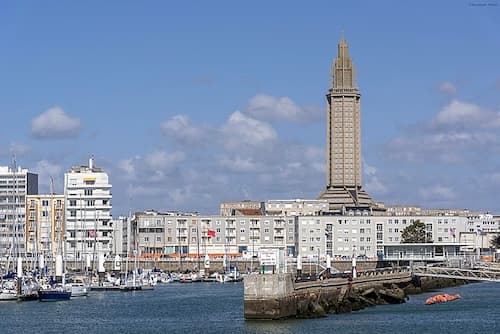
The southern part of the city, along the Seine estuary, is the industrial and maritime hub. It was there that the oil, chemical, and automotive industries established themselves after the war. However, the oil crisis of the 1970s precipitated their decline, and this economic downturn led to unemployment and a decrease in population.
Over the last thirty years, the service sector has experienced considerable growth, along with the establishment of aeronautical industries and wind farms, and the creation of Port 2000, which has breathed new life into Le Havre’s economy. Port 2000, the largest European maritime project since 1970, enables Le Havre to receive giant containers, thus transforming the port into a major European logistics platform.
Le Havre, the setting for ‘Impression au Soleil Levant’

The André Malraux Museum of Modern Art is dedicated to the Impressionist painters.
It was indeed in Le Havre that, in 1872, Claude Monet painted his iconic masterpiece, “Impression, Sunrise,” capturing the ethereal beauty of the port bathed in the morning light.
Monet indeed had a deep connection to Le Havre, as his family settled there in 1845, when he was only five years old.
This painting gave its name to the entire Impressionist movement.
Department of Seine-Maritime
Coordinates: Lat 49.494370 – Long 0.107929
Photos via Wikimedia Commons: Port Vauban by Ville du Havre CC BY-SA 4.0 – city centre by Photographe Erik Levilly CC BY 1.0 – St Joseph Church by Alexandre Prevot CC BY-SA 2.0 – Impression-sunrise by Monet Public domain


