Saint Germain des Prés, the cradle of French Existentialist Movement
Saint Germain des Prés became a vibrant intellectual and artistic hub in Paris during the interwar period.

The cafés on Boulevard Saint-Germain and the surrounding streets became meeting places for a new generation of artists, writers, philosophers, and political figures.
Existentialism, which gained prominence in France during the 1930s, emerged as a reaction against the established order. Jean-Paul Sartre, a leading figure in the movement, defended the belief in the non-existence of God and emphasised the importance of individual freedom and autonomy:
“L’Homme doit trouver en lui ses propres valeurs et il doit décider par lui-même les actes qu’il commettra” – “Man must find his own values within himself and decide for himself the actions he will take.”
At the heart of existentialism lies the idea that individuals are entirely responsible for constructing their identity and destiny through their choices and actions. Personal commitment to the search for truth and goodness is paramount and can only be achieved through direct experiences guided by individual convictions.
While existentialist principles have their roots in figures such as Blaise Pascal in the 17th century, it is the Danish philosopher Søren Kierkegaard who is often considered a precursor of the 20th-century existentialist movement.
Kierkegaard stated:
“L’Homme ne peut trouver le sens de sa vie qu’à travers la découverte de sa propre et unique vocation” – “Man can only find the meaning of his life through the discovery of his own unique vocation.”
Besides Kierkegaard, existentialist thought was developed by philosophers such as Martin Heidegger and Friedrich Nietzsche, as well as by writers such as Franz Kafka, Fyodor Dostoevsky, Albert Camus, Samuel Beckett and Eugène Ionesco, among others.
Where did the Existentialists meet in Saint Germain des Prés?
The cafés of Saint Germain des Prés played a vital role in the rise of literary and artistic circles in the early 20th century.

As Montmartre transformed and artists settled in Montparnasse and Saint Germain des Prés, a vibrant community of musicians, writers, actors, and other creatives emerged in the neighbourhood.
Personalities such as Picasso, Léo Ferré, Georges Brassens, Jacques Brel, Charles Trenet, Guy Béart, Charles Aznavour, Juliette Gréco, and Serge Gainsbourg frequented the Café de Flore, Café Les Deux Magots, Brasserie Lipp, and Le Procope.
These cafés were meeting places where lively discussions took place and ideas were exchanged, thus helping to shape the cultural landscape of the era.
Saint Germain des Prés also became a hub of nightlife, with underground clubs and concert venues like the Club Saint-Germain and the Blue Note, which drew crowds thanks to performances of New Orleans jazz and bebop by artists such as Sidney Bechet, Miles Davis, and Duke Ellington.
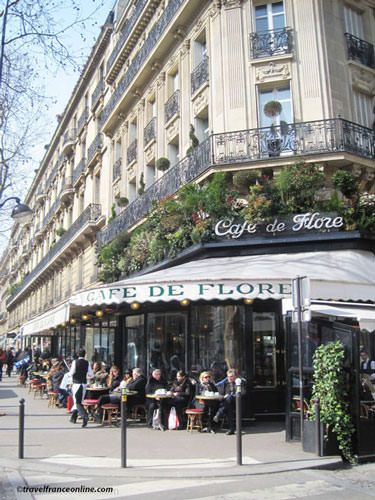
During World War II, these establishments remained open despite the restrictions and curfews imposed by the occupation of Paris, thus offering a semblance of normalcy and camaraderie during those difficult times.
The end of World War II changed the atmosphere of the neighbourhood.
The carefree youth had indeed adopted their own interpretation of Sartre’s existentialist philosophy, devoting themselves with boundless enthusiasm to the pursuit of life’s pleasures.
This rejection of traditional norms and this quest for individual freedom shocked many in Paris, still reeling from the war’s aftermath.
During the post-war period, the Avant-Garde or Vanguard movement gained momentum with Samuel Beckett, Eugène Ionesco, and Jean Cocteau. Their innovative works, influenced by a spirit of experimentation and exploration, challenged conventions and pushed boundaries.
Directions: 6th district
Metro: Saint Germain des Pres on Line 4
Coordinates Saint Germain des Pres: Lat 48.853798 – Long 2.333328