
Château de Vincennes – From a royal hunting lodge to a fortress

The Château de Vincennes is a vast fortified enclosure comprising a collection of buildings constructed over the centuries and arranged around two distinct courtyards.
The medieval fortress includes the imposing keep, various outbuildings and the royal chapel.
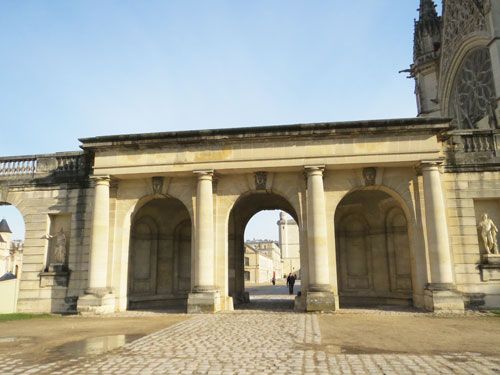
As for the 17th-century royal country residence, it is structured around the royal court (Cour Royale) and bring an elegant touch to the fortress’s military aesthetic.
The medieval fortress
In the 5th century, the Merovingian Kings had a hunting lodge built in Vilcena, a wooded area then located well beyond the city walls.
Seven centuries later, King Saint-Louis replaced the old manor with a small fortress.
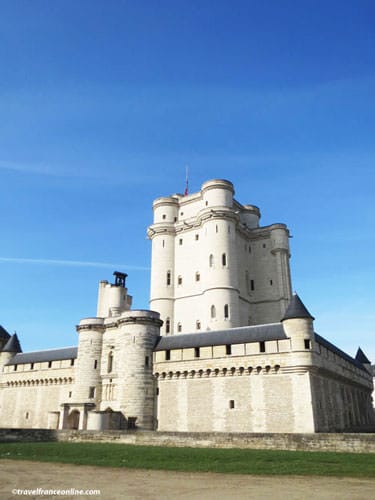
Then, in 1370, Charles V had this old fortress demolished to build the current fortified keep where he established his residence.
At the beginning of the 15th century, the ramparts and moats were completed, transforming the Château de Vincennes into a formidable fortress which had three gate towers and six defensive towers.
The 42-metre-tall Tour du Village (Village Tower) still dominates the town of Saint-Mandé, and has retained its original height.
The Tour du Gouverneur (Governor’s Tower), located to the east, provides access to the surrounding woods.
The Tour du Bois (Forest Tower) connects the Cour Royale (Royal Court) to the Esplanade and the Bois de Vincennes.
The defensive towers of the Château de Vincennes are known as the Tour de Paris, the Tour du Réservoir des Fontaines, the Tour du Diable, the Tour de la Surintendance, the Tour de la Reine, and the Tour du Roi.
Interestingly, the prestigious Manufacture Royale de Porcelaine de Sèvres (Royal Porcelain Manufactory of Sèvres) was founded in the Tour du Diable (Devil’s Tower) in 1738.
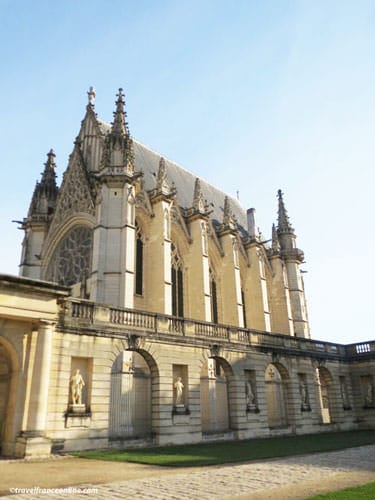
In the mid-14th century, Charles V commissioned the construction of the Chapelle Royale (Royal Chapel), which was completed in 1552. Inspired by the architecture of Sainte-Chapelle, it temporarily housed fragments of the Crown of Thorns and boasts magnificent 16th-century stained-glass windows depicting scenes from the Apocalypse.
The Chapelle Royale also houses the tomb of the Duke of Enghien, the pretender to the throne of France, who was executed in 1804 after being accused of plotting against Napoleon I.
The iconic 52m high keep is a remarkable example of 14th-century military architecture. It is the only surviving medieval royal residence in France and the tallest keep in Europe!
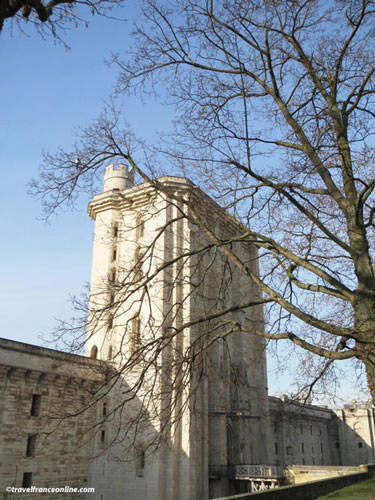
Integrated into the defensive enclosure, it is protected by a barbican and accessible via a drawbridge, which led to it being transformed into a prison during the French Revolution.
During the Hundred Days, Napoleon I and his troops entrenched themselves in Vincennes. He thus transformed the fortress into an arsenal, removed the battlements from the ramparts, lowered the towers and equipped them with cannons.
This period was also marked by one of the most famous anecdotes in French history. The General Pierre Daumesnil, nicknamed Jambe de Bois (Wooden Leg) for having lost a leg at the Battle of Wagram in 1809, was then governor of Vincennes.
Ordered to surrender the fortress to the Allies, he retorted with his famous oath: “Je rendrai Vincennes quand on me rendra ma jambe” – “I will surrender Vincennes when you return my leg.”
Today, the Donjon du Château de Vincennes accommodates a small museum offering audiovisual presentations that recount the long history of the castle.
The 17th century royal country residence
In 1650, Cardinal Mazarin, Prime Minister to Louis XIV, commissioned Le Vau to build the Pavillon du Roi , the Pavillion de la Reine and the north and south porticoes on the south side of the medieval fortress.
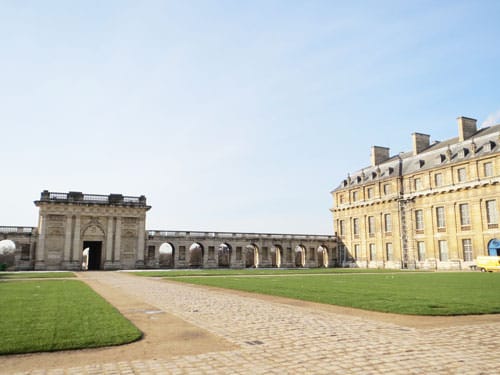
Le Vau ingeniously integrated the Tour du Bois into the south portico, transforming it into a triumphal arch and a majestic ceremonial entrance for the Cour Royale. From this gate, you can also clearly see the commemorative stele that marks the moat where the Duke of Enghien was executed in 1804.
The north portico, between the two courtyards, was demolished in 1837 but was rebuilt in the 1970s.
The Château de Vincennes was annexed to the City of Paris in the mid-19th century and bequeathed to the French army. Many buildings were thus modified, the land was redeveloped into a training ground, and the Hôpital Militaire (Military Hospital) was built.
During the Franco-Prussian war of 1870/1871, Vincennes thus served as a defensive fort. The ramparts were reinforced with casemates and the openings sealed to strengthen the fortress, but also contributed to its degradation!
During the Second World War, the old fortress suffered serious damage when the Germans blew up part of the ramparts and destroyed the Pavillon du Roi, set fire to the Pavillon de la Reine before retreating on August 24, 1944.
The French army recovered the Château de Vincennes after the war and restored the old fort and barracks. Today, Vincennes is fully restored, and the Pavillon de la Reine houses the War Museum.
A visit to the museum usually lasts an hour and is particularly popular with children for its authentic fortress atmosphere.
Directions – Avenue de Paris – Vincennes
Metro: Chateau de Vincennes on Line 1
Coordinates: Lat 48.843196 – Long 2.436079


