Passerelle Léopold-Sédar-Senghor, a tribute to a Senegalese Statesman
The Passerelle Léopold-Sédar-Senghor is much more than just a footbridge to cross the Seine. It forms a symbolic link between the historic heart of Paris and its vibrant Left Bank. It indeed offers pedestrians convenient access to the Jardin des Tuileries, accessible via an underground tunnel on the Right Bank, and to the Orsay Museum and Hôtel de Salm – Legion of Honour Museum on the Left Bank.
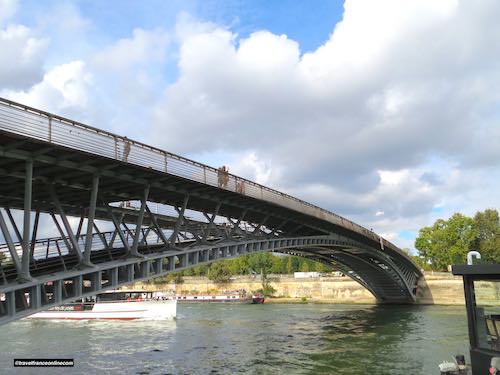
This single-arch footbridge replaced the Pont de Solférino, a cast-iron bridge inaugurated in 1861, which eventually succumbed to structural weaknesses caused by the constant passage of barges and the wake they generated. The old bridge was demolished in 1961, making way for a steel footbridge 100 metres upstream, which was in turn dismantled in 1992.
The current footbridge, initially named Passerelle Solférino, was built on the site of the Solférino Bridge and inaugurated in December 1999. It was renamed Passerelle Léopold Sédar Senghor on October 9, 2006, in homage to the centenary of the birth of the illustrious Senegalese politician and poet.
Léopold Sédar Senghor (1906-2001) was indeed a prominent figure in Senegalese and African history. A renowned poet, politician, and cultural theorist, he became the first president of Senegal (1960-1980) and played a decisive role in the destiny of his country and the African continent.
A fervent advocate for African culture and identity, Senghor worked for the emancipation of Black communities within the complex network of Franco-African relations. At the heart of his philosophy lay the conviction of the intrinsic value and richness of African heritage and traditions.
After completing his studies, Senghor graduated from the University of Paris, where he earned his agrégation in French Linguistics. Building on this academic success, he embarked on a career teaching at the universities of Tours and Paris. On June 2, 1983, he was elected to the prestigious Académie Française, occupying the 16th seat, succeeding Antoine de Lévis Mirepoix. He thus became the first African to sit in this venerable institution.
Passerelle Léopold-Sédar-Senghor, Eiffel Company’s architectural marvel
The Passerelle-Léopold-Sédar Senghor footbridge was designed with meticulous attention to detail, boasting a design that harmoniously blends form and function. This architectural masterpiece comprises two levels that gracefully converge at their centre, creating a striking visual contrast with the waters of the Seine.
Its complex metal structure, consisting of six sections, bears a striking resemblance to the iconic Eiffel Tower, as it was built in the renowned Eiffel workshops located in the northwestern suburbs of Paris.
Firmly anchored to the ground by two robust concrete pillars, driven 15 metres deep on either side, the footbridge’s single arch is perfectly stable. The decking, made of azobé, an exotic and rot-resistant wood from sub-Saharan Africa, lends the structure a touch of warmth and elegance.

However, the Passerelle Léopold-Sédar-Senghor encountered initial difficulties shortly after its inauguration. The pedestrians’ footsteps unintentionally caused slight oscillations in its structure, while the azobé wood decking proved slippery in wet weather.
To remedy these problems, counterweights and shock absorbers were quickly installed to improve the footbridge’s stability, and a non-slip surface was applied to the ground. Despite these initial difficulties, the ingenuity of the visionary architect Marc Mimram triumphed, earning him the prestigious L’Équerre d’Argent prize in 1999.
Metro stations: Tuileries on Line 1 is the closest – Otherwise Concorde on Line 1 and Assemblée Nationale on Line 12
Coordinates: Lat 48.862260 – Long 2.324631