Notre-Dame-du-Travail Church – workers’ parish

Nestled south of Place de Catalogne and the Echelles du Baroque, Notre-Dame-du-Travail Church is one of the most intriguing and unique churches in Paris.
Its name, Notre-Dame-du-Travail (Our Lady of Labour), was aptly chosen, as it was built to serve as the parish church for the workers constructing the Montparnasse train station.
In the 1840s, the development of the Embarcadère de l’Ouest (the station’s original name) indeed drew crowds of workers to the area.
These initially attended services at the parish church in the nearby village of Plaisance.

A second wooden church, Notre-Dame de l’Assomption de Plaisance, was erected in 1845 to accommodate the growing working-class population.
With the annexation of the village of Plaisance to Paris in 1860, the church was renamed Notre-Dame de Plaisance and enlarged in 1865. T
The construction and dismantling of the World’s Fairs held on the nearby Champ de Mars during the second half of the 19th century continued to draw a large working-class population to the neighbourhood.
The need for a new and larger church was clear!
In 1884, the parish priest thus launched a national fundraising campaign for its construction.
The architect Jules Astruc was commissioned to design the plans, and land adjacent to the original church was acquired.
Construction began in 1897, and Notre-Dame-du-Travail Church was inaugurated in 1902.
Notre-Dame de Plaisance, having become outdated, was eventually demolished in 1909.
A masterpiece of metal architecture
What sets Notre-Dame-du-Travail Church apart from other Parisian churches is its metal architecture, a style still innovative when it was completed in 1902.
The architect Baltard,, famous for his work on Les Halles covered market, introduced this innovative approach to construction in the 19th century.
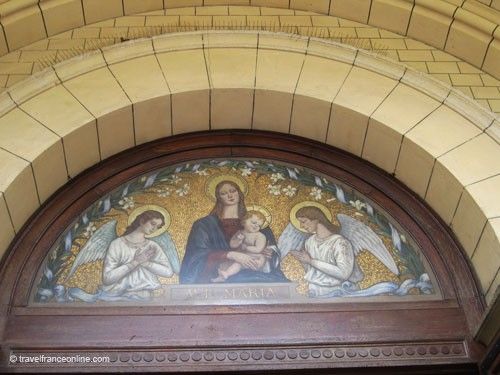
The exterior of the Notre-Dame-du-Travail Church may appear conventional, with its neo-Romanesque facade and two octagonal towers, its atypical bell tower and its bell, which was brought back from Sevastopol during the Crimean War in 1855, or even its tympanum.
The latter is indeed adorned with a neo-Byzantine mosaic depicting the Virgin and Child, created by the renowned Taillefert workshop.
However, the true uniqueness of the church lies in its internal structure, similar to that of the Saint-Jean-de-Montmartre Church, which is considered a jewel of metal architecture from the Art Nouveau period.
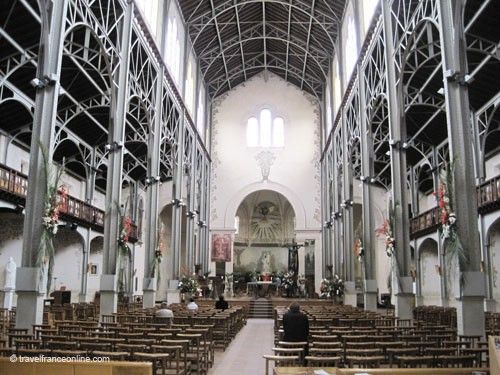
The unlimited use of metal beams and supports indeed creates a truly surprising and spectacular visual effect!
The vaulted nave is constructed with steel arches likely salvaged from the roof of the Palais de l’Industrie, which was built for the 1900 Universal Exhibition then dismantled.
This departure from traditional stone construction highlights the versatility and robustness of metal in architecture.
Eclectic Notre-Dame-du-Travail Church
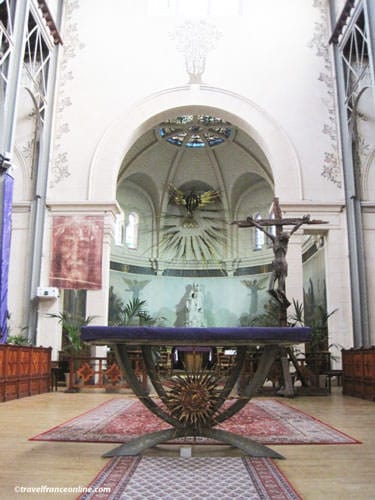
Notre-Dame-du-Travail Church is undeniably contemporary and resolutely eclectic, brilliantly blending styles that trace the evolution of art, from Art Nouveau to the early 20th century.

Its industrial aesthetic, with its elaborate metal structure and impressive dimensions, accentuated by the robust metal columns supporting the framework, is softened by certain architectural and decorative features.
Thus the three arches of the neo-Romanesque choir give it a touch of traditional elegance.
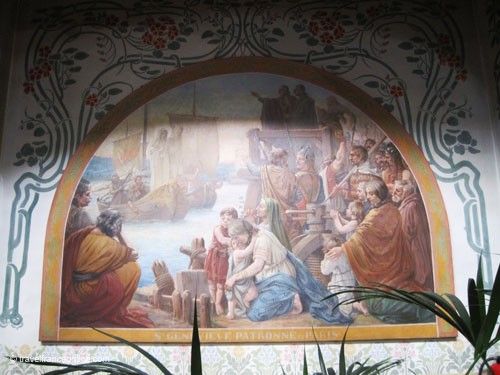
Similarly, frescoes by Giuseppe Uberti and Émile Desouches adorn the side chapels, depicting scenes from the life of Sainte-Geneviève, patron saint of Paris, as well as various trades and their patron saints.
Among these are (Saint-Eloi) Saint Eligius, patron saint of metalworkers, Saint Luke, patron saint of artists and craftspeople, and Saint Joseph, patron saint of carpenters and joiners.
An Art Nouveau garland of foliage delicately frames each crescent-shaped fresco.
A series of stained-glass windows adorned with Art Nouveau floral motifs delicately filter the sunlight, creating a serene atmosphere that bathes the neo-Romanesque chapel of the Virgin.
The statue of Notre-Dame-du-Travail, a work by Joseph Lefebvre (1898), stands beneath a sculpture of the Colombe de la Paix (Dove of Peace), by Jean-Jacques Bris.
This statue, placed on a pedestal adorned with carpenter’s tools, is meant to provide protection and support to workers.
You can also admire frescoes by Félix Villé depicting, on the right, “The Unemployed imploring the Virgin’s help” and, on the left, “The Workers glorifying the Virgin“.
The church’s apse is adorned with elegant stained-glass windows in shimmering colours representing various saints.
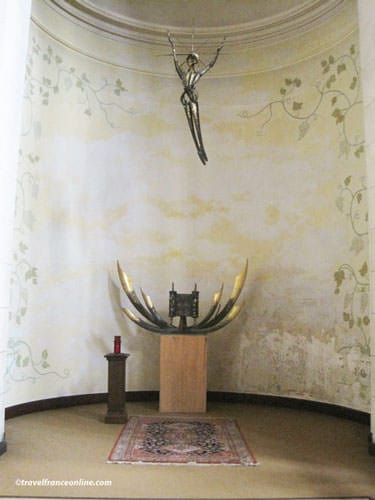
The left side chapel houses a contemporary sculpture by Jean-Jacques Bris, “Christ in Glory“.
Notre-Dame-du-Travail Church boasts also an eclectic art collection, including many contemporary pieces such as murals, canvases, Stations of the Cross, sculptures, and mosaics.
Among these works, the Pietà, sculpted by Georges Serraz between the two world wars, represents the Virgin Mary holding the hand of her deceased Son.
The baptismal font is adorned with an Art Nouveau mosaic, also made in the Taillefert workshop.
Amazingly, the church contains a painting from the old Notre-Dame de Plaisance Church: a replica of the Assumption painted in 1865 by Pierre-Paul Prud’hon.
Before leaving, be sure to admire the impressive organ, built by the organ-maker Haerpfer in 1991.
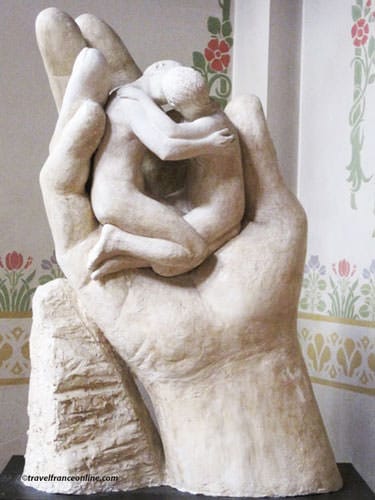
La Main Créatrice by Michel Serraz
La Main Créatrice (The Creative Hand) is another work by Michel Serraz! This monumental sculpture represents a hand embracing Adam and Eve, symbolising creation.
Although the Notre-Dame-du-Travail Church lacks the solemnity of a Romanesque or Gothic church, it is certainly worth a visit because of its unique architecture, which makes it a rarity in Paris.
It also bears witness to a bygone era, one in which Paris underwent significant renovation and expansion work, and in which France faced a massive rural exodus. At that time, poor agricultural workers indeed migrated to Paris in search of work, contributing to the capital’s growth and development.
Although their names fell into oblivion, they undoubtedly contributed to the creation of modern-day Paris. Their place of worship, Notre-Dame-du-Travail church, was thus rightfully designated a historical monument in 1976.
Notre-Dame-du-Travail Church is one of the 25 Paris churches I have selected for you, lesser-known, yet equally remarkable and beautiful.
Directions: 14th district – No59 Rue Vercingetorix
Metro: Pernéty or Gaîté on Line 13
Coordinates: Lat 48.836185 – Long 2.316847