The concave Place de Catalogne
The Place de Catalogne is a stone’s throw from Montparnasse station and the Montparnasse Cemetery. It is also the crossroads of five major streets in the district.
The architect Ricardo Bofilldesigned the Place de Catalogne during the area’s urban renewal in the 1980s. Originally from Catalonia, he chose to name the square after his native region, in Spain.
The Place de Catalogne alone symbolises the transformation that Montparnasse has undergone over the years. Once renowned for its bohemian charm, the area has seen many of its old buildings demolished to make way for new constructions.
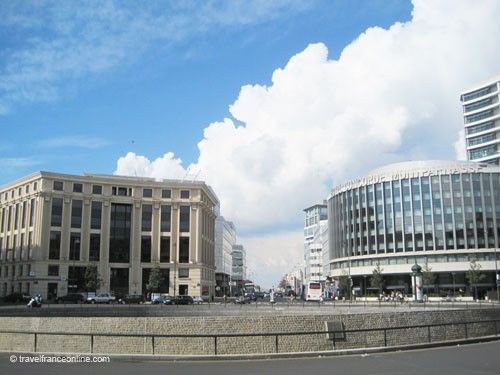
The square is thus framed by four groups of buildings with curved facades, which follow its circular shape. Among these buildings are the Echelles du Baroque, a twin building located at the southeast corner of the square, also designed by Ricardo Bofill.
The Urban Forest on Place de Catalogne
The imposing stone fountain known as Creuset-du-Temps, which once stood in the centre of the Place de Catalogne, has disappeared.
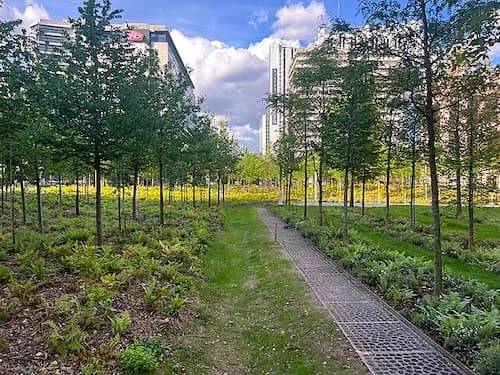
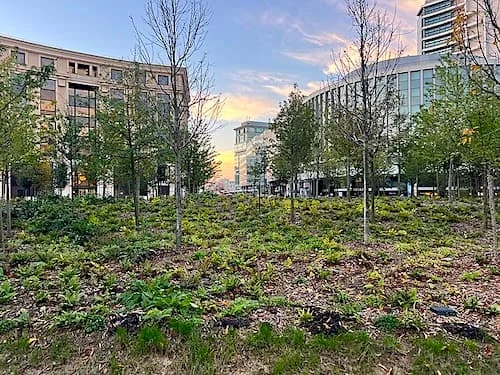
The City of Paris replaced it with a lush urban forest of 478 trees, a mix of oak, ash and cherry trees. Some are young saplings, while others are already half-developed, rapidly transforming the square into a welcome green space. This change is excellent news for the area, which was redeveloped in the 1970s and 1980s with perhaps too much concrete and not enough greenery.
The old fountain and its vast paved surface indeed acted as a heat trap, unable to absorb rainwater, resulting in summer temperatures up to 4°C higher than those in other districts.
Trees were the ideal solution to remedy this overheating problem! Paris is already a remarkably green city, home to around 500,000 trees, including 63,000 planted since November 2020. But these trees do more than beautify the landscape.
They combat climate change by absorbing carbon emissions, purifying the air, cooling the streets during heat waves and managing rainwater. They also create habitats for urban wildlife, making Paris a true sanctuary for biodiversity and a more pleasant and sustainable city to live in!
This transformation of the Place de Catalogne is part of a larger short-term greening initiative. Paris already has magnificent parks, charming public gardens, grand tree-lined avenues and even historic wooded cemeteries. And let’s not forget the famous Musée du Quai Branly and its impressive vertical garden!
But the city doesn’t intend to stop there; Its medium-term objective is to make 50% of its ground surfaces permeable to water, with even more green roofs, parks, tree-lined streets and vertical gardens! The new urban forest in Plaça de Catalunya is part of this grand project!
Fontaine du Creuset-du-Temps on Place de Catalogne
If you have never seen the Fontaine du Creuset-du-Temps, imagine an inclined disc 30 metres in diameter, partially buried.
Designed in 1988 by Polish artist Shamaï Haber, this fountain was a remarkable piece of urban art. It was indeed composed of 300,000 polished granite paving stones from Brittany, creating a smooth surface where water flowed in delicate, silent streams.
The effect was spectacular: mini-cascades evenly distributed across the fountain gave it movement and serenity. The fountain was illuminated from below, its colours changing with the natural light throughout the day. At times, the disc even seemed to float on the water!
Although the fountain has now disappeared, a visit to the new Urban Forest will allow you to see the Ecelles du Baroque, stroll around Place de Seoul or visit the unique Notre-Dame-du-Travail Church, a superb illustration of metal architecture located just south of the square.
Directions: 14th district
Metro: Gaîté or Pernéty on Line 13
Coordinates: Lat 48.837033 – Long 2.318657
Wikimedia Commons: Header and Photo 2 and Photo 3 by Chabe01 are CC BY-SA 4.0