
May 8, a dual commemoration in France
May 8 marks a double commemoration in France.
First, it is Victory Day 1945, or V-E Day, which commemorates the end of World War II and the triumph of France and its Allies over Nazi Germany. This day is one of the three French National Days – Fêtes Nationales, along with Bastille Day on July 14th and Armistice Day on November 11th.

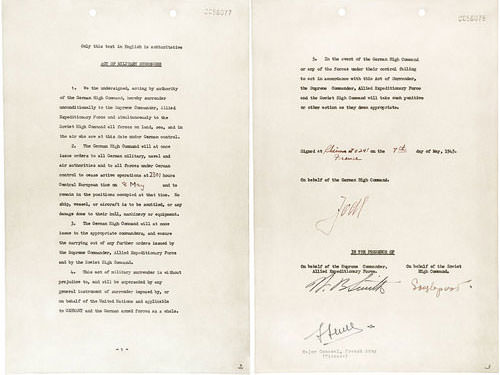
Field Marshal Alfred Jodl signed the act of German surrender in Reims on May 7, 1945, at 2:41 a.m. However, at Stalin’s request, the official surrender ceremony took place in Berlin on May 8th at 11:01 p.m., in the presence of representatives from the USSR, France, the United Kingdom, and the United States. When General de Gaulle, head of the provisional government, announced victory on May 8, 1945, church bells rang at 3 p.m. throughout France.
May 8 also commemorates the Setif, Guelma and Kherrata massacres, perpetrated by Algerian nationalists during the celebrations marking the end of World War II. Historians estimate that between 8,000 and 15,000 people perished in these tragic events.
May 8 – V-E Day celebrations in France – A few historical facts
Sainte Jeanne d’Arc National Day
Until 1953, the end of World War II was commemorated on two important dates: November 11, Armistice Day, and the Feast of Saint Joan of Arc, which commemorated May 8, 1429, the day Joan of Arc, at the head of a French army, recaptured Orléans from the English during the Hundred Years’ War. Saint Joan of Arc was martyred on May 30, 1431, and canonised in 1920 and became one of the patron saints of France. Saint Joan of Arc’s Day, celebrated on May 8, was then made a national holiday.
May 8 National Day
The evolution of May 8 as a national holiday in France reflects the complexity of historical memory and reconciliation efforts after World War II.
- March 20, 1953: Declared a national holiday.
- April 11, 1959: General de Gaulle abolishes this holiday as part of reconciliation efforts with Germany. However, many veterans continue to commemorate the end of World War II on the feast day of Saint Joan of Arc.
- 1965: Exceptionally celebrated on the 20th anniversary of the end of World War II.
- May 8, 1968: The celebrations are reinstated, but they take place after working hours.
- 1975: President Giscard d’Estaing abolishes the commemoration of the 1945 Allied victory, to promote reconciliation and prevent prejudice against Germany. This decision sparked resistance from many veterans who continued to commemorate May 8th.
- October 2, 1981: President Mitterrand reinstated the commemoration of the 1945 Victory and made May 8th a public holiday.
- 1982: Became a national holiday in France, marking the end of World War II and paying tribute to the sacrifices of those who fought for freedom and peace.
How do French people celebrate May 8?
Official ceremonies and tributes mark May 8th throughout the country:

- In Paris, the President of the Republic presides over a ceremony at the Tomb of the Unknown Soldier, beneath the Arc de Triomphe.
- Throughout France, towns and villages organise parades and tributes. These events often include:
- A procession or parade, led by the French flag and the municipal band, to the war memorial.
- The participation of the mayor, the town council, veterans’ associations, the clergy, law enforcement, firefighters, and local dignitaries.
- The raising of the flag, speeches, and the laying of wreaths at the war memorial.
- The playing of the Sonnerie aux Morts – Last Post as the flag bearers lower their flags.
- A minute of silence followed by the singing of La Marseillaise.
- The ceremony concludes with a concert by the orchestra performing Rompez les Rangs – Break the Lines, followed by a reception at the town hall.
- Government offices, banks, most businesses, and many shops will be closed that day. Some bakeries and boutiques may remain open for part of the day. Many restaurants and cafes located outside tourist areas will also be closed.
- Expect some road closures and pedestrian restrictions during the celebrations; thus, it is advisable to plan accordingly.
- Public transportation, including airlines, SNCF (trains), RATP (Paris metro), and major bus companies, will operate on May 8; however, service frequency may vary, and some trains will operate on reduced schedules. To avoid any inconvenience, it is recommended to check their websites beforehand.
Photos via Wikimedia Commons: Document of the surrender May 7, 1945 CC BY-SA 3.0 – Signing of the surrender by Office of War Information Domaine public – Celebration by Thesupermat CC BY-SA 3.0


