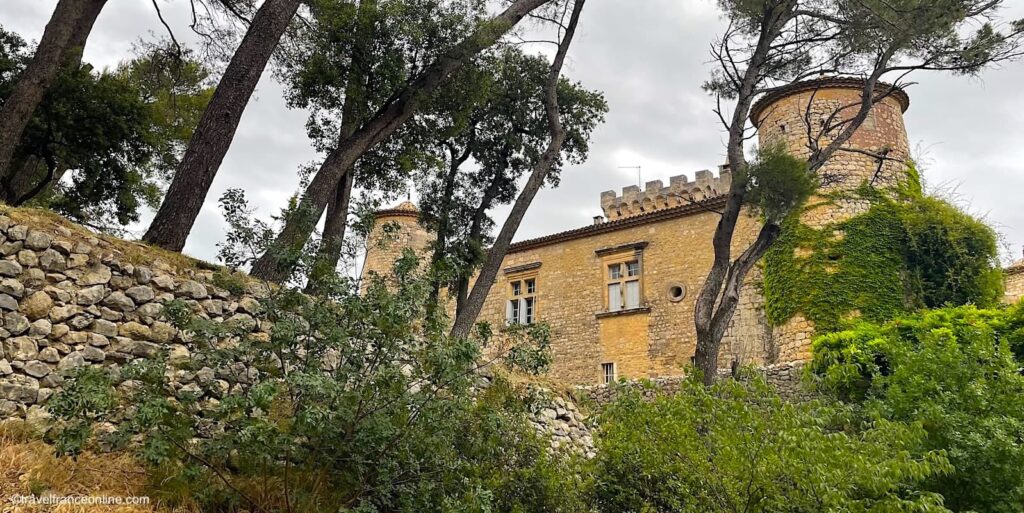
Lautrec in the Land of Plenty

Lautrec is a fortified medieval town located in the heart of the former diocese of Toulouse-Lautrec, and the former estate of the Counts of Toulouse-Lautrec.
Amazingly, their descendant, the painter Henri de Toulouse-Lautrec, never set foot there!
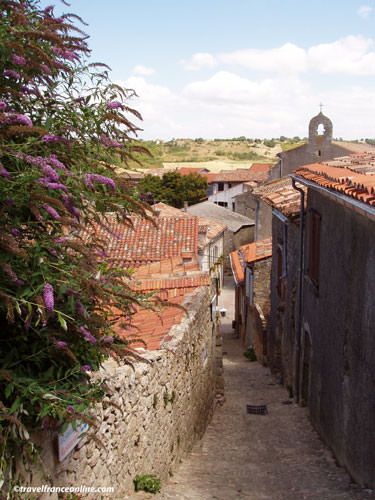
The village stretches across the slopes and at the foot of the Colline de la Salette, a hill that has attracted people since ancient times and has been continuously inhabited.
Archaeological excavations have indeed unearthed the remains of a Neolithic settlement in the lower part of the village.

A small archaeological museum, housed in the town hall, displays various objects from these excavations.
The Romans later developed the village, building a major road, still in use today, that runs alongside the old wash houses in the lower part of the village.
In the Middle Ages, travellers had to pay a toll to enter or pass through the village. This till left its name to the village as Lautrec derives from the Occitan word “L’autreg,” meaning toll.
The introduction of woad cultivation in the 13th century made Lautrec a prosperous town throughout the Middle Ages, earning the town and its surrounding region the nickname “Pays de Cocagne” (Land of Plenty).
Lautrec ranks among the Plus beaux villages de France
The citadel of Lautrec is listed among the most beautiful villages in France.

Today, only the ramparts and the Porte Caussade, the last of the original eight gates, remain of the 13th-century fortifications. This gate opens onto Rue Mercadial, which leads to Place des Halles, the market square which is surrounded by beautiful half-timbered houses.
A discovery trail starts in the village and climbs to the windmill, as well as to the orientation table and the cross located at the top of the Colline de la Salette. The Moulin de la Salette (Windmill), the emblem of the village, was built in the 17th century on the foundations of a windmill dating back to 1396.
Restored in 1991, it is the only remaining windmill of the nine that operated in Lautrec at the beginning of the 19th century and one of the last working windmills in the Occitanie-Midi-Pyrénées region!
The Calvaire of La Salette (Cross) marks the location of the old castle and offers an unobstructed view of the hills of Lacaune, the Montagne Noire, the plain of Castres and, in clear weather, of the Pyrenees in the distance.
Saint-Rémy Collegiate Church
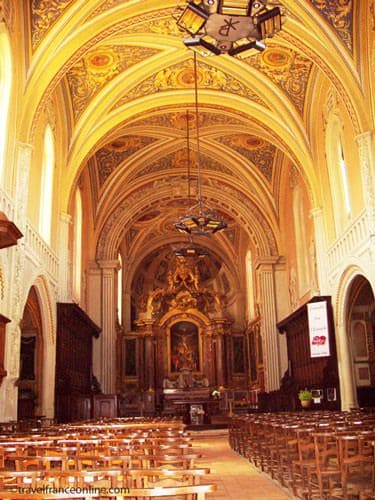
The Collegiate Church of Saint-Rémy was originally known as Sainte-Marie de la Paix (Saint Mary of Peace) and is one of Lautrec’s most iconic landmarks.
Two wealthy citizens, Sicard Saquet and Bernard Cavaser, financed its construction.
The foundation stone was laid in 1394. The church was enlarged in 1521 and again in 1625 to house the chapter of Saint-Pierre de Burlats.
It was later elevated to the status of a collegiate church and dedicated to Saint Rémy.
The church boasts a rich architectural heritage and collection of religious furnishings.
Among these, you can admire the splendid baptismal fonts, surmounted by a white marble sculpture dating from 1824, and depicting John the Baptist baptising Jesus.
One of the church’s other spectacular features is the 18th-century vault of the nave, framed by eight elegant side chapels.
In 1852, painter Jacques Pauthe adorned this vault with a splendid trompe-l’œil decoration, which was restored in the 1990s.
The chancel houses a marble altar surmounted by a 13-metre-high gilded wooden canopy, which supports a dome topped with a cross.
The collegiate church also contains 17th- and 18th-century paintings, a wooden lectern, and a large medallion depicting Bishop Saint-Rémy. The Collegiate Church of Saint-Rémy is obviously a listed historical monument.
Lautrec is a charming fortified village with a rich history and is a must-see when sejourning in the Tarn region.
Tarn department
Coordinates: Lat 43.707263 – Long 2.138453