
Square René Viviani
The Fontaine Saint Julien le Pauvre is located in the heart of the Square René-Viviani, a small public garden that replaced the former forecourt of the Saint Julien le Pauvre Church. This garden created in 1928, and situated between the church and the Quai de Montebello, offers a breathtaking view of the majestic Notre-Dame Cathedral.
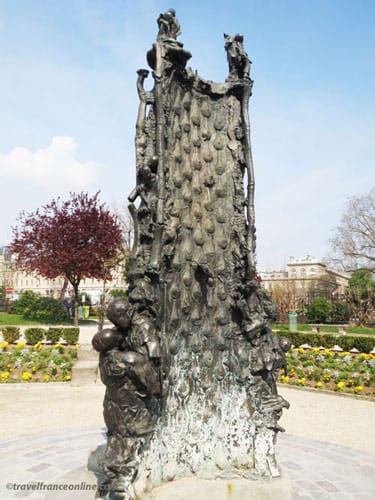
In 1995, the City of Paris commissioned George Jeanclos Mosse to create a new bronze fountain to replace a Fontaine Wallace located in the centre of the garden.
The sculptor drew inspiration from the legend of Saint Julien-le-Pauvre, also known as Saint Julian the Hospitaller, the patron saint of the neighbouring church, to create the fountain.
The fountain’s shaft is shaped like a tree trunk to symbolise the forest that once covered this area where the hermit Julian had settled.
Some 1.900 years ago, the Romans built a new city on the Left Bank, near the Petit Pont (bridge), because the Île de la Cité had become too small to house a rapidly growing population. This new settlement flourished until the barbarian invasions at the end of the 3rd century AD. Indeed, the Parisians demolished their monuments and reused the stones to reinforce the old ramparts of the Île de la Cité. The ruins were never rebuilt, and nature reclaimed the site, with a forest soon enveloping the ruins of the old Roman city.
Fontaine Saint Julien le Pauvre
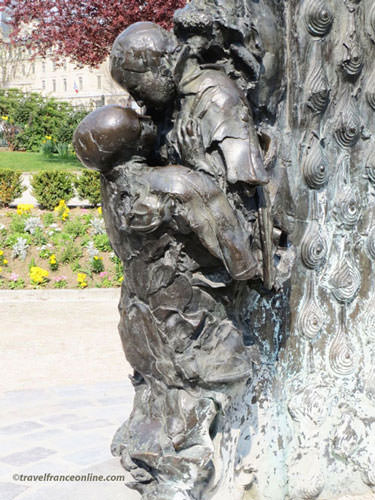
The shape of the Fontaine Saint Julien le Pauvre, sculpted in the image of a triangular tree trunk, along with the sculptures that decorate it, evokes the forest, hunting, and water.
Water indeed flows gracefully from three stag heads, symbolising the river and the passage used by the ferryman to transport souls to the afterlife.
Each side of the fountain is adorned with sculptural groups representing figures and children being guided toward a better world, symbolising both mourning and hope, as well as the benevolence, compassion, and unwavering devotion of Saint Julien-le-Pauvre.
While the fountain may appear unusual at first glance and not appeal to everyone, closer examination reveals the finesse and beauty of its sculptures.
Take a moment to sit on one of the benches near the fountain and let yourself be captivated by the details of the sculptures; you might find that your first impression is transformed.
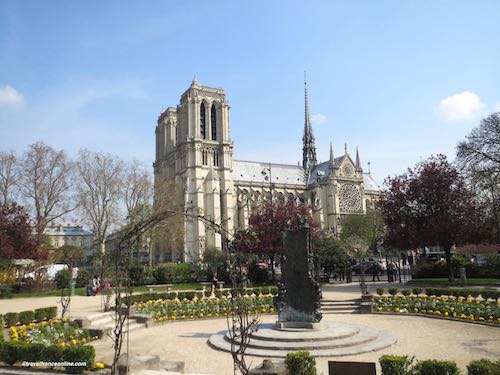
Before leaving, be sure to admire the oldest tree in Paris, a black locust (Robinia in French), planted by the botanist Jean Robin in 1601. Supported by stakes, it stands near the front corner of the church.
Directions: 5th District
RER B station: Saint-Michel Notre-Dame
Coordinates: Lat 48.852306 – Long 2.347748


