Wallace Fountains, a source of free drinking water in Paris
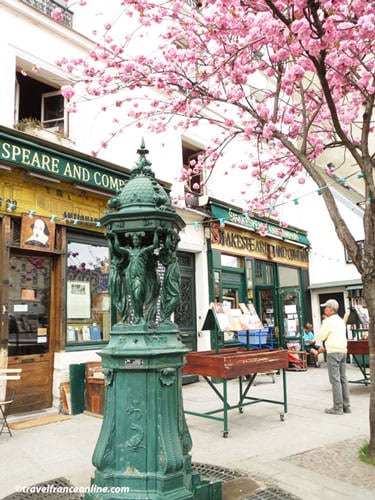
Despite their very English-sounding name, the Wallace Fountains are quintessentially Parisians!
At the end of the 19th century, these elegant public fountains were put into service in the streets and parks of Paris to provide free drinking water.
Many buildings and aqueducts had indeed been destroyed or damaged during the Franco-Prussian War of 1870-1871, when the Russians besieged Paris, and then during the Commune of Paris , the civil war that took place afterward.
As the water supply became expensive, it became imperative to supply the most vulnerable inhabitants, the elderly, the poorest and the working classes, with drinking water.
Sir Richard Wallace, a philanthropist
Sir Richard Wallace,, renowned philanthropist and Paris enthusiast, played an important role in the city’s reconstruction.
He indeed generously funded the creation and installation of public fountains to provide the population with free drinking water. These fountains were named as a tribute to his generosity.
The sculptor Charles-Auguste Lebourg created the Wallace Fountains in the 1870s.
Made of cast iron, they were all painted a uniform dark green to blend harmoniously into the landscape. Recently, a creative initiative was launched to bring these iconic fountains back into fashion.
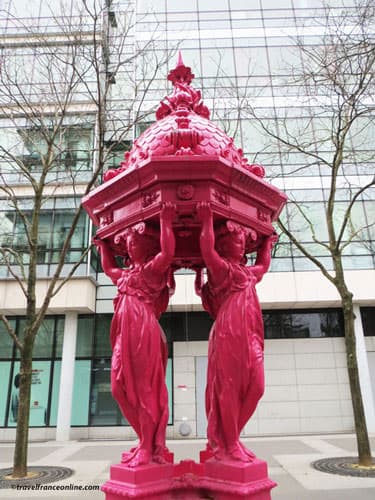
You will thus find three Wallace Fountains of different colours in the 13th district: pink on Rue J. Anouilh, red on Avenue d’Ivry and yellow on Place Verlaine.
Although the Wallace Fountains are not currently listed as historical monuments, like the Morris Columns, it is hoped that they will receive this recognition in the near future.
Wallace Fountains – 4 models
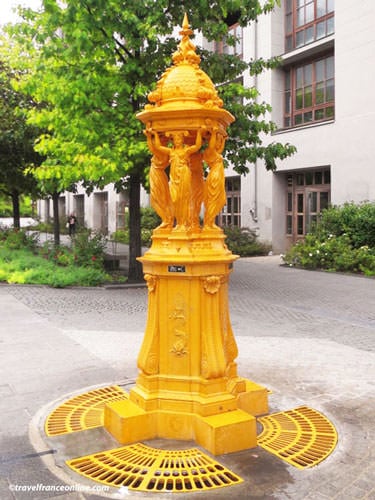
Wallace fountains come in four distinct models: the Large Model, the Applied Model, the Colonnade Model and the Small Model.
The Grand Model, the most commonly found in Paris, was inspired by the Fontaine des Innocents, a masterpiece of the French Renaissance located near Les Halles.
It features four caryatids symbolising Goodness, Simplicity, Charity and Sobriety, placed on an octagonal pedestal. Topped with a pointed dome adorned with dolphins, these caryatids, with their backs to the central column, each adopt a different posture.
The Small Models are a simpler alternative. These push-button fountains are scattered throughout Parisian public gardens, for the greater comfort of passers-by.
The Colonnade model, on the other hand, stands out by its elegance: four columns support a dome that protect the fountain. Unfortunately, only two of these majestic fountains remain.

One stands in Place de Barcelone, in the 16th District, and the second adorns Avenue des Ternes, in the 17th.
The wall-mounted model, so named because of its wall fixing, represents the mouth of a naiad from which water flows into a small basin supported by two columns.
The only remaining model is located on the perimeter wall of the Jardin des Plantes , in the 5th District, at the corner of Rue Geoffroy Saint-Hilaire and Rue Cuvier.
Wallace Fountains have been an integral part of Paris for over a century; Parisians and tourists love them for their beauty and functionality.
That said, please note that they are only in service from March 15th to November 15th to protect them from freezing during the winter.
Photos via Wikimedia Commons: Colonnade Model by Siren-Com CC BY-SA 3.0