
Caverne du Dragon – On site War Museum

The Chemin des Dames Museum, also known as the Musée de la Caverne du Dragon (Dragon’s Lair Museum), is a contemporary glass and concrete structure built near the entrance to the La Creute Quarry.
This limestone quarry, in operation since the 16th century, became the site of one of the bloodiest battles of the Western Front.
Indeed, during the First World War, the Germans transformed this quarry into an underground fortress, naming it Drachenhöhle – Dragon’s Lair – Caverne du Dragon.
After the war, the Caverne du Dragon became a place of pilgrimage for veterans and the families of fallen soldiers.
A Remembrance Site
The museum has been managed by the Aisne General Council since 1995 and was listed as a historical monument in 2006.
It overlooks the valley and the long trench where the French forces were positioned. Two commemorative stelae, placed along the road, pay tribute to the bravery of the 164th Division and the courage of the 4th Zouave Regiment at La Ferme de la Creute.
The museum is also located next to the La Constellation de la Douleur, a sculptural ensemble of nine imposing black wood sculptures, which pays homage to the memory of the Senegalese Tirailleurs who fell on these slopes on April 16, 1917, during the assault on the Caverne du Dragon.
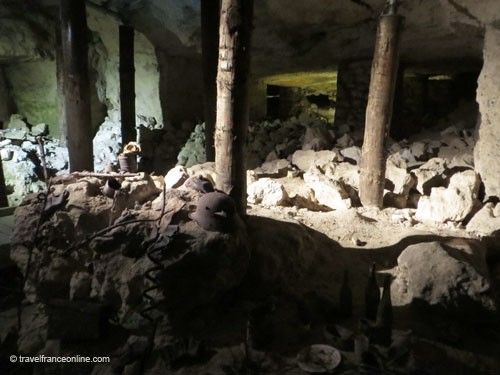
For safety reasons, the Caverne du Dragon can only be visited as part of a guided tour. The quarry had been worked since the 16th century for its limestone, used in the construction of monuments and churches. The marks of the tools used by the stone-cutters are still visible on the walls and ceilings.

However, these walls also bear the deep scars of war, and among the many inscriptions, one stands out:
“Plus de 16 Avril 1917 – No more 16 April 1917.”
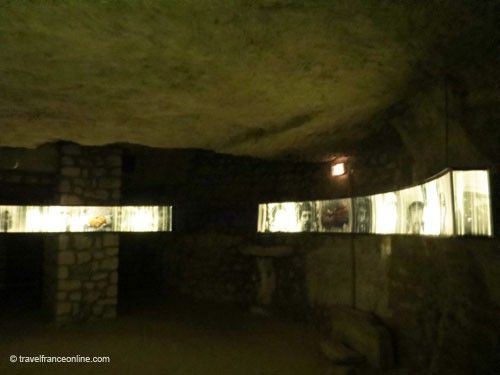
The assault on the Caverne du Dragon, known as the Battle of the Creute, was indeed one of the deadliest of the First World War! Among the objects displayed along the corridors and in the caverns are tools, weapons, and everyday items used by the soldiers who fought and perished there.
One room, converted into a memorial site, is illuminated by the soft light of dozens of memorial electric candles.
The Battle of the Creute
The fierce fighting of January 25 and 26, 1915, took place on a crucial section of the D18 road, known as the Chemin des Dames, between the La Creute farm and quarry, and the Hurtebise farm.

These two farms were situated on a narrowing of the ridge, forming what was called the “Hurtebise isthmus.”
Remarkably, this position was the only one that French forces had managed to hold along the Chemin des Dames, making it a prime target for the Germans, who had occupied the ridge since November 1914.
The Germans launched their attack with a brief but intense artillery barrage, concentrating their fire on the 500 metres band separating the two farms. Their infantry then launched an assault on the French position.
On the morning of January 27, after a two-day offensive, German forces captured the last French position on the Chemin des Dames.

However, the Germans paid a heavy toll for this victory. Tragically, the same was true for the French! Indeed, more than 1,500 French soldiers and 850 German soldiers perished, and another 1,100 French soldiers were taken prisoner.
In a symbolic gesture of triumph and revenge, the Germans renamed the battle the Battle of Craonne of 1915, in reference to the Battle of Craonne in 1814, where Napoleon defeated the Prussian and Russian troops commanded by General Blücher.
After this victory, German forces maintained their positions and control on the Chemin des Dames for months.
Nivelle Offensive

The French counter-offensive, Operation Nivelle or the Second battle of the Aisne, was launched by General Nivelle on April 16, 1917.
It resulted not only in a tragic defeat but also in astronomical casualties.
The French army’s objective was ambitious: to break through the 80-kilometre-long German defensive line stretching between Reims and Soissons by creating a massive breach on the Chemin des Dames ridge.
However, the chances were slim for the French forces. The Germans indeed enjoyed a considerable advantage, controlling both the strategic Chemin des Dames ridge and the La Creute quarry.

Having occupied these positions since the beginning of the war, they had had ample time to fortify their defences, by linking a 500-meter network of underground tunnels to create a formidable subterranean fortress known as the Caverne du Dragon.
These defensive installations also included medical and command posts, electrical and telephone networks, dormitories, food and ammunition depots, various equipment, and essential amenities such as a well and even a chapel.
Perfectly prepared for combat, the Germans were ready to defend the Chemin des Dames against any French attack.

The situation was very different for the French forces, who were positioned some 80 metres below La Creute quarry, in the open!
The French contingent numbered in the thousands, including 15,000 colonial troops, Senegalese Tirailleurs, and Zouaves. The French strategy relied on an intense artillery bombardment aimed at decimating the German lines and allowing the infantry to advance rapidly under the cover of artillery fire along the Chemin des Dames ridge.
But relentless bombardment had transformed the battlefield into a completely exposed, lunar landscape. On the day of the offensive, cold rain and snow slowed the advance of the French colonial troops, who had never encountered such weather conditions in their country.
Positioned in a vast trench at the foot of the Caverne du Dragon, they launched their assault, slipping and falling on the icy slopes under the relentless fire of German machine guns. Disoriented and gripped by panic, they tried to fight their way through the chaos; 1,400 French colonial troops died on that slope on April 16, 1917.
Operation Nivelle was a true disaster! On an 80-kilometre front, 40,000 soldiers were indeed killed or wounded in a single day.
The traumatic nature of this attack plunged the French army into a profound crisis of confidence, provoking widespread mutinies and revolts. Faced with the refusal of many soldiers to return to the front, Marshal Pétain took over command of the French troops on April 25.

Between April 16 and 25, the French forces had suffered 134,000 casualties: 30,000 dead, including 1,400 colonial soldiers killed on April 16; 100,000 wounded; and 4,000 taken prisoner.
Amidst the carnage of the Nivelle Offensive, the German forces also suffered heavy losses, with approximately 168,000 casualties.
In the weeks following the offensive’s failure, sporadic attacks continued as both sides fought for control of strategic positions. It was not until June 25 that the French forces finally managed to capture the Caverne du Dragon.
This was during this decisive attack that the Germans gave the quarry a new name: Drachenhöhle, Dragon’s Lair, in reference to the sinister spectacle of flames leaping from the quarry entrances, evoking the fiery breath of a dragon.
Aisne department – Oulches-la-Vallée-Foulon – Picardie region
Coordinates: Lat 49.441454 – Long 3.732433


