Abbaye Saint-Martin-des-Champs
The Arts et Métiers Museum (Arts and Crafts) was founded in 1794 in the church and former refectory of the monks of the Abbey of Saint-Martin-des-Champs.
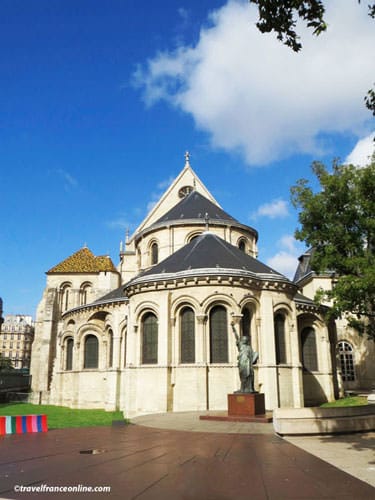
This fortified abbey, and that of the Knights Templar, were for centuries the only settlements on the Right Bank, which was then a vast marsh, hence its name, Marais (Marsh).
The church was built in 1130 to replace a 6th-century basilica. In 1993, restoration work uncovered a necropolis dating from that period; the first sarcophagus discovered is now on display in the ambulatory.
The church presents an harmonious mix of architectural styles. Its original Romanesque chancel complements the 13th-century Gothic features, such as a triumphal arch, painted columns, sculpted capitals, and its 19th-century painted ceiling. Saint-Martin-des-Champs was also the first Parisian church to incorporate diagonal ribs, illustrating a period of transition in architecture. Pierre de Montreuil, the renowned architect of Sainte-Chapelle, reinforced the large refectory with exterior buttresses.
The abbey was confiscated and declared state property during the French Revolution (1789) and was partly demolished. The only remaining vestiges are the church, the refectory, a few outbuildings, a section of the crenellated wall, and a splendid round tower visible on Rue du Verbois.
The forerunner of the Arts et Métiers Museum
Fortunately, thanks to Father Henri Grégoire, many of the abbey’s buildings were spared demolition in 1794, when he proposed converting them to establish the:

‘Conservatoire pour les Arts et Métiers où se réuniront tous les outils et machines nouvelles … On y réunira tous les Arts ‘.
’Conservatory for Arts and Crafts will gather all the tools and new machines…where we will bring all Arts together’.
What would become the Arts et Métiers Museum thus welcomed its first visitors in 1802!
The architect Vaudoyer oversaw the restoration work in 1845, which led to the church and remaining monastic buildings being listed as historical monuments in 1862.
The church underwent further restoration before the First World War to accommodate its growing collections, with the most recent restoration dating from 1993.
The Arts et Métiers Museum now covers 10,000 square metres and focuses primarily on industrial design and the arts and crafts, with 6,000 square metres dedicated to permanent exhibitions. It is divided into seven sections spread across three floors: scientific instruments, materials, energy, mechanics, communication, construction, and transportation. The museum also houses a collection of over 80,000 objects and thousands of drawings.
Arts et Métiers Museum’ Star exhibits
Although it is difficult to list all the works on display, here’s a brief overview of some that particularly caught our attention:
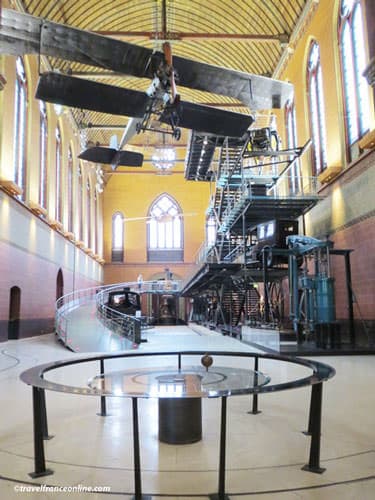
- Since 2000, Clement Ader’s Avion III has been suspended above the grand staircase. The Escalier d’Honneur, a masterpiece of classical architecture, was built in 1740 by Soufflot, the architect of the Pantheon.
- Lavoisier’s Laboratory, a cornerstone exhibit since 1866, pays tribute to the scientist, often considered the “father of modern chemistry.”
- In the automata section, you can admire remarkable works such as the Joueuse de Tympanon (Tympanum Player) by German watchmaker Pierre Kintzing are featured. This complex mechanism depicts a young woman whose arms, head, and torso move in synchronised motions as she plays tunes on an instrument capable of producing eight different melodies!
- Cugnot’s steam-powered Fardier (wagon) is considered the pioneer of self-propelled road vehicles, laying the foundation for all subsequent motorised transport.
- In 1870, Watt designed a steam engine that revolutionised industry, providing aa reliable and powerful energy source that surpassed the limitations of hydraulic power.
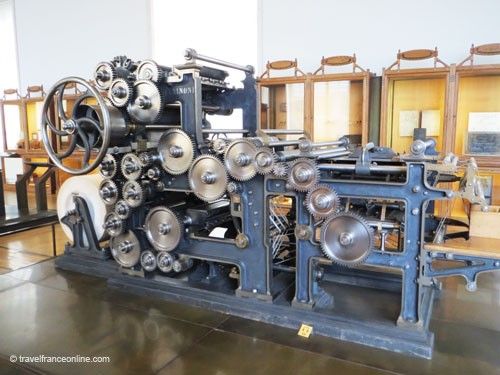
- In 1883, Marinoni revolutionised the printing industry with his type-printing machine, which significantly increased printing speed by using a press cylinder and plates wound around.
- The Couvreux excavator, dating back to 1870, capable of digging in both dry and wet soils. It moved along a specialised three-track service rail that advanced in line with the work being done.
- The Jacquard loom, introduced around 1810, remains a timeless innovation in textile manufacturing.
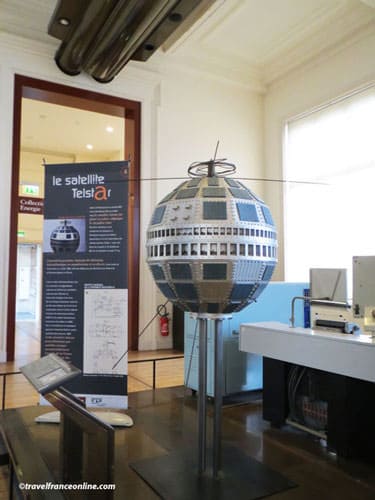
- The Telstar satellite, launched launched into an elliptical orbit on July 10, 1962, enabled the first live transatlantic television broadcast, a historic event marking a significant milestone in global communications.
- Developed by LAAS (Laboratory for Analysis and Architecture of Systems) in Toulouse, the Lama robot was designed for the autonomous exploration of the surface of extraterrestrial planets.
- The Cray-2, a supercomputer, built in 1985, testifies to the rapid progress of technology since its invention.
- Léon Bollée’s Multiplying machine, introduced in 1889, represents a major innovation in computing.
- Among its diverse exhibits, the Arts et Metiers Museum displays remarkable collections of art objects, including vases by Gallé and an electro-gold-plated shield by Boquillon, circa 1850, among other treasures.
Exhibits in the church of the Arts et Métiers Museum

An iconic ‘flying machine”, the Blériot IX Aeroplane that crossed the English Channel on July 25, 1909, is suspended in mid-air within the nave.
Motor vehicles are showcased on an imposing metal structure designed by architect François Deslaugiers in 2000.
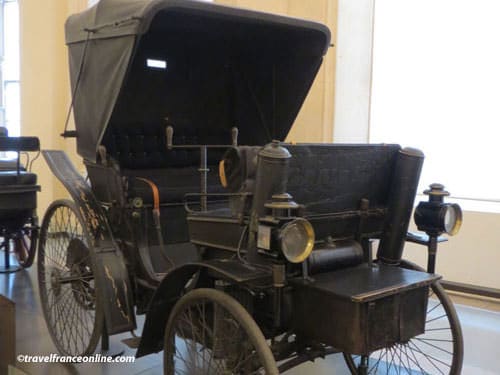
A staircase leads to various platforms where you can admire an 1899 De Dion Bouton, an 1896 Panhard Levassor, the propeller-driven Helica built by Leval in 1921, an 1909 Peugeot Grand Touring, and a counter-weighted steam engine (Beam Engine) invented by Scott in 1860.
You will also find a bronze replica of Bartholdi’s Statue of Liberty exhibited in the centre of the nave.
Finally, you will find a wealth of other models on display in the museum’s Construction section and in the entrance courtyard.
Foulcault’s Pendulum in the Arts et Métiers Museum
One of the most fascinating attractions? Foulcault’s Pendulum in the church’s apse!
On March 31, 1851, physicist Léon Foucault demonstrated the Earth’s rotation using a pendulum.
He indeed suspended a 28 kg lead sphere from a 67 m long cable attached to the keystone of the Pantheon‘s dome, where a replica has been installed.
The similar pendulum, on display at the Arts et Métiers Museum, has a 25 kg sphere made of brass, steel, and lead, suspended from the keystone of the apse by an 18 m long cable.
This pendulum has a period of oscillation of 8.5 seconds, completing a full rotation in 31 hours and 47 minutes at a latitude of 48°50′.
It is subject to two forces: gravity and the Coriolis force.
Opening hours: 10am-6pm
Open at Easter Sunday-Monday, Ascension, 8Mai, Pentecost Sunday-Monday, 14July, 15August, 1st and 11 November
Free entrance on 1st Sunday of the month and Thursday after 6pm
Directions: 3rd district – 60 Rue réaumur
Metro station: Arts et Metiers, Reaumur-Sebastopol on Lines 3, 11
Bus: 20, 38, 39,47
Coordinates: Lat 48.865900 – Long 2.355757
Have a look at Foucault’s Pendulum in the short video below, its’ amazing!