
Newfoundland Memorial Park
The Newfoundland Memorial Park is located between the villages of Beaumont-Hamel and Auchonvillers, along the D73 road.
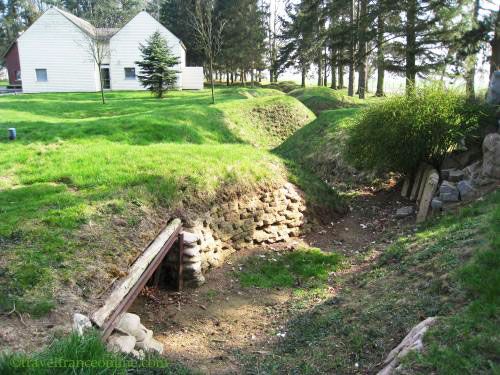
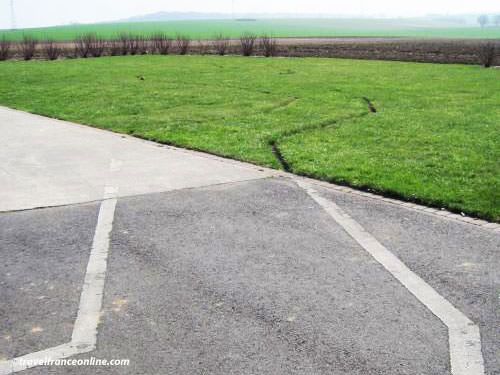
The free parking lot, opposite the park entrance, occupies the Uxbridge Road Trench, which outlines are clearly visible in the asphalt and grass.
The Newfoundland Memorial Park park pays tribute to the men who fought and died on July 1, 1916. Preserved in its wartime state, the battlefield movingly bears witness to the sacrifices made during the First World War.
The Newfoundland Memorial Park’s visitor centre opened on July 1, 2001 and provides a comprehensive presentation of the context and course of the battle. Through various exhibits, including documents, memorabilia, photographs and video clips, you indeed discover the history of Newfoundland and the Royal Newfoundland Regiment’s involvement in the conflict.
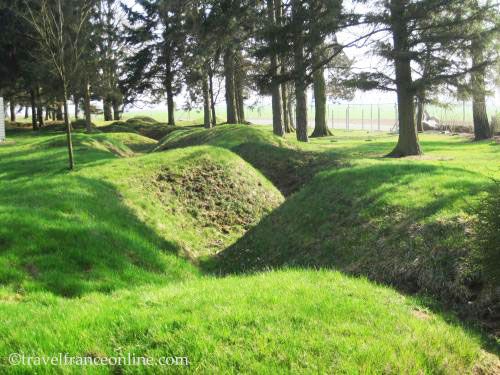
Administered by Veterans Affairs Canada, the park offers free guided tours led by Canadian students.
Newfoundland and Labrador were a former colony and dominion of the United Kingdom until March 31, 1949. It became the 10th province to join the Canadian Confederation under the common name of Newfoundland.
An amendment to the Constitution of Canada, adopted on December 6, 2001, changed the official name of the province to Newfoundland and Labrador. However, most Canadians continue to use both names to refer to both territories.
The Dominion of Newfoundland acquired the territory after the First World War and transformed it into a memorial site.
Royal Newfoundland Regiment – Newfoundland Memorial Park
The Newfoundland Memorial Park honours the soldiers of the Royal Newfoundland Regiment who fought valiantly during the tragic July 1, 1916, offensive.
Dedicated on July 7, 1925, it holds a place of paramount importance as one of the few Canadian national historic sites located outside Canada, alongside the Vimy Ridge Canadian National Memorial.
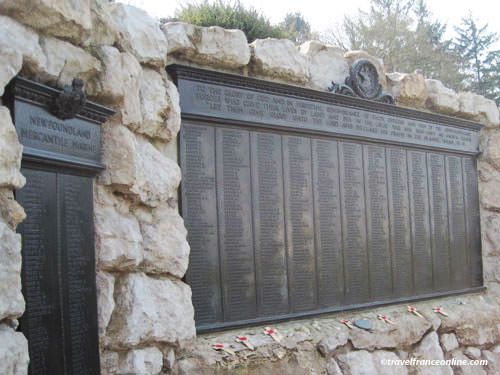
The Newfoundland Memorial Park was designed by landscape architect Cochius. A bronze plaque, at its entrance, bears an inscription and a poignant poem by John Oxenham (1852-1941), immortalising their bravery and devotion:

Tread softly here! Go reverently and slow!
Yea, let your soul go down upon its knees,
And with bowed head and heart abased strive hard
To grasp the future gain in this sore loss!
For not one foot of this dank sod but drank
Its surfeit of the blood of gallant men.
Who, for their faith, their hope,—for Life and Liberty,
Here made the sacrifice,—here gave their lives.
And gave right willingly—for you and me.
From this vast altar—pile the souls of men
Sped up to God in countless multitudes:
On this grim cratered ridge they gave their all.
And, giving, won
The peace of Heaven and Immortality.
Our hearts go out to them in boundless gratitude:
If ours—then God’s: for His vast charity
All sees, all knows, all comprehends—save bounds.
He has repaid their sacrifice:—and we—?
God help us if we fail to pay our debt
In fullest full and unstintingly!
Farther on, a second stone bears a commemorative plaque dedicated to the 29th Division, adorned with the regiment’s insignia: a bright red triangle, a symbol of their unity and strength.
Newfoundland Memorial Park’s Solitary Caribou Memorial
The Newfoundland Memorial Park is both a battlefield and a burial ground, as many soldiers still rest beneath the park’s soil.
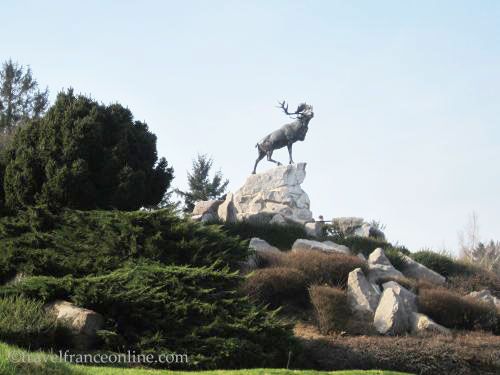
English artist Basil Gotto created the Solitary Caribou Memorial, as the Caribou is emblem of the valiant Newfoundland Regiment.
Perched atop an artificial cairn, the statue of a Caribou is surrounded by native Newfoundland shrubs. Its imposing presence represents a majestic male stag, “standing atop a cairn of Newfoundland granite facing the former foe with head thrown high in defiance.” The Caribou gazes down the slope of the battlefield, where countless comrades in arms lie buried , watching over the missing.
Three bronze plaques, affixed to the base of the memorial, are engraved with the names of the 814 Newfoundlanders who died during the First World War, as well as those whose burial is unknown.
Newfoundland Memorial Park – Offensive on Y Ravine on July 1, 1916
The Newfoundland Regiment played a decisive role in the major British offensive launched on July 1, 1916. This offensive targeted both the German front lines and their rear areas. Before August 1915, this sector was held by the French, but control had passed to the British.
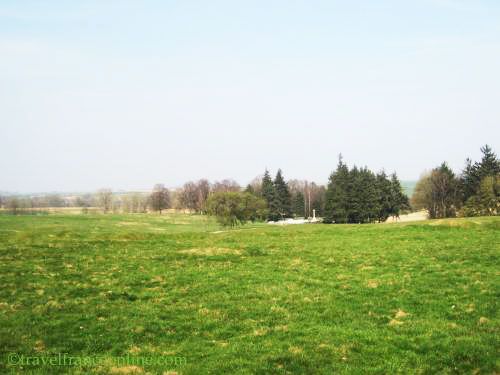
The Germans, entrenched in the Beaumont-Hamel sector from the beginning of the conflict, were mainly miners. Over time, they had meticulously built an extensive network of bunkers and caves, thus fortifying their defensive positions.
The most formidable bunker was nestled in the natural contours of a Y-shaped ravine, at the foot of the hill. The front-line trenches of the British battalions of the 29th Division were positioned on the ridge, at the Lone Caribou Memorial.
The Germans, positioned below in the Y-shaped ravine, enjoyed a considerable strategic advantage thanks to their fortifications.
In the days leading up to the assault of July 1, 1916, British artillery had relentlessly bombarded German defences for seven consecutive days. The objective was to weaken enemy positions and reduce their resistance.
But the German forces, sheltered in their bunkers and caverns, suffered relatively light losses during this bombardment. As soon as the artillery fire ceased, they quickly repositioned themselves in their trenches, anticipating the imminent British attack.
With the bombardment stopped, the Germans took up their machine guns and prepared to repel the assault. At precisely 7:30 AM on the morning of July 1, 1916, ten minutes after the explosion of the Hawthorn mine to the left of their positions, the Commonwealth troops of the 29th Division sprang from their trenches to advance.

Tragically, barely out of their shelter, the soldiers of the 29th Division were exposed and vulnerable, victims of the German defences that awaited them. The advancing soldiers were met with heavy fire from the well-prepared German defences as they descended the slope towards the enemy trenches and machine guns.
The first wave of attackers suffered catastrophic losses, a fate shared by the Newfoundland Regiment, which launched its assault at 9:00 AM. The men were mowed down by enemy fire as soon as they left the trenches, and even those who managed to get out were hit on the descent.
Tragically, many soldiers perished or were seriously wounded before even reaching the German front line. The battlefield where this terrible offensive took place has since become a vast cemetery, where countless men still rest.
Y Ravine Cemetery in the Newfoundland Memorial Park

The men who fell during this tragic attack of July 1, 1916, were buried in makeshift graves on the battlefield.
Their remains were transferred the following year to the Y Ravine n° 1 Cemetery, at the foot of the slope.
Tragically, only 275 of the more than 400 soldiers who fell that day could be identified. It is also believed that the remains of 53 British soldiers and 8 Newfoundlanders still lie beneath the grounds of the memorial park.
The Tree of Danger, preserved in its petrified state, stands silently at the foot of the slope, like a witness to this battle.
Hawthorn Ridge Cemetery in the Newfoundland Memorial Park
Hawthorn Ridge Cemetery No. 2 was opened in 1917. It contains the remains of 200 men who fell on July 1, 1916. Yet, in the grim aftermath of the battle, only 149 of them could be identified. The ridge on which this cemetery now stands once was a desolate no man’s land, an arid buffer zone separating the Allies from the German lines. The British named it Hawthorn Ridge after the solitary hawthorn tree that stood there when they took up positions there in 1915.
Hunter’s Cemetery and Memorial to the 51st Highland Division in the Newfoundland Memorial Park
The capture of Beaumont-Hamel by the 51st Highland Division on November 13, 1916, was a significant victory in the dark context of the war.
The 51st Highland Division Memorial , the work of sculptor George Harry Paulin, represents a Scottish soldier in traditional Highland dress, his solemn gaze turned towards the sacred site of Y Ravine. Inaugurated in 1924, it embodies the division’s spirit and resilience.
The Hunter Cemetery, where more than 40 soldiers of the 51st Highland Division and the 63rd Royal Naval Division are buried, is near the memorial. This circular cemetery, set up in a shell crater, is named after a military chaplain, Reverend Hunter, who fought alongside the regiments of the 51st Division.
Department of Somme – Newfoundland Memorial Park – Picardie region
Coordinates Newfoundland Memorial Park: Lat 50.072523 – Long 2.648016


