Bastille Fortress
Bastille Day, also known as Quatorze Juillet, commemorates the storming of the Bastille Fortress on July 14, 1789, and has been celebrated as a National Day since 1880.
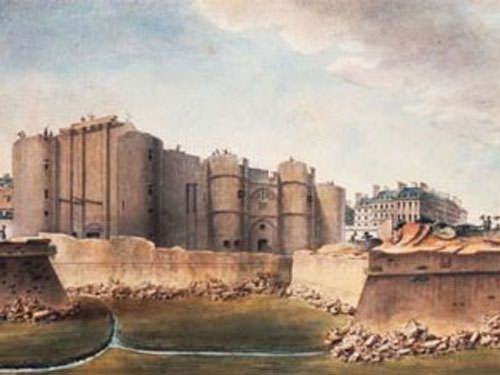
Construction of the Bastille began in 1370. It consisted of eight imposing 24-metre-high round towers, surrounded by wide moats. Originally designed as a military stronghold, it was transformed into a state prison at the end of the 16th century.

On July 14, 1789, only seven prisoners remained there, a paradox since most of them were of German origin and worked as cabinetmakers in the neighbouring Faubourg Saint-Antoine (district). The fortress nevertheless became a powerful symbol of tyranny and oppression.
The storming of the Bastille by 633 revolutionaries marked a decisive turning point in the French Revolution. Demolition began the day after its capture and was completed in 1792. Many of the stones were reused for construction projects, including the Pont de la Concorde (bridge). Some were also used to create 83 models of the fortress, each sent to a French department as a symbol of the monarchy’s end.
Today, the dark cobblestones of the Place de la Bastille mark the outline of the fortress, recalling the events of that historic day. The French National Day is a celebration of liberty, equality and fraternity, embodying the spirit of the French Revolution and the fundamental values of the Republic.
What is Bastille Day?
The national holiday, or July 14th, commemorates not only the storming of the Bastille.
It actually marks the anniversary of theFête de la Fédération, or Festival of the Federations, which took place a year later, on July 14, 1790, on the Champ de Mars.
The Federation Festival was a grand celebration organised to honour the first anniversary of the uprising in great pomp and ceremony. However, in the years that followed, the commemoration of July 14th fell into oblivion. The tragic connotation of the storming of the Bastille was deemed incompatible with the symbolism of liberty, equality, and fraternity.
Bastille Day celebrations were reinstated only after France’s defeat in the Franco-Prussian War of 1870-1871. In 1880, a law was passed to make July 14th a National Holiday, to revive patriotism and celebrate the country’s recovery. Thus, Bastille Day became a day when the French could unite in national pride and attach to their values.
How do French celebrate?
Bastille Day celebrations bring together people from all walks of life. The highlight of the day is the spectacular, meticulously orchestrated military parade on the Avenue des Champs-Elysées. To secure a good spot, it is advisable to arrive early.

French and foreign troops parade from the Arc de Triomphe to the Place de la Concorde, accompanied by an impressive flyover by the Patrouille de France. The parade ends in front of a large canopy where the President of the Republic and his distinguished guests attend the ceremony. After the parade, a garden party is held in the Elysée Palace gardens.
At nightfall, a fireworks display launched from the Eiffel Tower on the Champ de Mars, followed by joyous festivities in the streets.
Since its inception in 1880, the Bastille Day has been synonymous with joyous celebrations: people dance in the streets and party until dawn. The traditional Bal du Quatorze Juillet (July 14th ball) has indeed become a true institution, celebrating French culture through music and dance. And just like in Paris, the evening begins with a fireworks display.
Finally, on a more serious note, Bastille Day is also an opportunity for the President of the Republic to grant pardons.
Photos via Wikimedia Commons: Bastille Fortress in 1420 by Theodor Josef Hubert Hoffbauer (1839–1922) Public domain – Bastille during demolition Public domain – Patrouille de France and Header by XtoF CC BY-SA 4.0