
Cerny-en-Laonnois village
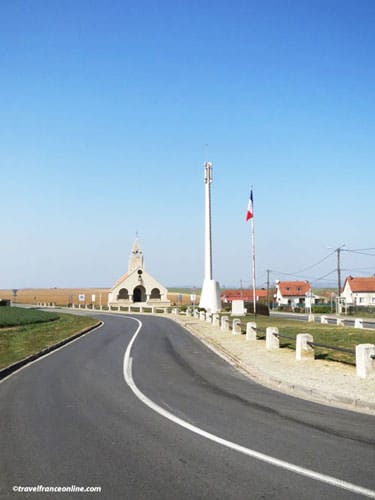
The village of Cerny-en-Laonnois stands on the crest of the Chemin des Dames, at the intersection of the D18CD and D967 roads.
On a clear day, the panorama encompasses the majestic cathedrals of Soissons, Laon, and Reims.
The village boasts a rich history, dating back several centuries, as it was the birthplace of Saint Remi, the first bishop of Reims. More recently, Napoleon stopped in the small village before the Battle of Craonne in 1814, from which he emerged victorious.
However, the most poignant chapter in the village’s history unfolded during the First World War, as it found itself at the heart of the constant offensives on the Chemin des Dames.
Before the outbreak of the Great War, Cerny-en-Laonnois had nearly 200 inhabitants, mainly farmers who worked the land on the surrounding plateau.
Sugar refinery, a German stronghold
The fertile surrounding lands have long been ideal for sugar beet cultivation, making the Aisne the leading sugar beet-producing department in France. Once harvested, these beets were transported to the Cerny-en-Laonnois refinery.
But, everything changed on August 31, 1914, when German forces drove French troops back from the plateau.
From September 5 to 13, Franco-British forces launched a successful counter-offensive in the Aisne Valley, regaining control of the territory between Venizel and Berry-au-Bac and forcing the Germans to retreat to the ridge.
Among the fortified positions held by the Germans was the Cerny-en-Laonnois refinery.
The Allies launched a fierce assault on the refinery between September 13 and 15, but failed to dislodge the German defenders entrenched on the ridge, thus halting their initial advance.
The British then began constructing a network of trenches stretching from Cerny-en-Laonnois to Craonne to consolidate their hold on the region.
Both sides launched relentless offensives until mid-October, culminating in the First Battle of the Aisne, which tragically resulted in heavy casualties.
In early 1915, the Germans reinforced their control of the Chemin des Dames. They fortified not only the plateau and the ridge, but also established a vast network of underground quarries. These vital strategic positions remained in German hands until 1918, determining the course of the conflict in the region.
Cerny-en-Laonnois, a Remembrance site
The village of Cerny-en-Laonnois, along with 18 other villages located on the ridge, was destroyed during the war, leading to the area being designated a “red zone.”
What was left of the original village was abandoned after the war, and a new one was rebuilt in 1924, a few hundred meters away.
The population of Cerny-en-Laonnois today is only half of what it was before the First World War (200 inhabitants), and the café-brasserie Le Poilu is the only business within a 17-kilometre radius.
Despite its small population (100 inhabitants), Cerny-en-Laonnois has become a major memorial site along the Chemin des Dames.
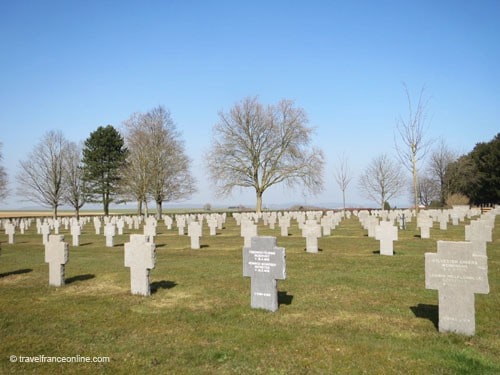
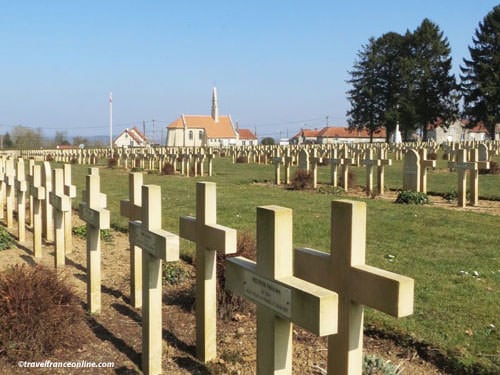
A French military cemetery and a German military cemetery were established after the war, and decades later, four memorials were erected in tribute to the sacrifices made during the conflict.
Chemin des Dames Memorial Chapel of Cerny-en-Laonnois
The Chemin des Dames Memorial Chapel in Cerny-en-Laonnois was built in the early 1950s by the National Union of Veterans, an official organisation that includes former officers, prominent figures from the Catholic Church, the president of the Protestant Federation of France, and the Chief Rabbi of France.
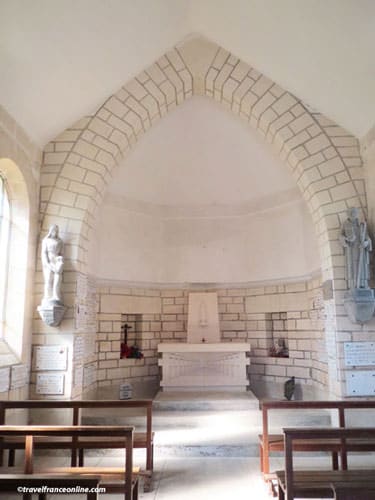
Inaugurated on April 22, 1951, the Memorial Chapel is a place of remembrance that pays tribute to the memory of those who perished during the First Battle of the Aisne (1914), Battle of Chemin des Dames or Second Battle of the Aisne (1917) and the Third Battle of the Aisne (1918).
From its inception, it served as a venue for major commemorations, including the 40th anniversary of the start of the First World War in 1954, and the 45th and 50th anniversaries of the Nivelle Offensive in 1962 and 1967, respectively. Every year in April or May, a religious and military ceremony is held to honour the memory of those who fought and died in the battles of 1917.
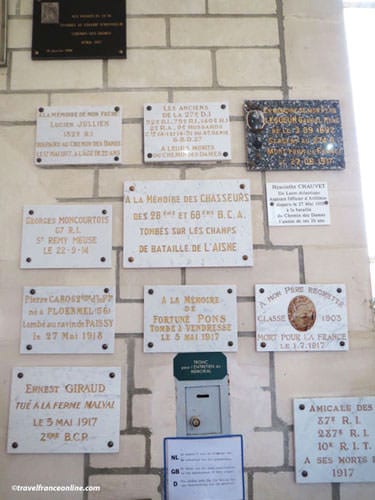
The small Neo-Romanesque chapel was built with the beautiful local cream-coloured limestone, and a statue of the Virgin and Child adorns its facade. Inside, numerous commemorative plaques movingly recall the courage and sacrifice of the soldiers who fell on the Chemin des Dames. The Memorial Chapel underwent a complete restoration in preparation for the centenary of the Great War
Lantern of the Dead
The origin of the Lanterne des Morts – Lanterns of the Dead dates back to the 13th century.
These towers are topped with a mansard-roofed chamber pierced by three openings. At dusk, a light or fire illuminated the chamber, serving as a beacon to guide the souls of the deceased.
The Lantern of the Dead in Cerny-en-Laonnois was erected in the early 1960s, near the memorial chapel, on a small patch of lawn. Its glow pierces the darkness of night, symbolically guiding the souls of the soldiers who fell on the battlefields of the Chemin des Dames.
Visible from the cathedrals of Laon, Reims, and Soissons, the lantern is a poignant tribute, it perpetuates the memory of the Fallen and ensures that their sacrifice is never forgotten.
38th Infantry Division commemorative stele
A stele dedicated to the 38th Infantry Division has been erected in front of the Lantern of the Dead, to pay tribute to the soldiers who fought under the colours of this division.
The inscription commemorates their bravery and sacrifice, particularly highlighting their actions during the September 1914 assault on the Cerny-en-Laonnois sugar refinery, as well as their engagements in April and October 1917.
It bears the following dedication:
“La 38e Division d’Infanterie, groupant les RICM, 4e Zouaves, 4e Mixte Zouaves Tirailleurs, 8e Tirailleurs Tunisiens, 32e RAC, compagnies du Génie 19/2 – 19-52, a combattu en septembre 1914 – Chemin des Dames – Craonne – Heurtebise, en avril 1917 – Cerny – les Bovettes – Heurtebise, en octobre 1917 – Chavignon – Carrières Bohéry – Reprise du Fort de la Malmaison le 23 octobre”. – “The 38th Infantry Division, comprising the RICM (Marine Infantry Regiment), 4th Zouaves, 4th Mixed Zouave-Tirailleur Regiment, 8th Tunisian Tirailleurs, 32nd RAC (Regiment of Artillery), and Engineer Companies 19/2 – 19-52, fought in September 1914 at Chemin des Dames, Craonne, and Heurtebise; in April 1917 at Cerny, Les Bovettes, and Heurtebise; and in October 1917 at Chavignon, Carrières Bohéry, and the recapture of Fort de la Malmaison on October 23rd.”
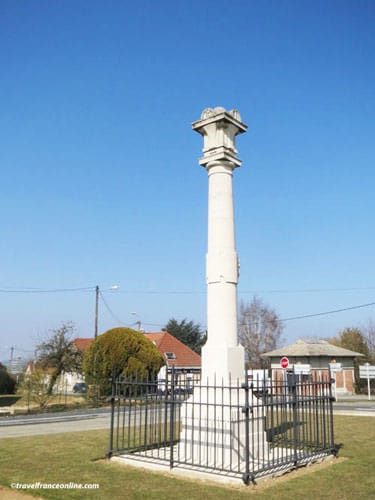
1st Loyal North Lancashire Memorial Column
The memorial column of the 1st Battalion of the Loyal North Lancashire Regiment pays tribute to the soldiers of this battalion who fell in the line of duty during the relentless offensives on the ridge.
The inscription reads:
“En commémoration des officiers, adjudants-chefs, des sous-officiers et des hommes du 1er Bataillon du Loyal North Lancashire Regiment qui sont morts au champ d’honneur pendant la guerre 1914-1919” – “In memory of the officers warrant and non commissioned officers and men of the Battalion Loyal North Lancashire Regiment who laid down their lives on active service 1914-1919 “.
Department of Aisne – Picardie region
Coordinates: Lat 49.442906 – Long 3.667299


