Viaduc des Arts – dedicated to artistic creativity
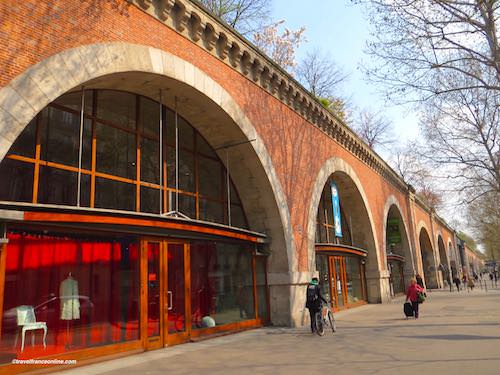
The Viaduc des Arts was built in 1859 to support the railway line that connected the Paris-Bastille station to Verneuil-l’Étang, a town located 45 km east of the Chateau de Vincennes.
The railway line remained in service until 1969, when the station was demolished to make way for the Opera Bastille, which was inaugurated in 1984.
The viaduct then became obsolete. The 71 arcades with large bay windows and wooden frames, located at street level, originally housed railway equipment warehouses and were converted into high-end art and craft workshops and boutiques.
Many artists who have the chance to secure one of these locations choose to set up their studios in view of passers-by, inviting them to observe as they create.
The Viaduc des Arts boasts a prime location and vibrant atmosphere, and is one of the capital’s best-kept secrets.
Coulée Verte René-Dumont or Promenade Plantée

In 1988, the City of Paris entrusted Philippe Mathieux and Jacques Vergely with the landscaping of the upper section of the Viaduc des Arts.
The landscape architects transformed the former railway line into a 4.5 km green way, initially named the Promenade Plantée, and later renamed the Coulée Verte René-Dumont in homage to the late environmental politician.
The Coulée Verte René-Dumont stretches from the Place de la Bastille to the Bois de Vincennes.
The original native vegetation, mosses and lichens, that bordered the tracks, was preserved, while numerous tree and shrub species and flowerbeds were planted.
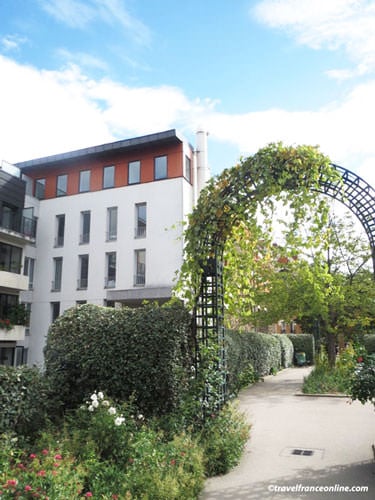
The Coulée Verte René-Dumont offers one of the most beautiful walks in Paris, passing through four charming public gardens: Hector-Malot, Reuilly-Paul Pernin, Gare de Reuilly, and Charles-Péguy.
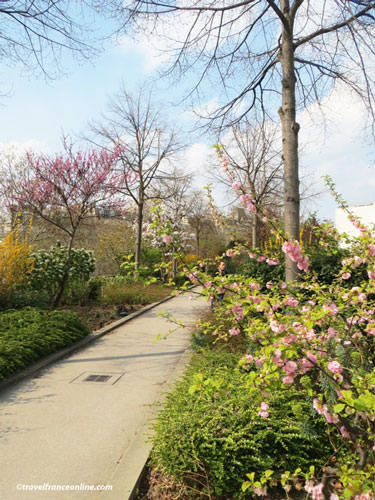
It is mostly located 10 metres above street level, covers a total area of 3.7 hectares, plus 3.3 hectares of gardens, and follows the route of the old railway, highlighting original infrastructure such as bridges, viaducts, embankments, trenches and tunnels.
The walk follows Avenue Daumesnil, continues in front of the town hall of the 12th arrondissement, at No. 130, before joining the BZ/12 footbridge.
Along its route, it crosses the Reuilly public garden, briefly descends to street level via Avenue Vivaldi, and then rejoins the former railway line. It passes through a tunnel under Avenue de Picpus, then splits onto Rue du Sahel.
One route heads towards Porte Montempoivre, passing under the ring road via another tunnel beneath Boulevard Soult, while the other leads to Square Charles Péguy, where it ends.
With its bucolic atmosphere, the Coulée Verte René-Dumont is an excellent place for a Sunday stroll.
Opening hours:
The Coulée Verte René-Dumont is divided in 3 sections that all open at 8am but have different closing hours that vary according to the season.
Section Rue Edouard-Lartet to Avenue Emile Laurent closes at 6pm, 7.30pm or 8.30pm
Section Avenue Emile Laurent to Tunnel de Reuilly: 7pm, 8.30pm ot 9.30pm
Section Jardin de Reuilly to Bastille: 5.30pm, 8.15pm or 9.15pmFacilities: You’ll find a few public toilets at street level and a lift on Avenue Daumesnil.
Dogs are allowed on a lead except on the section running above the Viaduct des Arts.
Bikers will be happy to know that there is a cycle track between the Tunnel de Reuilly and the Bois de Vincennes.
Directions: 12th district
Metro: Bastille, Gare de Lyon, Montgallet
Closest velibs’ stations: #4007 #11001 #4101
Coordinates for Viaduc des Arts and access to Coulée Verte on Rue de Lyon: Lat 48.849605 – Long 2.371083