
Helen’s Tower – One of the first Memorials erected after WWI
The Ulster Tower Memorial stands along the D73 road, just before the junction leading to the Thiepval Memorial to the Missing.
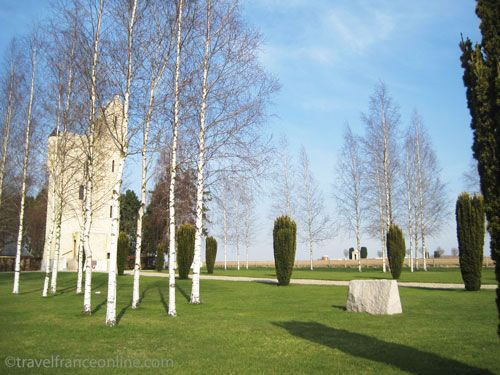
It pays tribute to the courage and sacrifice of the men of the 6th Ulster Division,, who valiantly attacked Schwaben Redoubt on July 1, 1916, the first day of the Battle of the Somme.
Built shortly after the war, the Ulster Tower was one of the first memorials erected.
Field Marshal Sir Henry Wilson inaugurated it on November 19, 1921, in the heart of a landscape still marked by the fighting.
Several prominent figures attended the inauguration ceremony, including the Primate of Ireland, the Moderator of the Presbyterian Church of Ireland, and the President of the Methodist Church of Ireland.
Helen’s Tower – A model for the Ulster Tower
The design of Ulster Tower is very similar to that of Helen Tower, located in the Clandeboye Estate, Bangor, County Down, Northern Ireland. Built in the 19th century by Lord Dufferin in memory of his mother, Helen Blackwood, Baroness Dufferin and Claneboye, Helen Tower held great sentimental value.
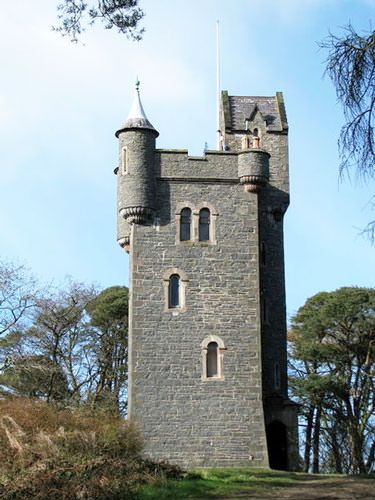
The 36th Ulster Division was training near Helen Tower at Clandeboye, as the estate had been converted into a military training camp. The tower therefore had a profound symbolic resonance for the division. Helen Tower was also immortalized by Lord Alfred Tennyson, a famous Victorian poet, in one of his works:
Helen’s tower, here I stand,
Dominant over sea and land.
Son’s love built me, and I hold
Mother’s love in letter’d gold.
Love is in and out of time,
I am mortal stone and lime.
Would my granite girth were strong
As either love, to last as long
I should wear my crown entire
To and thro’ the Doomsday fire,
And be found of angel eyes
In earth’s recurring Paradise
Schwaben Redoubt
The Thiepval sector was of strategic importance to the German forces during the First World War, due to its location north of the British front.

Perched on a ridge and surrounded by marshes, the village offered an unobstructed view of the Ancre valley and the surrounding area.
From the beginning of the conflict, the Germans built a vast network of fortifications in the region.
These fortifications included redoubts linked together by trenches, shelters and a complex network of tunnels, all protected by formidable machine-gun nests.
Key redoubts in the area included Zollern Redoubt, near the Mouquet Farm in the northwest, Stuff and Leipzig Redoubts in the south, and Schwaben Redoubt, located between the present Thiepval Memorial and Ulster Tower.
These redoubts were strategically positioned along a 2-kilometre line, thus strengthening German defensive capabilities. Over the following months, the Germans continued to fortify and reinforce these defensive positions, thus consolidating their hold on the Thiepval region.

The German defence system at Thiepval was extensive and formidable, with additional machine gun posts strategically placed in the cellars of houses, transforming the village into an impregnable fortress.
However, the Schwaben Redoubt was the most imposing and best fortified among these fortifications. Built by German troops from Swabia at the beginning of 1915, the Schwaben Schanze-Swaabe earthworks included deep galleries linking it to the Zollern Redoubt, near the front-line trenches, and to the village of Thiepval.
Given its strategic importance, the main objective of the Battle of Thiepval Ridge was to capture it. However, to achieve this objective, the Allies first had to neutralise the formidable defences of the Schwaben Redoubt and other fortified positions in the region.
July 1, 1916
The British Commonwealth troops positioned their first line at the edge of Thiepval Wood, the trees growing on the hillside opposite Thiepval Road and behind Connaught Cemetery.
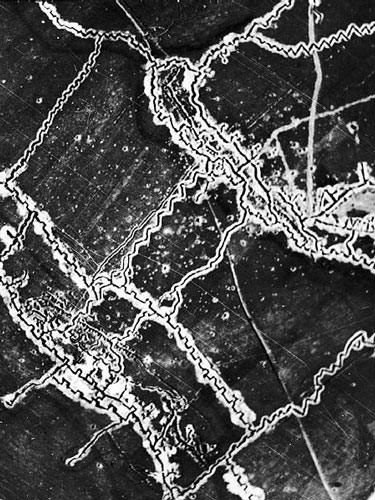
During the offensive, the men of the 109th Brigade made significant progress, advancing 120 metres across no man’s land. They successfully entered the Schwaben Redoubt and continued their advance towards the Stuff Redoubt, gaining approximately 1.5 kilometres of ground on the German lines.
However, the 108th Brigade encountered greater difficulties in its advance towards the village of Thiepval, despite the support of the 107th Brigade.
Despite fierce German counter-attacks, the men of the 36th Division managed to hold their positions. However, they eventually found themselves in a precarious situation, running out of ammunition and bombs, and ended up being surrounded by German lines.
The losses suffered by the 36th Division during the offensive of July 1, 1916, were considerable, with approximately 5,000 soldiers killed.
Ulster Tower Memorial
The commemorative plaque located at the entrance to the Ulster Tower Memorial, unveiled in 1951, pays tribute to the nine soldiers awarded the Victoria Cross during the Battle of the Somme.
Another memorial honours members of the Orange Order who participated in this battle.
It is engraved with the following inscription:
“This Memorial is Dedicated to the Men and Women of the Orange Institution Worldwide, who at the call of King and country, left all that was dear to them, endured hardness, faced danger, and finally passed out of the sight of man by the path of duty and self sacrifice, giving up their own lives that others might live in Freedom.
Let those who come after see to it that their names be not forgotten.”
At the entrance, the Union Jack flies atop a flagpole, a symbol of the memorial’s importance.
The dedicated members of the Somme Association maintain the Ulster Tower Memorial. The acquisition of the 23-hectare Thiepval woods, where the 36th Division launched its assault, was a crucial step for the association. Guides from the association accompany visitors through the excavated and restored trenches of Thiepval Wood, offering them a glimpse into ‘life during the war’.
Objects and personal effects unearthed at the site are displayed inside the tower, thus perpetuating the memory of those who fought. The excavations are continuing, with plans to open more trenches to the public once they have been secured.
Surprisingly, the surrounding countryside bears few traces of the violent battles of the last century. Although the Leipzig Redoubt and the Thiepval wood trenches still exist, aerial views reveal the lasting trace of these trenches across the fields.
Department of Somme – Picardie – Hauts de France region
Coordinates: Lat 50.060772 – Long 2.679814
Photos via Wikimedia Commons: Helen’s Tower by Ross CC BY-SA 2.0 – Attack on Schwaben Redoubt aerial view by No. 4 Squadron RFC Public Domain – Attack on Schwaben Redoubt 1 July 1916 map by Gsl Public domain – Aerial view Thiepval sector via Google Maps


