
The site of the Battle of Passchendaele
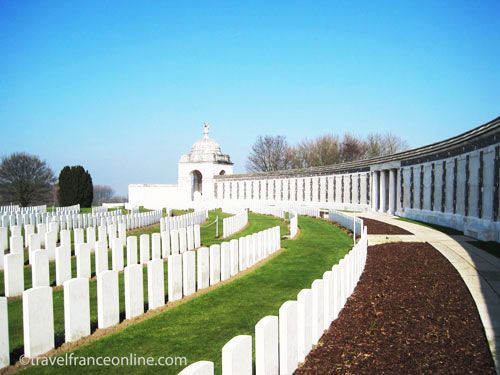
The cemetery at Tyne Cot is located near the village of Passchendaele, about 10 kilometres northeast of Ypres . This region of the western front, delimited by the towns of Zonnebeke and Ypres and the Passchendaele Ridge, was the scene of the Battle of Passchendaele.
Also known as the Third Battle of Ypres, this battle took place from June to October 1917.
The objective of this three-month offensive was to capture a series of ridges located south and east of Ypres, with Passchendaele Ridge being the easternmost.
This ridge was located only 5 kilometres from Roulers, a crucial railway station for supplying German troops.
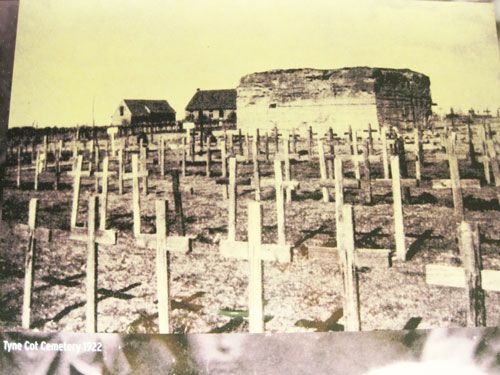
The Tyne Cot Cemetery was established on the slope of the Passchendaele Ridge, in an 8-kilometre area that marked the German front line.
The site, then known in Flemish as Nieumolen, was defended by casemates and barbed wire. British soldiers of the Northumberland Fusiliers regiment nicknamed the place Tyne Cot, because the German blockhouses reminded them of the cottages of Tyneside.
A Canadian division captured the village of Passchendaele. The Australians and New Zealanders captured Passchendaele Ridge on October 4, 1917.
The Germans briefly occupied Tyne Cot Cemetery from April 13 to September 28, 1918.
Tyne Cot Cemetery – Sacrifice Cross
Four German pillboxes originally stood on the site of the current cemetery.
After the ridge’s capture, Commonwealth forces used one of these particularly imposing blockhouses as an advanced aid station.
Soldiers who fell in combat at Passchendaele or died from their wounds were buried near this large pillbox, transforming the site into a field military cemetery.
The human losses during this three-month offensive were considerable: 8,900 British soldiers, 1,350 Australians, 1,000 Canadians and more than 500 New Zealanders perished during the conquest of the ridge.
The four bunkers have been preserved within the grounds of the Tyne Cot Cemetery.
Three have remained in their original state, two of them now being surrounded by poplar trees.

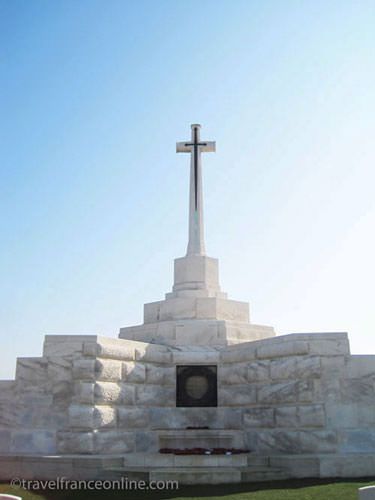
The fourth bunker, the largest, which served as a first aid post, has been turned into a base to support the Cross of Sacrifice.
This impressive monument stands in the centre of the cemetery and overlooks the graves.
A small part of the bunker remained visible at the base of the monument, encased in a bronze wreath.
During his visit to the battlefields in 1922, King George V was indeed so deeply shocked and saddened by the endless rows of white crosses that he suggested erecting the Cross of Sacrifice on the blockhouse as a symbolic gesture.
Tyne Cot Cemetery
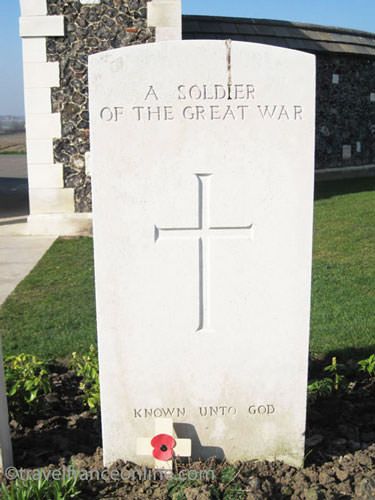
From 1919 to 1921, exhumation companies endeavoured to find soldiers who had fallen in battle and been hastily buried in numerous mass graves in the region. Thanks to their efforts, 11,956 men were buried with military honours at Tyne Cot Cemetery, but unfortunately, 8,369 of them remained unidentified.

Their graves bear the following epitaph:
“A soldier of the Great War, known only to God.”
Tyne Cot Cemetery is the largest Commonwealth cemetery in the world. At the rear of the cemetery stands an imposing wall, the Memorial to the Missing.
King Albert I of Belgium donated the land to the United Kingdom in perpetuity in recognition of the sacrifices made by the British Empire for the defence and liberation of Belgium during the First World War.
The cemetery houses sculptures by Joseph Hermitage and Ferdinand Victor Blundstone, the latter of whom contributed to the Newfoundland National Memorial.

The Commonwealth War Graves Commission maintains the Tyne Cot Cemetery to this day.
The 343 graves located between the Cross of Sacrifice and the Wall of Remembrance are the original field graves, dug between October 6, 1917, and March 1918.
The Commonwealth War Graves Commission maintained the cemetery, designed by Sir Herbert Baker and opened in 1927.
These graves belong to soldiers of the 50th Northumbria Division, the 33rd Division, and two Canadian units.
These tombs were hastily dug, which explains their irregular arrangement. They were left in their original place, and include four German graves, three of which remain unidentified.
Tyne Cot Cemetery Memorial Wall to the Missing
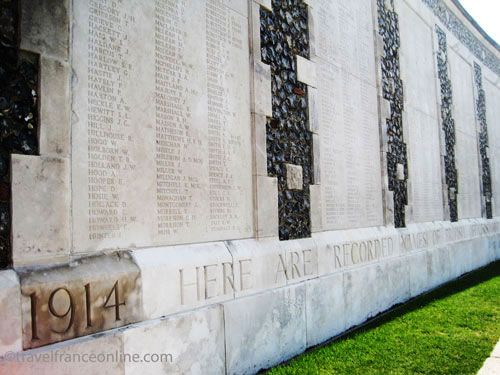
An impressive wall, known as the Tyne Cot Cemetery Memorial Wall to the Missing, marks the northeastern boundary of the cemetery.
It bears the names of 33,783 Commonwealth soldiers and 1,176 New Zealand soldiers who fell in the area after August 16, 1917, and whose identities have never been established.
The New Zealand Commonwealth War Graves Commission has chosen to erect its memorials on the battlefields where its men fell.
However, the New Zealand Tyne Cot Memorial is part of the Wall of Remembrance.

The Tyne Cot Wall of Remembrance lists the names of missing soldiers that couldn’t be engraved on the Menin Gate Memorial in Ypres. Sadly, the Menin Gate proved too small to contain all the names of the missing!
Therefore, an arbitrary deadline of August 15, 1917, was chosen. The names of those who disappeared after that date are engraved on Tyne Cot Wall of Remembrance.
A magnificent rotunda stands at each of the Remembrance Wall. You will find the guestbook in the rotunda near the cemetery interpretation centre.
Tyne Cot Cemetery Interpretative Centre
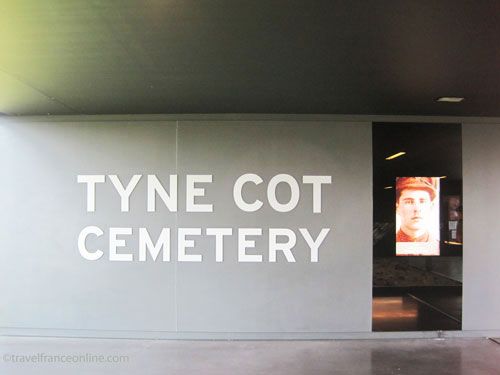
We suggest you visit the Interpretation Centre before exploring the cemetery. Queen Elizabeth I inaugurated it in July 2006 to commemorate the 90th anniversary of the Battle of Passchendaele.
Its construction was financed by the European Commission, the Flemish government, the province of West Flanders, the municipality of Zonnebeke and a private partner, for a total amount of 1.5 million euros.
The building offers a panoramic view of the surrounding hills, the former battlefield of Passchendaele.
The centre displays photos, information panels, memorabilia, military maps detailing troop movements, and various documents relating to the offensive.
An audio recording continuously broadcasts the list of names of all the soldiers buried in the cemetery. When available, their photos appear on a large screen, offering a simple and moving way to pay tribute to the many anonymous soldiers who rest there.
You will also discover the Passchendaele Archives Project, which brings together personal files, photos, service records and family archives to pay tribute to all the missing soldiers who died during the offensive. All the information collected is integrated into an online database.
The project is constantly welcoming new documents and invites anyone whose family member fought and died at Passchendaele or who has documents relating to this battle to contribute.
Archaeologist Peter Barton designed the interactive centre and car park in memory of Private Bert Fearns of the Lancashire Fusiliers, who fought on the site on October 1, 1917.
Another ongoing project, by the Belgian Western Front Association (WFA), aims to partially identify the soldiers buried in Tyne Cot Cemetery by linking them to their original burial sites on the battlefield.
Tyne Cot Cemetery attracts approximately 18,000 visitors each year from all over the world. A visit to Tyne Cot Cemetery and the Interpretive Centre is a deeply moving experience.
James Trott – Yorkshire Regiment 9th Battalion
Among the men killed at Passchendaele was James Trott, of the 9th Battalion of the Yorkshire Regiment. Her great-niece, Carol Thomas, contacted us and here is what she wrote:
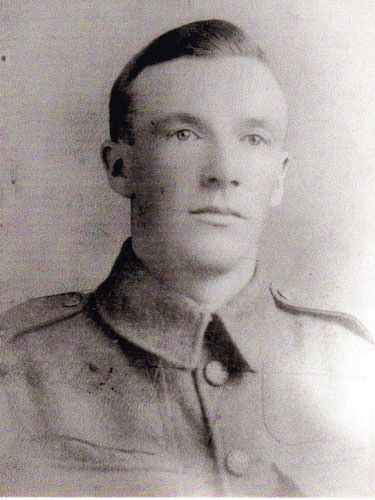
“I am just typing up some memories from my Grandmother that she recorded in the late 80’s.
Apparently her brother James died on the 19th September and had just been home on leave and went back on the last day of August – she says they all had their picture taken together in the station but sadly we don’t have a copy of that.
This is what my grandmother says about that time:
A lot of men had come home on leave, they used to have a farewell party and I was saying to Mum and Dad “Oh we should have a farewell party” and Mother said “Oh no, when he comes back for good, we’ll have a real good welcome home party”.
But he never came back, he was killed on the 19th September.
He was stretcher bearing and he was bringing in the wounded, and the officer wrote to my mother.
To think that he’d never had chance to a sort of live….he was such a nice lad, I’ve got his picture.”
Belgium – Flanders
Coordinates: Lat 50.887420 – Long 3.000690


