
Ypres Salient
The Menin Gate is located on the site of the former Hangoartpoort, one of the city’s medieval fortifications.
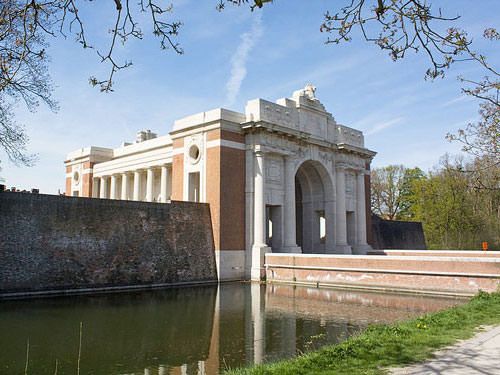
Originally built as part of the defensive system of Ypres, the gate was reinforced by Marshal of France Vauban in the 17th and 18th centuries, thus acquiring its imposing stature.
By the start of the First World War, however, the gate had succumbed to the ravages of time. The Menin Gate is also known as Menenpoort, after the road that led to the nearby village of Menen.
Ypres became a focal point of the conflict, witnessing fierce fighting between Allied forces and advancing German troops.
Located in the heart of the German advance through Belgium, Ypres was of considerable strategic importance. Its capture would have allowed the Germans direct access to the Channel ports, thus enabling them to prevent the landing of British troops.
The Belgian Army valiantly defended Ypres, which was dangerously close to the front line, repelling the German advance in October 1914.
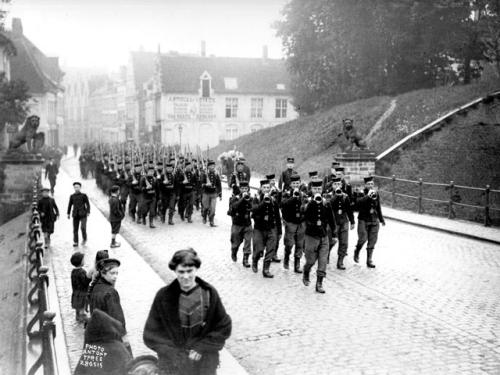
The strategy of the Belgian army, consisting of isolating the western flank of the country by breaching the dikes on the Yser, north of Ypres, played a crucial role in protecting the city from German occupation.
However, despite the relentless assault, Ypres remained the last bastion to resist the enemy advance. This particular geographical configuration of the Ypres sector was known as the Ypres salient. It was indeed surrounded on three sides by German forces; the Salient made the Allied positions inherently vulnerable to enemy attacks.
This extraordinary situation intensified the violence of the fighting and contributed to the considerable human losses during the numerous offensives launched in the region.
The Ypres salient was indeed the scene of five successive battles, each leaving an indelible mark on the landscape and the course of the war.
The First Battle of Ypres, also known as the First Battle of the Flanders, took place between October and November 1914. Despite the Allies’ success in halting the German advance east of the city, the Germans managed to encircle Ypres on three sides, besieging the city and subjecting it to relentless bombardment throughout the conflict.
In the spring of 1915, the Second Battle of Ypres broke out when the Germans launched a new offensive to capture this strategic city.
The Third Battle of Ypres, better known as the Battle of Paschendale, took place from July to November 1917. This monumental offensive aimed to capture the ridge and village of Passchendaele (Passendale), located northeast of Ypres, to establish a strategic bridgehead in the region.
These successive offensives, marked by relentless fighting and staggering losses, sadly show the crucial importance of the Ypres Salient and the unwavering determination of those who fought to protect it.
As a result, by the end of the war, Ypres was nothing but ruins, reduced to a pile of rubble by the incessant assault.
Menin Gate Memorial
The site of the old medieval gate was carefully chosen to accommodate the imposing Menin Arch, a Memorial to the countless soldiers who passed through it on their way to the front.
For many of these British and Commonwealth soldiers, the Menin Gate marked the final threshold before facing the horrors of war. Tragically, of the 300,000 men who ventured beyond that gate, 90,000 never returned.
Designed by Sir Reginal Blomfield and commissioned by the British government, the Menin Gate pays monumental tribute to the 54,389 officers and soldiers of the British and Commonwealth forces who died defending the Ypres Salient before August 16, 1917.
Inaugurated on July 24, 1927, this colossal arch-shaped memorial silently testifies to the scale of the losses suffered in the crucible of war.
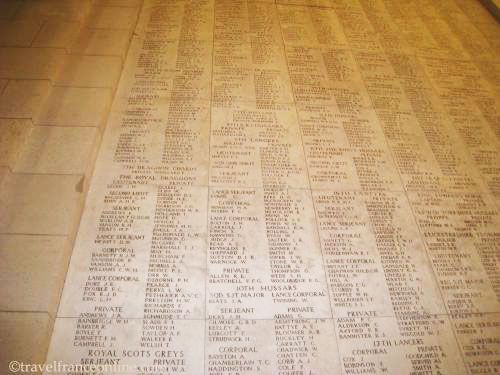
The Menin Gate’s inner walls are engraved with the names of those whose remains were never recovered. The list of names carved in stone is endless…

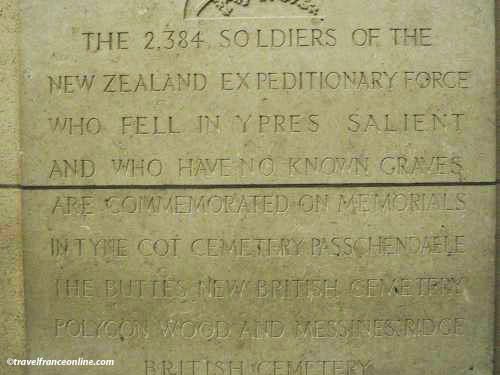
The imposing Menin Gate Memorial didn’t have ‘enough walls space’ to engrave the names of all those who remain Missing. Thus, October 15, 1917, was arbitrarily chosen; The names of the 34,984 soldiers who died after that date were inscribed on the walls of the Tyne Cot Cemetery Memorial to the Missing.
However, the names of the Missing from New Zealand and Newfoundland were engraved on separate memorials erected by their countries.
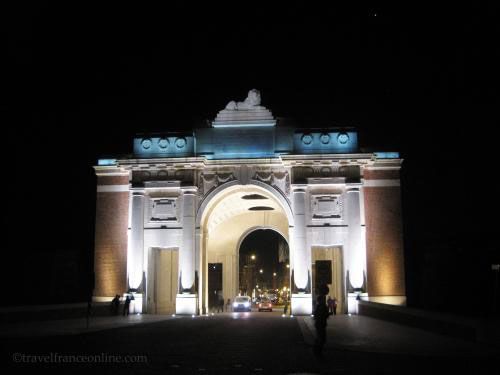
A majestic lion stands on the roof of the Menin Gate Memorial, a symbol of the Unity and Resilience of Great Britain and Flanders.
The monument is also engraved with numerous inscriptions.
One reads as follows:
“Ad Majorem Dei Gloriam (To the greater glory of God) – Here are recorded names of officers and men who fell in Ypres Salient, but to whom the fortune of war denied the known and honoured burial given to their comrades in death”.
This text, as well as the main inscriptions overlooking the east and west facades, is by Rudyard Kipling.
“They shall receive a crown of glory that fadeth not away”, in Latin: “Pro Patria” and “Pro Rege” (‘For Country’ and ‘For King’), and in French and English and dedicated by the citizens of Ypres:
“Erigé par les nations de l’Empire Britannique en l’honneur de leurs morts ce monument est offert aux citoyens d’Ypres pour l’ornement de leur cité et en commémoration des jours où l’Armée Britannique l’a défendue contre l’envahisseur”
“Erected by the nations of the British Empire in honour of their dead this monument is offered to the citizens of Ypres for the ornament of their city and in commemoration of the days where the British Army defended it against the invader.”
The discovery of remains of Missing soldiers is a regular phenomenon.
With each discovery, these Fallen Heroes receive the tribute they are due and are buried with military honours in military cemeteries.
However, sometimes descendants choose to repatriate the ashes of their ancestors, thus offering a deeply personal tribute to their deceased loved ones.
When the soldier’s remains can be identified, his name is removed from the Menin Gate or the Tyne Cot Memorial. However, these cases remain exceptional, especially a century after their death.
Last Post Ceremony
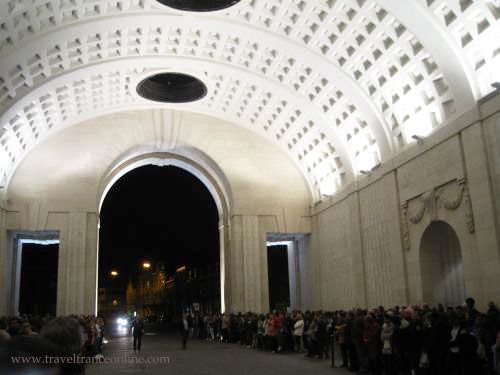
The Last Post ceremony at the Menin Gate pays a poignant tribute to the 54,389 missing British and Commonwealth forces who died to defend the Ypres Salient and the freedom of Belgium.
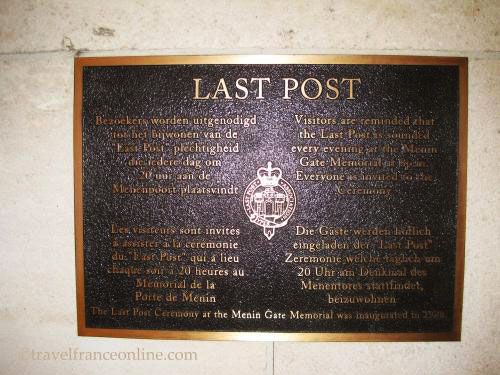
Celebrated every day at precisely 8:00 PM under the Memorial Arch, this ceremony is a cherished tradition in Ypres since July 2, 1928.
Throughout the ceremony, an atmosphere of contemplation and respect is palpable.
The road leading to the Menin Gate is closed a few minutes before the start of the ceremony, with barriers being installed to ensure the safety of the participants. Inside the memorial, the voices of the assembled people echo against the stone walls, creating a murmur of expectation.
However, when the bugles of the local volunteer firefighters arrived, a silence instantly falls over the crowd. They play the haunting notes of The Last Post, followed by a minute of silence, a poignant moment of reflection and remembrance.
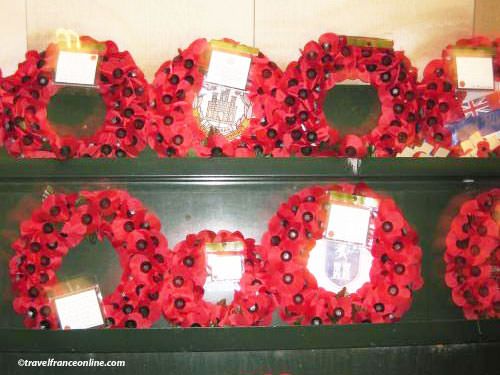
Various organisations place wreaths in the Memorial’s niches. With precision and dignity, the bugles then sound the Reveille, signalling the end of the ceremony. The spectators respectfully dispersed at the sound of the bugles, and the street reopened a few minutes later.
Many people linger to browse the long list of names adorning the walls of the memorial, some searching for the name of a distant relative.
Tip: Attending the Last Post ceremony at the Menin Gate is a deeply moving experience and a must when visiting Ypres. To fully enjoy this experience, arrive around 7:50 PM to secure a prime spot. It is also advisable to book a restaurant beforehand, especially during the holiday season, to avoid being turned down.
Belgium – Flanders – Ypres
Coordinates: Lat 50.851994 – Long 2.891089
Photos via Wikimedia Commons: Gate and river by Johan Bakker CC BY-SA 3.0 – Belgian soldiers at the beginning of WWI by n.d. Public Domain:


