
Germigny des Prés Church, a rare illustration of Carolingian architecture
Germigny des Prés Church is nestled on the banks of the small Bonnée River in the Loire Valley.

The village of Germigny-des-Prés exudes a picturesque charm typical of rural French villages, however, its true renown lies in its remarkable church!
Built at the beginning of the 9th century, it is indeed the oldest known Carolingian church in France and boasts a unique Byzantine mosaic, uncovered during a 19th-century restoration.
Germigny des Prés Church was the oratory of Theodulf, minister to Emperor Charlemagne. It is thus officially known as the Eglise de La Très Sainte Trinité and Oratoire Carolingien de Germigny-des-Prés (Church of the Most Holy Trinity and the Carolingian Oratory of Germigny-des-Prés).
Theodulf, Abbot of St-Benoît-sur-Loire
Theodulf was born in Italy and joined Charlemagne’s court around 782 AD. Renowned for his erudition and theological acumen, he became a trusted advisor and minister to the emperor, wielding considerable power and influence.
Theodulf was also Abbot of Saint-Benoît-sur-Loire and Bishop of Orléans. During his ministry, he actively supported educational initiatives and contributed to the revival of the arts and culture.
He indeed commissioned the monk Alcuin of Northumbria to create a Bible in Carolingian script, a priceless illuminated manuscript known as the Bible of Theodulf.
In 806 AD, Theodulf built a magnificent country estate, complete with an oratory, the current Germigny des Prés, Church, near his abbey of Saint-Benoît-sur-Loire.
However, his fortunes declined after the death of Charlemagne in 814 AD. Having fallen under suspicion, he was deposed by King Louis the Pious, Charlemagne’s son, and imprisoned in Angers, where he died in 820.
Tragically, a few decades later, the Vikings looted and burned his manor during their raids on the Loire.
A Byzantine architecture

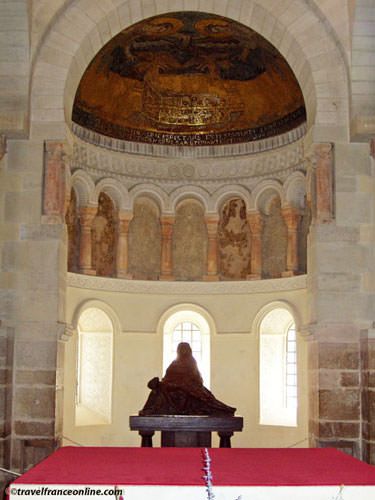
Germigny des Prés Church is a rare and remarkable architectural gem. Built in the 9th century on a Maltese Cross plan with four identical apses, it illustrates Carolingian craftsmanship and innovation at their best.
However, what truly distinguishes the church is its Byzantine architectural style, a rarity in the Loire Valley.
Theodulf indeed commissioned Odo of Messina, a renowned Armenian architect at Charlemagne’s court, to design his oratory, which thus closely resembles the cathedral of Echmiatzin in Armenia.
Germigny des Prés Church’s decoration also bears the mark of Byzantine aesthetics, with a lavish use of gold and silver.
Mosaic of Germigny des Prés Church
Although the sumptuous mosaics, stucco work, marble, and porphyry floors that once adorned the walls of the church in Germigny-des-Prés have long disappeared, one remarkable element remains: the original mosaic that decorates the apse dome.
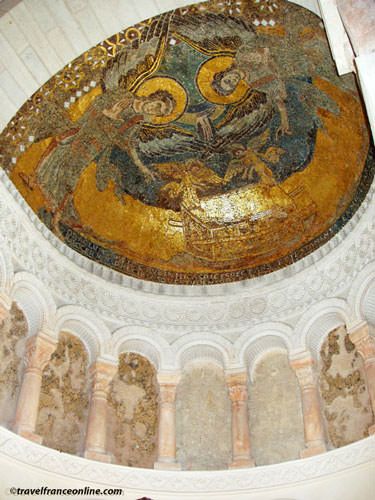
It is believed that this mosaic was over three centuries old when Theodulf acquired it in Ravenna. It likely came from the palace of Theodoric the Goth, king of Italy, in the 6th century.
Composed of 13,000 cubes of coloured glass, the mosaic depicts the Ark of the Covenant, with the Hand of God in Heaven and two angels on either side. A dedication, added by Theodulf, surrounds the composition in silver letters on a blue background.
The preservation of this exceptional mosaic is due to a fortunate accident. Monks had hidden it under several layers of plaster to protect it from destruction during the French Revolution. However, over time, the plaster crumbled, revealing the mosaic during the restoration work in 1840.
Amazingly, the church has also preserved its 9th-century stained-glass windows.
Germigny des Prés Church
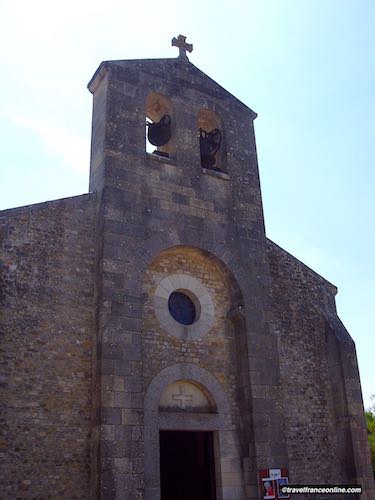
Germigny des Prés Church remained in ruins until the 15th century when the nave was rebuilt and the chruch became the parish church.
While much of its original splendour had vanished, some vestiges remained, such as the visible plan of the western apse. It also houses an exquisite early 16th-century wooden statue depicting Sainte Anne teaching the young Virgin Mary to read.
However, the restoration was not without its challenges. In the 1840s, during work overseen by the architect Lisch, much of the original structure was lost, except the eastern apse, which housed the precious mosaic.
Despite this setback, the reconstruction efforts strove to respect the church’s original plan, using a model of the original oratory as a guide.
Finally, a stone Lantern of the Dead was erected in the 16th century along the path that crosses the gardens located behind the church.
Department of Loiret
Coordinates Germigny des Prés Church: Lat 47.846218 – Long 2.266488


