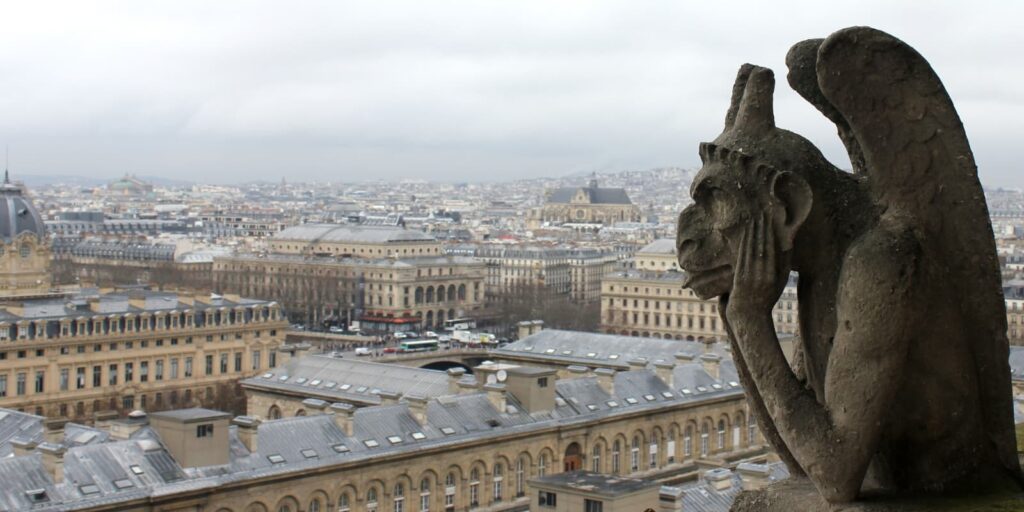
Saint Louis en l’Isle Church dedicated to King Louis IX

The construction of the Saint Louis en l’Isle Church spanned several decades, reflecting the difficulties and delays inherent in the ambitious architectural projects of the time.
Originally designed to meet the need for a larger place of worship on Île Saint-Louis, the construction of the church was interrupted due to financial constraints and changes in architects.
François Le Vau‘s initial plans were indeed delayed, and work on the foundations didn’t start until 1645.
Further setbacks followed, and it was not until 1664 that the Archbishop of Paris laid the first stone, inaugurating a new phase of construction under the direction of the architect Le Duc.
Despite the progress made, the project faced adversity, notably the collapse of the roof in 1701, which required the intervention of architects Bullet and Doucet to oversee its completion.
The nave was finally completed in 1723, followed by the transept and the dome two years later.
Jean Caulet, Archbishop of Grenoble, consecrated Saint Louis en l’Isle Church on July 14, 1726.
The church is indeed dedicated to Louis IX. Renowned for his piety and devotion, the king left a profound legacy, which led to his canonisation in 1297 as Saint Louis of France.
Legend has it that Louis IX sought refuge and spiritual inspiration on Île aux Vaches before departing for the Eighth Crusade.
The island was later renamed Île Saint-Louis. Saint Louis died of the plague off the coast of Carthage (Tunisia). Saint Louis en l’Isle is therefore twinned with the Cathedral of Carthage.
Saint Louis en l’Isle Church post Revolution

Saint Louis en l’Isle Church was closed during the French Revolution. It was looted, its furnishings destroyed, statues broken and metal objects melted.
Surprisingly, the revolutionaries spared the statues of Sainte-Geneviève (patron saint of Paris) and the Virgin Mary which they transformed into symbols of Liberty and Equality!
The church was declared state property in 1798, but bought back by a devoted parishioner who allowed the former priest to celebrate clandestine services there.
Pope Pius VII celebrated Mass there on March 10, 1805, during his stay in Paris for the coronation of Napoleon I. The walls were covered with Gobelin tapestries to conceal the damage caused by the Revolution.
A commemorative plaque, placed behind the altar, recalls this event. The city of Paris acquired the church in 1817, and the old priest celebrated masses until 1821.
A wealth of Baroque decoration
The exterior of Saint Louis en l’Isle Church is not particularly attractive!

Its 30-metre-high bell tower replaced the original tower, which was struck by lightning in 1740.
Its round openings have a practical function: they allow the tower to withstand the strong air currents frequently found along the Seine. The clock, however, adds a touch of elegance to an otherwise understated exterior.
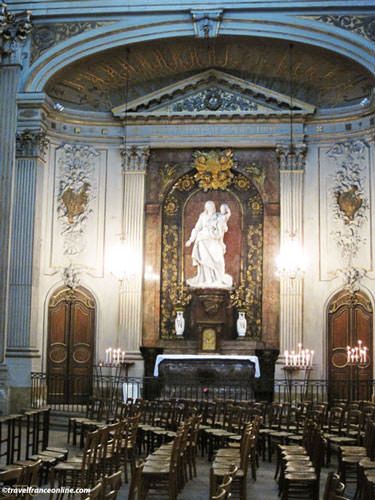
But once inside, the church reveals all its splendour.
Louis Auguste Napoléon Bossuet, who was the parish priest of Saint Louis en l’Isle Church in 1864, spent a fortune purchasing the lavish Baroque decorations.
He acquired many paintings and sculptures recovered from churches that were closed or destroyed during the Revolution.
Among these treasures are magnificent woodwork and gilding, a remarkable 14th-century alabaster bas-relief depicting the Nativity of the Virgin Mary, and a magnificent embroidery from Longchamp Abbey.

The abbey, founded by the sister of King Saint Louis, was destroyed during the Revolution.
Bossuet also acquired eight small 16th-century paintings on wood, which now adorn the Chapelle des Fonts Baptismaux (Baptistery Chapel). They depict scenes from the life of Christ, including the emblematic Notre-Dame du Secours Perpétuel (Our Lady of Perpetual Help).
This revered icon depicts Christ in the arms of the Virgin, while Our Lady watches over him, flanked by the archangels Gabriel and Michael, holding the instruments of the Passion.
The City of Paris contributed to the financing of the stained glass windows, and the famous organ builder Bernard Aubertin was commissioned to create a magnificent Baroque organ for the church. This instrument makes Saint Louis en l’Isle Church one of the most renowned venues for sacred music in the capital.
Saint Louis en l’Isle Church’s prestigious parishioners

Throughout its history, Saint Louis en l’Isle Church has attracted the attention of prominent figures and renowned people.
In 1678, the famous playwright Jean Racine had his son baptised there. Famous architects, includingChampaigne, who contributed to its decoration, were buried there, and Le Vau, famous for his work at Versailles, took his vows in the church.
More recently, Marie Curie and President Georges Pompidou, who both resided on the island, found comfort and spiritual reflection there. Saint Louis en l’Isle Church was listed as a historical monument on May 20, 1915.
Tip: Île Saint-Louis is connected to Ile de la Cité; It is therefore possible to visit both during the same visit.
Saint Louis en l’Isle Church is one of the 25 Paris churches I have selected for you.
Directions: 4th district
Metro: Cité on Line 4 or Sully-Morland and Pont-Marie on Line 7
Coordinates Saint Louis en l’Isle Church: Lat 48.851317 – Long 2.357686