
Who was Saint-Gerbold?
Although part of his life is shrouded in mystery, Saint Gerbold is venerated for his miracles and unwavering devotion.
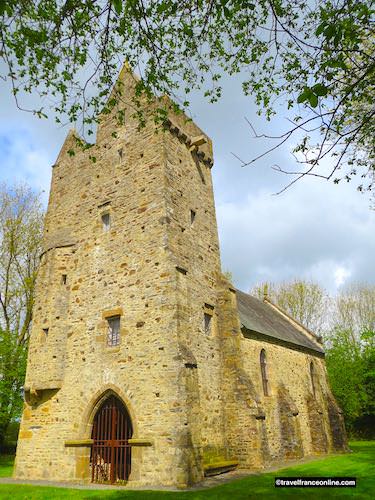
Born in Calvados, probably in Caen, he went to England, where he served a wealthy lord. However, his fate took a dramatic turn when he rejected the advances of the lord’s wife, leading to false accusations and a cruel punishment: being tied to a stone wheel and thrown into the sea.
The stone miraculously transformed into a boat and guided him safely to the shores of Ver-sur-Mer, near Bayeux. There, he embraced the solitude of the hermit. But this peace was short-lived, for the people of Bayeux soon discovered the miraculous journey of the stone wheel and sought to elevate Gerbold to the rank of bishop.
However, his inflexible and austere morality alienated him from the people, and he had to renounce his episcopal duties. In a bold act of defiance, Gerbold threw his episcopal ring into the river, vowing not to return unless it was found. By a stroke of luck, a fisherman caught the fish that had swallowed the ring. Thus, Gerbold made a triumphant return and resumed his episcopate, and as if by magic, managed to end a terrible epidemic of dysentery.
Gerbold died in 695; his relics are kept in the Church of Saint-Exupere in Bayeux and in the church of Petit-Celland, east of Avranches, in the Manche department.
Saint-Gerbold Chapel became a hermitage
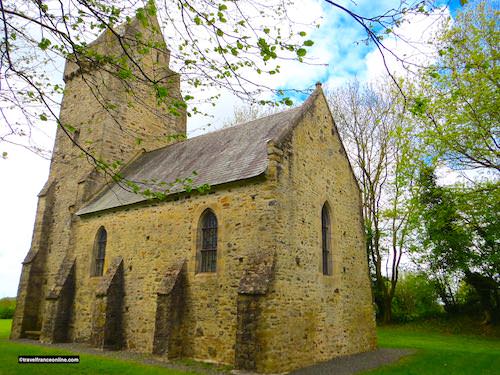
The Saint-Gerbold chapel was built in 1451 by the Argouges family, lords of Gratot, and was transformed into a hermitage in 1620. The Argouges family likely dedicated the chapel to the saint because of their connection to the city of Bayeux, their ancestral home.
The Saint-Gerbold hermitage was once fortified, and vestiges of the enclosure that once protected it can still be seen today.
The Argouges family chose them the hermits from among the priests who officiated in the church of their castle. These had a room within the castle to rest in after their services before returning to the hermitage. However, even if the legend even mentions the existence of an underground tunnel connecting the two buildings, there is no proof that Gerbold was ever attached to the Château de Gratot.
The hermits of Saint-Gerbold Hermitage
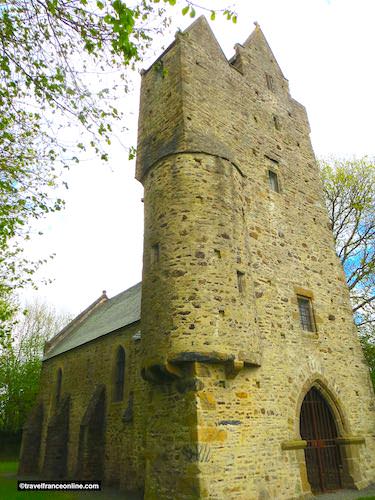
The seven priests who led the Saint-Gerbold hermitage up to 1830 were renowned for their pious lives. Although tradition holds that they were buried in the vegetable garden after their deaths, this remains uncertain.
What is certain is that these hermits, from mendicant orders such as the Franciscans, Dominicans, and Augustinians, had taken vows of poverty.
However, despite their isolated communal life, they were deeply committed to their religious duties and shared fellowship with other hermits.
Placed under the authority of the Bishop of Coutances, they celebrated Masses in honour of Saint Gerbold at the hermitage, while also attending services at the church in Gratot Castle on Sundays and holidays.
On Saint Gerbold’s Day, they perpetuated the tradition by offering two masses and presenting a capon to the Lord of Gratot, in homage to their revered patron saint.
Restoration of Saint-Gerbold Hermitage
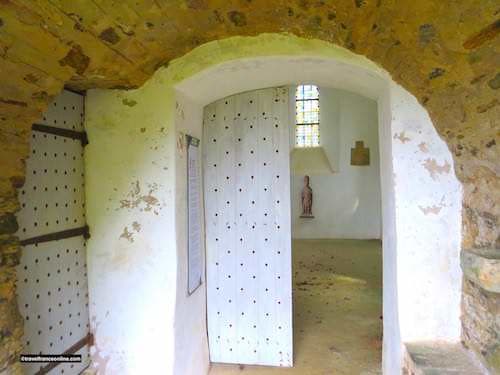
The Saint-Gerbold Hermitage was seized and sold as national property during the French Revolution, but Guillaume d’Ouessey, Lord of Gratot, recovered it at the beginning of the 19th century.
However, the hermitage changed hands several times after his death in 1830. It quickly fell into disrepair, and by 1878, the chapel was in complete ruin. The nave vault collapsed in 1947, and the porch was demolished in 1975.
Fortunately, the hermitage was listed as a historical monument in 1995, and the General Council of the Manche department acquired it in 2000, and engaged in major restoration work.
An exquisite statue of Saint Gerbold, dating from the 15th century and bearing traces of its original paint, was unearthed in the nave during this work. Probably hidden by parishioners during the French Revolution to preserve it from destruction, the statue is now kept at the abbey of Hambye, southeast of Coutances.
Department of Manche – Off D74 – Route de l’Ermitage – Gratot – car-park in field next to it
Coordinates: Lat 49.070912 – Long -1.474409


