
Vestiges of the medieval Château de Gratot
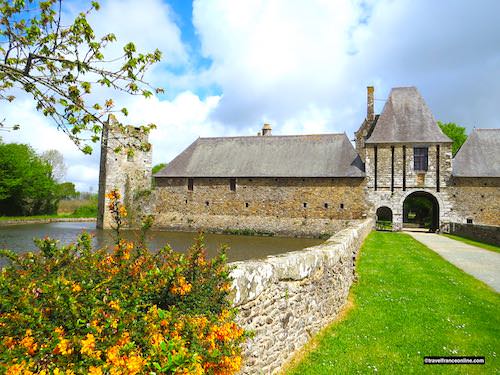
Although partially in ruins, the silhouette of the two large towers of the imposing Château de Gratot is impossible to miss from the D244 departmental road that runs alongside it today.
Built on the foundations of a 13th-century fortified house, constructed by the Argouges family, the castle retains traces of its medieval origins.
Remarkably, the north side of the fortifications blends harmoniously with the more recent structure, thus preserving an impression of continuity across the centuries.
The original ramparts once surrounded the church and the castle farm, now located beyond the deep moat.
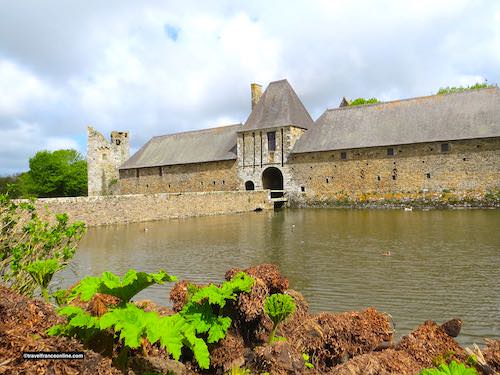
Only the gates and massive doors remain of the drawbridge, now replaced by a stone bridge.
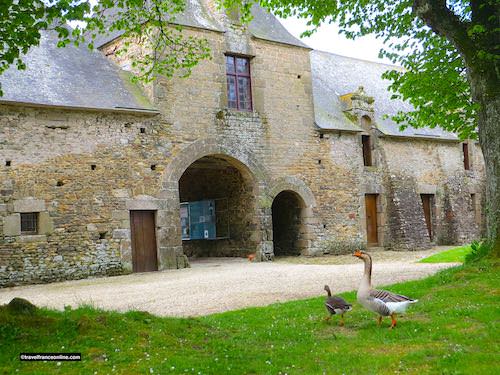
Other surviving remains of the fortifications include the Tour Ouest – west tower, which originally served as the main entrance and was part of the rampart. It now stands next to the guardhouse and the outbuildings erected in the 16th century.
This building housed the stables and farm equipment. Its dormer windows, adorned with granite spheres and a half-sun motif, symbolised the social status of the owners and conferred certain privileges upon them.
Chateau de Gratot, home to the Argouges family for 5 centuries
For five centuries, the imposing Château de Gratot was the residence of the Argouges family. Sixteen generations indeed succeeded one another from 1251 to 1711, carefully embellishing and enlarging it over the centuries.
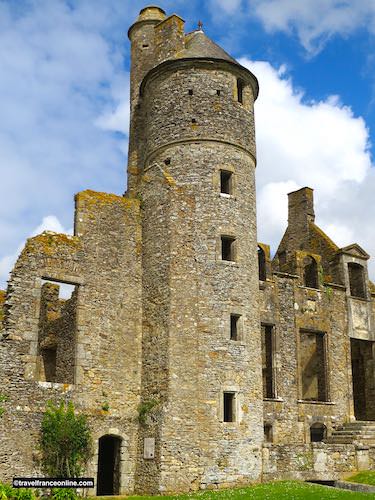
The Argouges erected the emblematic watchtower, Tour Ronde – Round Tower, in the 15th century, during the Hundred Years’ War.
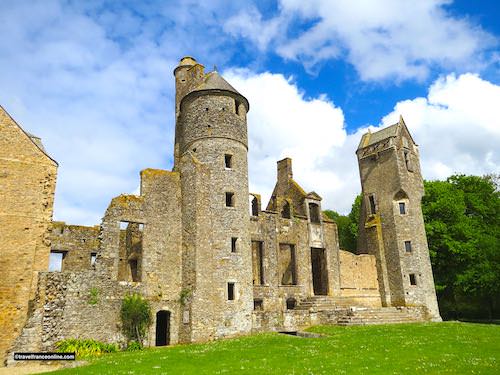
During the Renaissance, they transformed their old feudal castle by adding the elegant Tour à la Fée – Fairy Tower.
They also landscaped the park and widened the moat to allow for boating. The Petit Pont – Little Bridge, a beautiful four-arched stone bridge, dates from this period and led to former French-style gardens, now lost.
The guardhouse and outbuildings were constructed in the 16th century.
Marquis Jean-Antoine d’Argouges had the elegant pavilion built in the 18th cnetury when the fiefdom of Gratot was raised to the rank of marquisate.
However, the Argouges family encountered financial difficulties, forcing them to sell their ancestral castle to Bishop Talaru de Chalmazel of Coutances.
Revival of the Chateau de Gratot
For the next 150 years, the Château de Gratot experienced tumultuous successions, marked by conflicts and financial difficulties, which ultimately led to its slow decline.
The estate was thought to be on the brink of ruin when a Parisian publisher acquired it in 1910, but renovation plans were tragically interrupted by his untimely death.
However, Jean Tiphaigne, the château’s devoted tenant farmer, undertook its revival by purchasing it in 1925. With determination and perseverance, Jean’s descendants, supported by dedicated volunteers, embarked on a vast program of rehabilitation and preservation of the château in 1968.
The restoration program is funded exclusively by admission fees, cultural events, and festivals held at the château. Today, several key structures, including the 18th-century pavilion, the Tour à la Fée, the Tour Ronde and the outbuildings, have thus been restored.
Legend of the Tour à la Fée
And of course, a castle wouldn’t truly be a castle without its legend!
The Tour à la Fée is a remarkable example of Bessin region architecture, a style introduced to Gratot by the Argouges family, originally from the town of Bayeux.
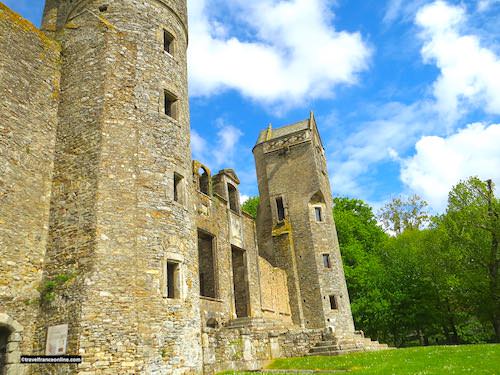
Erected at the end of the 15th century, this Renaissance stair tower is characterised by its octagonal base and square upper chamber. It is adorned with two finely crafted balustrades, one decorated with acanthus leaves and the other with four-petaled roses and a gargoyle, and a gabled roof.
A true thoroughfare within the castle, the extraordinary Tour à la Fée occupies an important place in the history and legends of Gratot, inspiring tales of mystery and magic that endure to this day.
Legend indeed tells the story of a Lord of Argouges who, returning from the hunt, saw a mysterious and beautiful young woman bathing in a fountain, but who vanished as if by magic at the sound of his horse’s hooves.
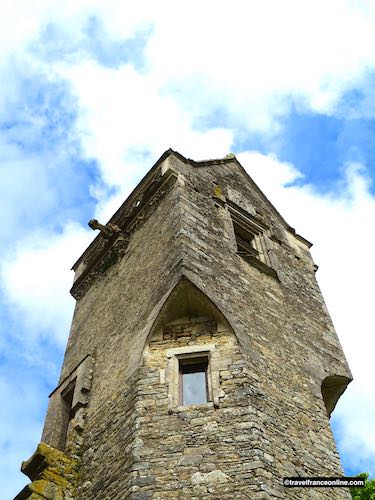
Intrigued and captivated, the young lord returned to the fountain day after day, patiently awaiting the young woman’s return. Finally, she reappeared, and he declared his love and asked her to marry him.
However, Andaine was a fairy, and she agreed to become his earthly wife on the condition that he never utter the word “death.” The young lord consented, and for seven years, the couple lived in perfect happiness until the day they organised a tournament in the castle courtyard.
But as Andaine was late in arriving, her impatient husband called out from the tower: ” “Dame, etes lente en vos besognes, seriez bonne à aller querir la mort – Lady, you are slow in your work; you would be better off seeking death.”
With these words, the fairy let out a piercing cry before climbing onto the windowsill and vanishing, leaving behind the imprint of her hand and foot, still visible today. Legend says that on stormy nights, the echo of Andaine’s voice can still be heard at the foot of the tower, whispering these haunting words: “Death! Death!”
Castle of the Lords of Argouges
In the 15th century, the Argouges family replaced their medieval fortress with a grand château.
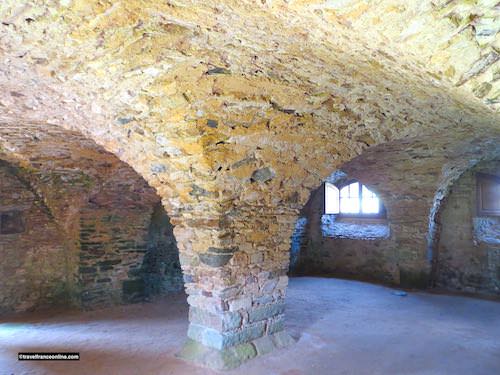
In the 17th century, they undertook significant renovations, transforming the facade with large windows, stucco work, and finely crafted woodwork, as well as dormer windows in the attic. A grand exterior staircase was built to provide access to the reception rooms, contributing to the château’s splendour.
Comprising fifteen rooms, the château housed the bedrooms and living quarters on the upper floors, while the cellars contained the kitchens, storerooms, and laundry. These cellars underwent numerous modifications and reinforcements over the years to accommodate the evolving structure of the château.
Unfortunately, the castle was ravaged by fire in 1800. The remains of this structure, which once had three storeys, still stand today, linking the Tour à la Fée, the Tour Ronde and the imposing North building, a remnant of the original 13th-century fortified house.
Tour Ronde – Tour de l’Horloge
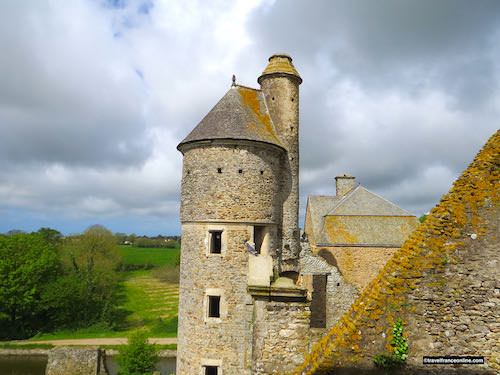
Built in the 15th century, during the Hundred Years’ War, this watchtower, topped with a distinctive pepperpot roof, was a crucial stronghold for the castle.
The upper room, where the guards lived, still retains traces of murals depicting men in armour.
A true crossroads of the castle, this stair tower facilitated movement between all the floors and the cellars, and was the scene of constant activity. The steps, worn by time, were regularly replaced with new flagstones to ensure their continued functionality.
It is also known as Tour de l’Horloge – Clock Tower, as it once housed an imposing clock, complete with its ropes, weights, and tools.
18th century Pavilion
Built in the early 18th century, the pavilion is the last addition to the château.
It stands between the main building of the castle and the Tour Ronde. This elegant classical building features a mansard roof and triangular pediments adorned with round windows.
The Château de Gratot was listed as a historical monument in 1970.
Department of Manche – 80 Rue d’Argouges – Gratot on D244 near Coutances
Coordinates: Lat 49.068282 – Long -1.489900


