Saint Denis Basilique, a masterpiece of Gothic architecture

The Saint-Denis Basilique played a major role in French history.
It indeed served as the necropolis for the kings and queens of France from 987 to 1789.
This majestic building is dedicated to Saint-Denis, the first bishop and patron saint of Paris, who was martyred in the 3rd century in Montmartre.
The village of Catulliacum was renamed Saint-Denis in the 7th century, after Dagobert I transferred the relics of the holy man to the abbey he founded there.
Thanks to generous royal patronage, the Abbey of Saint-Denis became one of the main pilgrimage sites in France.
It underwent significant restoration work Under the patronage of King Pepin the Short and was consecrated as a basilica in 775 AD.
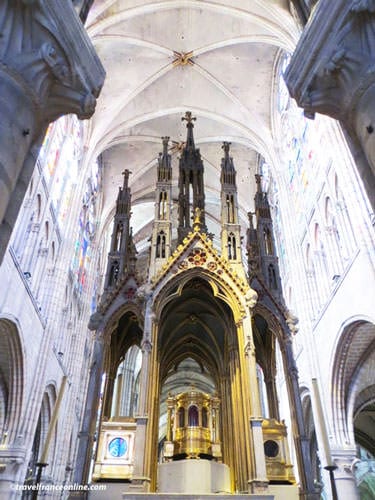
Saint Denis, patron saint of the basilica
The legend surrounding Saint-Denis, and in particular the “miracle of the leper”, attracted pilgrims from all over the kingdom.
It is said that on the night preceding the solemn dedication of the new church, Jesus descended into the basilica, accompanied by the apostles Peter and Paul, as well as Saints Denis, Rusticus and Eleutherius, and a multitude of angels, and performed all the rites of consecration.
The church was then empty, except for a poor leper, who, fearing he would not be admitted on the day of the consecration because of his terrible disease, had hidden in a dark corner and thus attended this miraculous nocturnal dedication.
Of course, Jesus knew that the poor leper was in the church and, approaching him, healed him of his ailments. He also instructed him to go to the King and the bishops and warn them in His name that it was no longer necessary to proceed with the dedication of the church, since He Himself had done so.
We have a few documents relating to this original basilica. However, excavations carried out in the 1930s unearthed a crypt containing numerous human and animal remains, including sarcophagi from the 4th and 5th centuries. This crypt could be the original burial place of Saint Denis.
Saint Denis Basilique after the Revolution
Abbot Suger reconstructed the Romanesque basilica in the 1140s, with the ambition of making it one of the most beautiful in France. One of the most avant-garde elements at the time was the construction of a chevet, which included a series of monolithic columns supporting one of the oldest Gothic ribbed vaults in France.
In the 13th century, King Saint Louis entrusted Pierre de Montreuil, a renowned master of Rayonnant Gothic architecture, to complete this monumental project.
Amazingly, Saint Denis Basilica escaped destruction during the French Revolution, but the tombs it housed were desecrated: the royal remains were inhumed without ceremony in mass graves and covered with quicklime.
Napoleon Bonaparte commissioned the reopening and restoration of the basilica in 1806. The last alteration took place in 1845, when the architect Viollet-le-Duc had the north tower demolished due to structural problems, and in 1966, the basilica was elevated to the rank of cathedral in 1966.
Saint Denis Basilique – Royal necropolis of France

Dagobert I was the first monarch to be buried in the basilica in 639 AD. His tomb, rebuilt in the 13th century, is next to the reliquary housing the relics of Saint Denis.
From the advent of the Capetian dynasty in 987 to the French Revolution in 1789, the Saint Denis Basilique was the final resting place of all the sovereigns of France, except for three. It thus contains more than 70 royal monuments and recumbent statues representing 42 kings, 32 queens, 63 princes and princesses, and 10 barons of France. These majestic tombs thus bear witness to the evolution of styles of French religious architecture and sculpture throughout the centuries.
The Merovingian and Carolingian funerary stelae and metal plaques (before 987) have a sober and finely sculpted aesthetic.
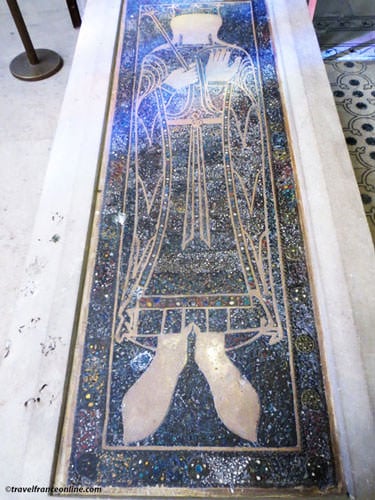
That said, Clovis, the first king of France, was buried in the abbey church of Ste-Geneviève, and his descendants were buried at the Abbey of Saint-Germain-des-Prés. In the 19th century, their recumbent statues and two of their deceased children’s were moved to the chevet.
The fourteen recumbent statues commissioned by King Saint Louis around 1263 are displayed in the transept.
Those of the Valois kings (1328-1589) were created during their lifetime and are thus considered the first examples of official portraits!
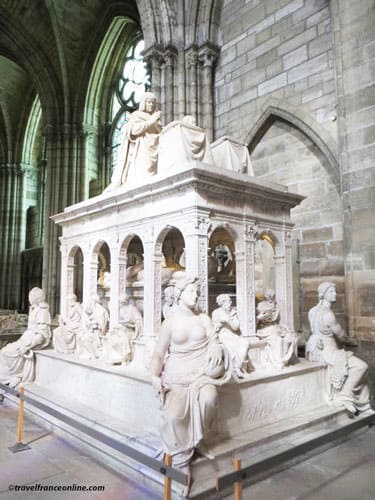
French Renaissance mausoleums are placed in the nave and ambulatory; They depict the monarchs in two distinct ways. On the upper level, they are in all their royal splendour, reflecting their earthly status. On the lower level, they are represented as humble and emaciated corpses, stripped of their earthly ornaments, awaiting divine judgment. This dual representation underlines the religious beliefs of the time, emphasising the equality and humility of all individuals, regardless of their earthly condition, in the face of death.

However, Catherine de Medici and Henry II chose to be shown fully clothed, reclining on opulent beds in the Italian Renaissance style!
Despite the tragic desecration of the tombs during the Revolution, the museum’s curator, Alexandre Lenoir, managed to salvage most of the statues and recumbent monuments.
Although the tombs had been stripped of their royal insignia and symbols, Lenoir recognised their artistic value and saved them for his Musée des Monuments Français, precursor to the Louvre Museum.
Saint Denis Basilique Crypt

The crypt of the Basilica of Saint-Denis comprises several parts:
The Archaeological Crypt where Saint Denis was initially buried, the Royal Ossuary, the Crypt of Suger housing the tombs of the Bourbons, and the Bourbon Chapel.
The Archaeological Crypt contains sarcophagi dating to the 4th and 5th centuries, presumably the original burial of Saint Denis.
The Royal Ossuary is a narrow corridor lined with two black marble walls. During the French Revolution, the tombs of the kings and queens of France were desecrated and their remains thrown into mass graves.
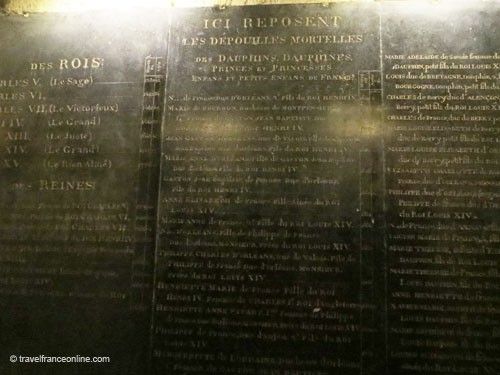
In 1817, King Louis XVIII ordered the exhumation of all royal relics and their placement in the ossuary. Unfortunately, the remains could not be identified because they had been covered with quicklime. The bones were gathered together, those of the kings on one side, those of the queens on the other, their names engraved on the black marble slabs.
The central crypt, known as Suger’s Crypt, houses the black marble tombs of the last Bourbons. Louis XVIII oversaw the transfer of the remains of Marie Antoinette, Louis XVI and his sister, Madame Élisabeth, from the Chapelle Expiatoire to the Basilica of Saint-Denis on January 21, 1815, 22 years to the day after the execution of Louis XVI.
Louis XVIII was the last Bourbon king to be buried in the Basilica of Saint-Denis.

A corridor leads to the Bourbon Chapel, a small crypt housing several cenotaphs dedicated to the Bourbons.
An urn, placed in a small niche in the wall of this corridor, contains the mummified heart of the son of Marie Antoinette and Louis XVI. The young dauphin, who would have ascended the throne as Louis XVII without the Revolution, died tragically at the age of 10, carried off by illness and, one imagines, despair.
One of the doctors who performed the autopsy secretly kept the small heart and mummified it.
However, his remains could not be buried next to his parents at the Saint Denis Basilique, as he was buried in an unmarked grave. It was only in 2004, thanks to DNA tests, that his heart was formally identified.
Saint-Denis Basilique is one of the 25 Paris churches I have selected for you, although located outside Paris.
Directions: City of Saint-Denis – 9km north of Paris
Metro: Basilique de St-Denis Line 13
Coordinates: Lat 48.935571 – Long 2.359524