Sainte-Geneviève Abbey and St Etienne du Mont Church
St Etienne du Mont Church is nestled behind the Panthéon and is the only remaining vestige of the once prestigious Abbey of Sainte-Geneviève.

Around 510 AD, Sainte-Geneviève, who would become one of the three patron saints of Paris, founded a monastery under the patronage of King Clovis, the first king of France. The abbey quickly became one of the city’s most influential religious institutions.
Later, pilgrims flocked to pray at the gilded shrine housing the relics of Sainte-Geneviève, where, according to legend, countless miracles had occurred. The pilgrimage had become so popular by the 9th century that the Basilique of Saint-Pierre-Saint-Paul, the abbey church, was renamed the Église Sainte-Geneviève. It was rebuilt and enlarged in the 12th century to serve as a parish church for the many clerics and servants who lived nearby.
In 1225, a small chapel dedicated to Saint Etienne (Stephen) was built on its north side. It was, in turn, enlarged and transformed between the 15th and 17th centuries to become the present-day St Etienne du Mont Church.
The Abbey of Sainte-Geneviève was destroyed during the French Revolution, and the tombs of King Clovis, Queen Clotilde, and Sainte-Geneviève were desecrated. Only St Etienne du Mont Church and a few monastic outbuildings escaped destruction.
The ghosts of Sainte-Geneviève Abbey in the Lycée Henri IV
In 1796, the French state founded its first secular secondary school, the Lycée Henri-IV, on the site of the former monastery.

The abbey ruins were demolished in 1807 to make way for the school and the opening of Rue Clovis. However, some buildings miraculously escaped destruction.
The Tour Clovis (Tower), the former abbey church’s bell tower, still overlooks the school and the street, and the nuns’ refectory, along Rue Clotilde, was transformed into a chapel.
The 15th-century Gothic cloisters and cellars were restored in 1744, as well as two magnificent 18th-century staircases, the library founded in 1624, and the coin and medal collection. All these remains are now listed as historical monuments.
St Etienne du Mont Church, a fine illustration of French religious architecture
The construction of the St Etienne du Mont Church spanned 134 years, from 1492 to 1626. It is thus the only church in Paris, and perhaps even in all of France, that so clearly illustrates the architectural transition from Gothic Flamboyant to the French Renaissance.
This evolution is most evident in the facade, which remains its most remarkable exterior feature. It indeed boasts a harmonious blend of styles: Renaissance ornamentation integrated into a delicate three-tiered Gothic structure, characteristic of the Middle Ages, a slender Gothic pinnacle, a large rose window, and a portal reminiscent of a Greek temple.
The architect Victor Baltard restored the facade in the 19th century and replaced the statues destroyed during the French Revolution.
The church’s bright and spacious interior retains its original Gothic plan, but the decoration reveals a gradual architectural evolution.
The chancel, apse, and bell tower, completed around 1540, feature elaborate ornamentation and tracery, such as carved wooden panels, characteristic of the Flamboyant Gothic style.
However, the nave, whose construction began in 1580, reflects the growing influence of the Renaissance style, with harmonious proportions and classical details.
St Etienne du Mont Church’s ambulatory and chancel also boast one of the most complete collections of 16th- and 17th-century stained glass. Amazingly, almost all of these windows remain in their original positions.
The church also houses Paris’s oldest organ case, which was assembled in 1631. Preserved in its original state, it is listed as the city’s fifth-oldest organ. Finally, the pulpit, created in 1651, is a superb example of Baroque art.
The only surviving rood screen in Paris

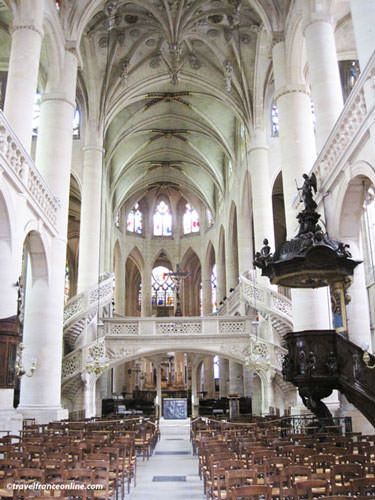
But St Etienne du Mont Church is also famous for possessing the only surviving rood screen in Paris, a masterpiece from the early 16th century.
Rood screens were a common architectural element in medieval churches. They separated the chancel, reserved for the clergy, from the nave where the congregation gathered. They also served as a platform from which the priest proclaimed the Word of God. Most Parisian churches removed their rood screens in the 18th century to make the churches more inclusive for parishioners.
The structure of the rood screen at St Etienne du Mont Church is typically Gothic, but its decoration reflects the emerging Renaissance style. The balustrade, a delicate stone lacework, was carved from the white limestone of Saint-Leu. Two elegant openwork staircases wind around the pillars, leading to the chancel and the raised gallery, whose function, beyond its decorative beauty, remains a mystery.
The shrine of Sainte-Geneviève
The church is exceptional not only for its exceptional architecture, but also for being the custodian of the relics of Sainte-Geneviève, the patron saint of Paris.

Although her relics were burned during the Revolution, her original stone sarcophagus escaped destruction.
Many of her relics were also recovered from various French churches and gathered in a gold-and-silver casket. This shrine is housed in the neo-Gothic Chapelle Sainte-Geneviève, which was completed in 1853, and is adorned with a colourful stained-glass window depicting significant episodes from her life.
Every year, pilgrims and parishioners gather at the chapel from January 3rd to 11th to pay homage to the saint and invoke her protection and guidance.
Finally, St Etienne du Mont Church is also the resting place of two illustrious figures: the French philosopher Blaise Pascal (1623-1662) and the playwright Jean Racine (1639-1699), whose remains were transferred here after the dismantling of the Abbey of Port-Royal-des-Champs.
St Etienne du Mont Church is, unsurprisingly, on the list of the 25 Paris churches I have selected for you, lesser-known, yet equally remarkable.
Directions: 5th District – At the rear of the Pantheon
Station: Luxembourg on RER B
Coordinates St Etienne du Mont Church: Lat 48.846539 – Long 2.348090
Photo via Wikimedia Commons: Church in 1655 by Martin Zeller Public domain