The colours of Provence

Provence is the quintessential holiday destination in the south of France!
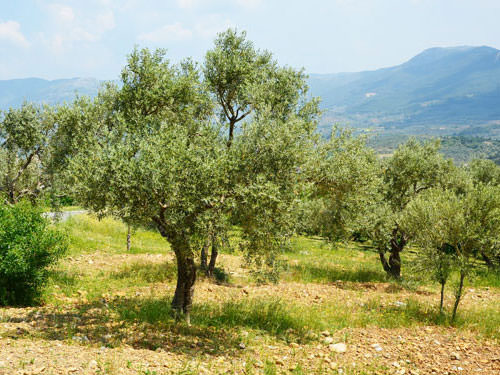
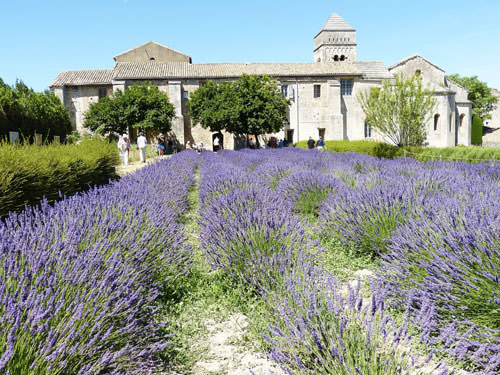
Its name indeed conjures up images of sun-drenched landscapes dotted with fields of lavender, sunflowers, and mimosa, and vast olive groves stretching as far as the eye can see, along with the song of cicadas and the buzzing of bees gathering nectar.
We also picture the picturesque villages and farms, locally called “mas”, that dot the hinterland, and the trendy ports, lively seaside resorts and fine sandy beaches drawing those seeking the pleasures of the warm Mediterranean climate!
Tracing the footsteps of the first settlers
Modern Provence evolved from the ancient Gallia Transalpina or Gallia Narbonensis, later known as Provincia Nostra (Our Province), then simply Provincia.
Founded by the Romans at the end of the 2nd century BC, west of the Alps, the Provincia extended from the Rhône Valley to the Mediterranean coast.
However, the Romans weren’t the first to colonise the region; traces of human occupation indeed date back to around one million years BC.
Over the following millennia, the region underwent significant climatic changes and sea level variations, which led to further population migrations.
Provence experienced two distinct waves of settlement around 6000 and 2500 BC, followed by the arrival of the Ligurians from 1000 BC and the Celts around 500 BC, who mixed to form a unique Celto-Ligurian group, whose roots are deeply embedded in the current native population.
These early inhabitants, renowned for their trading culture, established trade with neighbouring populations, attracting settlers who founded trading posts along the coast.
The Greeks founded Massalia (modern-day Marseille) around 600 BC, making it a major centre of ancient maritime trade.
The Roman Province
From its foundation, the Transalpine Province enjoyed a period of prosperity known as the Pax Romana, or Roman Peace, which lasted three centuries.
However, the stability of the Roman Empire began to crumble due to excessive territorial expansion, leading to a series of barbarian invasions beginning around 275 AD. These incursions, which were repeated over the next two centuries, sowed insecurity throughout the empire, hastening its decline.
Emperor Constantine (306-337 AD) sought to restore unity and control by promoting Christianity as the official religion of the empire. However, the first attempts to institutionalise Christianity met with only limited success. Indeed, the vastness of the Roman Empire, stretching from Great Britain, France and Spain in the west to Syria, Turkey and North Africa in the east, represented an insurmountable challenge for a centralised power.
Provence after the fall of the Roman Empire
Until the 9th century, Provence was subjected to a series of invasions and raids by the Visigoths, the Burgundians, the Ostrogoths and the Normans. Local populations, though, adapted to the invaders’ cultures where they could not repel them head-on.
From the 9th century until 1481, Provence was ruled by the Counts of Provence, descended from three successive feudal dynasties: Catalan, Burgundian, and Angevin, and was incorporated into the Kingdom of France in 1481.
Provence’s golden age in the 14th century coincided with the crisis of the Roman Catholic Church. The popes of France indeed separated from Rome and established their seat in Avignon, nicknamed the “City of Popes”, which remained under papal authority until the French Revolution.
The upheavals of the revolution gave way to a period of reconstruction, spurred by the industrial boom of the mid-19th century. Today, Provence is part of the Provence-Alpes-Côte d’Azur (PACA) region, one of the 13 administrative regions of France and the third most important economically.
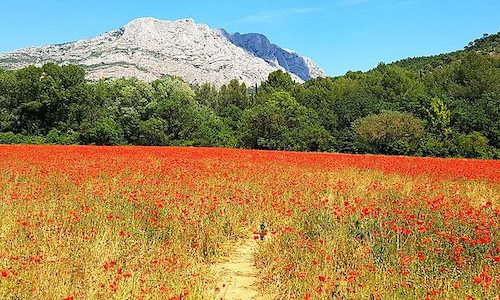
Photos via Wikimedia Commons: Gallia Narbonensis map by Erik Warmelink CC BY-SA 4.0 – Header by Georges Seguin (Okki) CC BY-SA 3.0 – Mountain and poppy field by Moony Ana CC BY-SA 4.0