Peyrusse-le-Roc, a medieval village frozen in time
Peyrusse-le-Roc is a ruined medieval village nestled in the heart of the Aveyron region.
Once a flourishing Gallo-Roman settlement covering more than 10 hectares, Petrucia prospered thanks to its seven silver and lead mines, which ensured its wealth and renown well into the Middle Ages.
In the 8th century, its destiny changed when King Pepin the Short seized Duke Waïfre of Aquitaine. Peyrusse-le-Roc was then annexed to the County of Toulouse and, in the 13th century, became the largest bailiwick in Rouergue, exercising its jurisdiction over some one hundred parishes.
Its strategic location and dynamic economy, punctuated by numerous annual fairs and lively markets, attracted visitors from all the surrounding regions.
In the 14th century, Peyrusse-le-Roc was indeed home to a thriving community of 700 houses and approximately 3,500 inhabitants, including 40 noble families, six notaries, and a money changer. The village also had an armed garrison of 187 men and four knights.

However, the tumultuous Hundred Years’ War and the subsequent dismantling of its fortifications after the Wars of Religion in the 16th century triggered the end of its economic and strategic importance.
The depletion of the silver and lead mines worsened economic difficulties, prompting many inhabitants to seek work elsewhere, particularly in the neighbouring bastide town of Villeneuve d’Aveyron.
Peyrusse-le-Roc gradually fell into oblivion and ruin, losing its status as a royal bailiwick in 1719.
Over the following centuries, it remained a ghost town, its dilapidated buildings serving as quarries for neighbouring communities.
Rehabilitation of Peyrusse-le-Roc
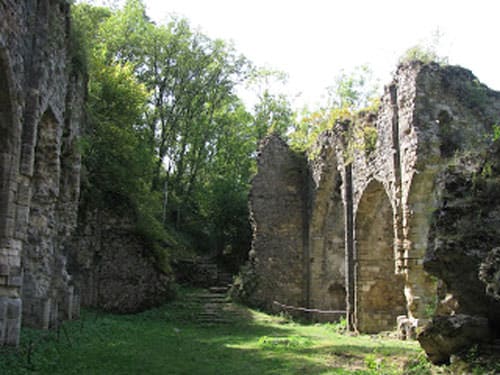
Fortunately, in 1956, a collective effort by local authorities was undertaken to preserve what remained of Peyrusse-le-Roc’s historical and architectural heritage.
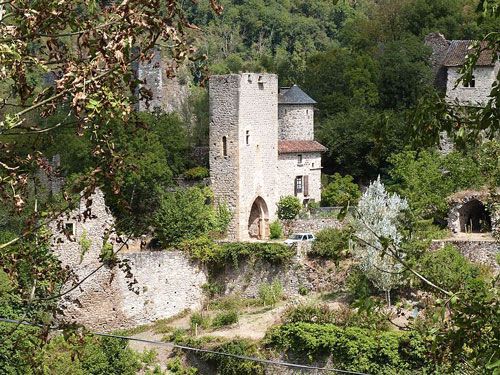
Among these vestiges are the imposing ramparts and the barbican, robust witnesses to the village’s strategic fortifications.
The 13th-century Church of Notre-Dame de Laval, along with the bell tower and the four-story hospital built during the Hundred Years’ War, offers a glimpse into the village’s religious and social life.
Finally, two impressive towers perched atop Roc del Thaluc, imposing remnants of the castle, dominate the surrounding area and offer breathtaking views of the meandering Audierne River and its valley.
Department of Aveyron department
Coordinates: Lat 44.494947 – Long 2.140746
Credits: ©Atelier434-Melanged Magic – Evelyn Jackson – Photo via Wikimedia Commons: Barbican and Header by Thérèse Gaigé CC BY-SA 4.0