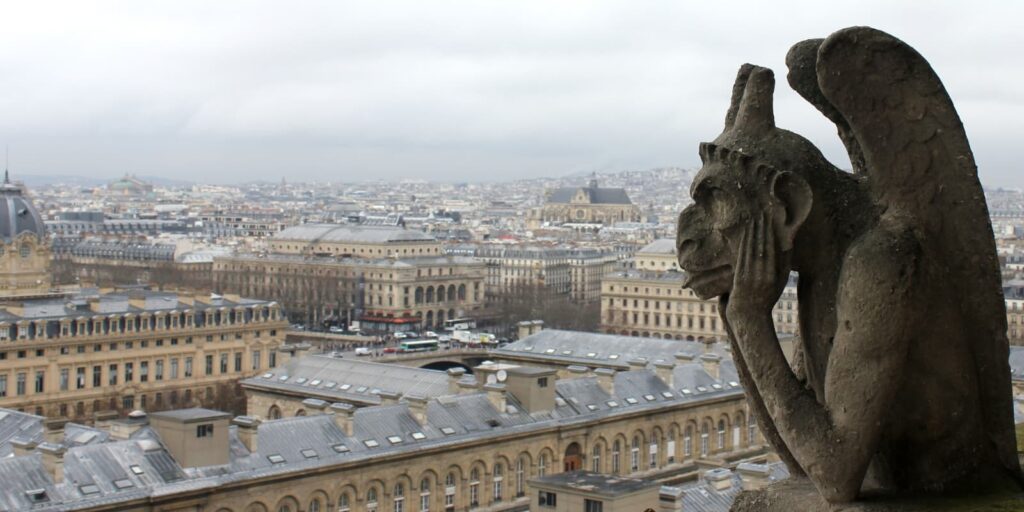
The medieval village of Monchauf

The charming Parc Monceau is a public garden laid out on the former estate of the Duke of Chartres, cousin of King Louis XVI, today located in one of Paris’s most prestigious districts.
The history of the place dates back to the 9th century, when the land belonged to the Abbaye of Saint-Denis.
The monks surrounded their estate with a wall and established a small hamlet on the summit of a barren hill. T
his hamlet was originally called Montchauf (derived from the Latin “Mons Calvus“, meaning “arid hill“), a name which evolved into Monceau.
It was one of the few hamlets scattered in this uninhabited region covered with moors, fields and forests, which were royal hunting grounds until the end of the 18th century.
Carmontelle’s extravagant park
In 1778, the Duke of Chartres acquired the Montchauf estate and spent lavishly on the construction of his lavish country estate known as the Folie de Chartres. He entrusted the renowned architect Carmontelle with the design of an extravagant English-style park.
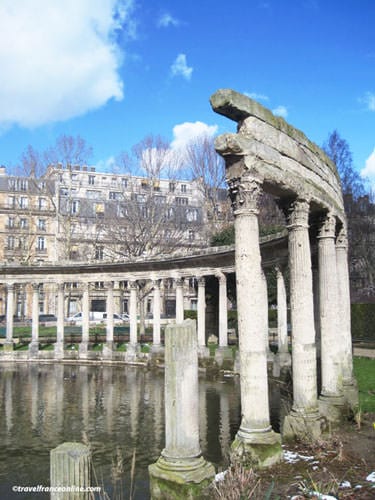
Carmontelle’s vision included a wide variety of elements: a Roman temple, antique statues, a river with a waterfall, a lily pond, a Chinese bridge, a farm, a Dutch windmill, a minaret, a small Egyptian pyramid, fake tombstones, and a grotto nestled among trees, thickets, bushes, and flowerbeds.
The Colonnade de Carmontelle, an oval basin surrounded by Corinthian columns, is one of the few remaining vestiges of this original park.
Ten years later, landscape architect Thomas Blaikie transformed the park into an English garden, although its size was considerably reduced by the construction of the General Farmers Wall in 1787. This unpopular tax barrier was demolished during the French Revolution, leaving only the tollgate Chartres Pavilion, originally called the Barrière de Chartres. This building, which served as a customs office and observation post, marks the entrance to the park on Boulevard de Courcelles.
The Folie de Chartres became state property during the Revolution, then was returned in the 19th century to Louis-Philippe I, a descendant of the Chartres family.
Creation of the Parc Monceau
In the 1850s, half of the remaining park was urbanised and transformed into luxury properties, while the City of Paris acquired the remaining 9 hectares.
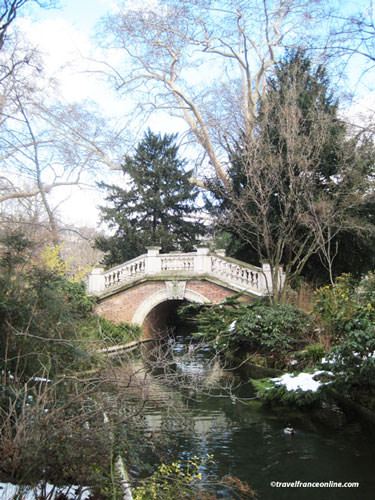
Landscape architect Alphand was commissioned to redesign the park, giving birth to the current Parc Monceau. He revitalised the park by replanting vegetation and creating a circular path as well as two main avenues crossing it from east to west and from north to south.
The architect Davioud added a magnificent dome to the Pavillon de Chartres, now known as the Rotonde du Parc Monceau. This elegant rotunda is now classified as a historical monument and constitutes the main entrance to Parc Monceau. Davioud replaced Carmontelle’s Chinese bridge with a new structure inspired by the Rialto Bridge in Venice.
He also restored the colonnade, the oval basin, the miniature Egyptian pyramid, and the fake tombstones. Finally, he created the four imposing entrance gates in gilded wrought iron. You’ll also find, not far from the colonnade, a Renaissance arcade, salvaged from the Hôtel-de-Ville (Paris City Hall), which burned down during the Commune of 1871.
Today, Parc Monceau is popular with office workers and young families for its children’s play equipment, permanent merry-go-round, and many scattered benches that offer a place to relax.
Opening hours: 7 am-10 pm in Summer – 7 am-8 pm in Winter.
Free Wi-FiDirections: 8th District
Metro: Monceau on Line 2
Coordinates: 48.879683 – Long 2.308955