Nougat, a confectionery invented in Mesopotamia
The recipe for Nougat de Montélimar, prized for its sweet, nutty flavour and irresistible texture, originated in ancient Mesopotamia modern-day Iraq). Documents dating back to the 10th century reveal that the inhabitants of Baghdad were already very fond of this delicacy. Nougat crossed the Mediterranean at the end of the 16th century to become a quintessential Provençal speciality, appearing in books on pharmacy and dietetics (yes, you read that right, dietetics).

The visionary agronomist Olivier de Serres was, in fact, the driving force behind the production of nougat in Provence. He realised that the warm Provencal climate was ideal for growing almonds, a key ingredient in nougat making. Nougat soon replaced the traditional honey and walnut cakes previously produced in the region.
Until the beginning of the 19th century, nougat was known as nux gatum, derived from the Latin words nux (meaning nut) and gatum (meaning cake).
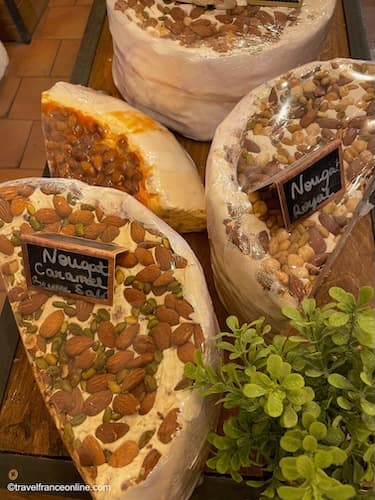
Montélimar became the undisputed capital of nougat with a simple yet perfect recipe: lavender honey, whipped egg whites (hence its immaculate white colour), and almonds. Some variations of the recipe include pistachios, walnuts, dried fruit, and vanilla, which give the nougat various colours.
Nougat de Montélimar since 1701
The origins of the Nougat de Montélimar nougat date back to 1701.
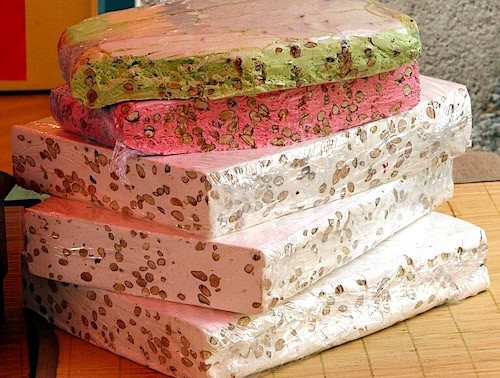
Over the centuries, its reputation has steadily grown, culminating in a decree on March 12, 1996, which officially defined the criteria for obtaining this prestigious designation. Thus, only confectionery containing at least 30% blanched almonds (or 28% almonds and 2% Sicilian pistachios), 25% honey, and natural vanilla are entitled to the coveted “Nougat de Montélimar” label.
Nougat producers, or nougatiers, are, however, permitted to source honey, almonds, and eggs from other regions, thereby guaranteeing the use of the highest quality ingredients in its production.
In 2003, nougat makers joined together in an association to obtain a Protected Geographical Indication (PGI) to preserve the traditional recipe and production methods of the genuine Nougat of Montélimar.
Why did Montélimar become the capital of nougat?
Montélimar’s rise to the prestigious title of Capitale du Nougat may seem surprising at first glance, given its inland location, far from the coastal city of Marseille. However, several key factors came into play.
First, Montélimar’s strategic geographical location proved to be a major asset, as the town became an important stop on the new railway line connecting Paris to the French Riviera in 1858. Travellers not only could enjoy the magnificent scenery but could also take the opportunity to sample local specialities, including the delicious Nougat de Montélimar.
However, it was the election of Montélimar’s mayor, Émile Loubet, who later became President of the French Republic from 189 to 1906, who propelled the town to the forefront and thus contributed to the growth of the nougat industry. Loubet was indeed a tireless promoter of his town and its nougat!
The construction of the Nationale 7, the legendary N7 road linking Paris to the Mediterranean via Montélimar, was the town’s crowning achievement. With the introduction of paid vacations in the 1930s, people stuck in traffic jams on the N7 (yes, even back then!) found refuge in Montélimar, where they discovered and savoured the irresistible nougat! While the Autoroute A1 (motorway) has long since replaced the N7, the Montélimar rest area still houses a shop selling delicious nougat.
Department of Drôme
Coordinates: Lat 44.556944 – Long 4.749496
Photos via Wikipedia Commons: Photo1 by Xocolatl CC BY-SA 4.0 – Photo2 and Header by Sémhur CC BY-SA 3.0