
The Tournemire and Anjony Families, a tale of dynasties
Tournemire, a charming village of 125 inhabitants, is renowned for its remarkable architecture and is considered one of the most picturesque villages in France.

Perched on a hill, it offers a breathtaking panorama of the lush Dore Valley, in the heart of the Auvergne Volcanoes Natural Park.
The village of Tournemire developed around an imposing fortress built by the influential Tournemire dynasty around the 10th century.
However, the dynasty’s rise to power came to an end in the mid-14th century with the outbreak of the Hundred Years’ War. They indeed made the ill-advised decision to ally themselves with the Plantagenet kings of England to defend their feudal autonomy against the ambitions of the French monarch.
Charles VII, determined to drive the English out of the region, not only stripped the Tournemire family of their lands as punishment but also took other extreme measures to assert his authority.

He thus ennobled Louis d’Anjony, heir to a wealthy family of fur traders from Aurillac, who had rallied to his cause and fought valiantly alongside Joan of Arc against the English.
As a token of his gratitude for his unwavering loyalty and support, Charles VII granted the d’Anjony family the privilege of building a fortress, now known as the Château d’Anjony, on the remains of the former Tournemire stronghold.
Needless to say, this sparked animosity and a series of conflicts between the two families that persisted for centuries! The Tournemire line died out in the mid-17th century when the last descendant fell in a skirmish and was killed.
Château d’Anjony, a quintessential example of medieval military architecture
The imposing Château d’Anjony overlooks the small village and is still inhabited by the Anjony family.
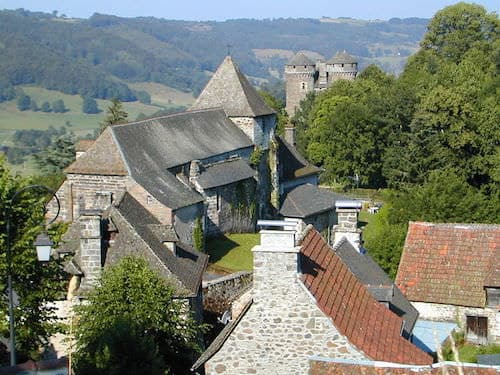
A perfect example of medieval military architecture, its design prioritised functionality and defence over ornamental elegance, despite some improvements made in the 15th century.
Its four imposing round towers, topped with pepper mill-shaped roofs and fortified with machicolations, surround a majestic central keep.
Amazingly, the castle remains in its original state, having never been attacked and having been continuously maintained and inhabited throughout its history! This fortress owes much of its resilience to the robust volcanic stone used in its construction.
The entrance is located in one of the towers and leads to a vaulted room that once served as a storehouse.

The 17th-century apartments, located in a massive, unadorned rectangular building topped with a slate roof, escaped destruction during the French Revolution and contain superb decorative features.
Thus, a remarkable 16th-century fresco, long hidden behind 18th-century wood panelling in the Hall of the Nine Worthies, survived. This fresco, nicknamed Les Neuf Preux – The Nine Worthies,” was discovered in the 20th century during major restoration work. The Guard Room, for its part, houses a magnificent tapestry depicting the “Triumph of Emperor Justinian,” portrayed as King Louis XIII.
Outside, a series of outbuildings lines the drive leading to the castle. Many of them rest on the foundations of older structures and blend harmoniously with the local architecture of volcanic stone and slate roofs.
Saint-Jean-Baptiste Church, the custodian of a Thorn from the Crown of Jesus
Tournemire boasts another remarkable monument: the parish Church of Saint John the Baptist, formerly the Chapelle Sainte-Croix – Chapel of the Holy Cross, which served as the private chapel of the lords of Tournemire.
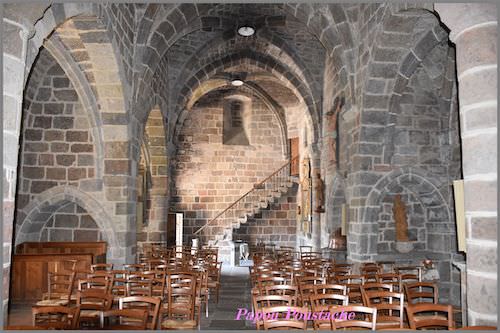
Dating from the 12th century, this Romanesque church houses an extraordinary relic, which, Rigault de Tournemire acquired in Jerusalem during the First Crusade: a Thorn from Christ’s Crown, hence its original name. Local legend recounts that in the Middle Ages, this thorn miraculously shed a drop of blood every Good Friday!
The church is also adorned with superb 16th-century frescoes depicting scenes from the Life of Christ. It underwent significant restoration after a devastating fire in the 14th century, but the seven side chapels, the vault, and the porch were completely rebuilt.
The Church of Saint John the Baptist was listed as a historical monument in 1944.
Department of Cantal – 25kms north of Aurillac and Aurillac Tronquiere airport
Coordinates: Lat 45.054094 – Long 2.479209
Photo via Wikimedia Commons: Header and Photo3 by Béa Public domain – Other photos ©Papou Poustache


