Evergreen Mistletoe and Celtic Sacred Oak
Mistletoe holds a special place among the four plants traditionally venerated by Christians to celebrate Christmas. Its evergreen leaves symbolise the very essence of “life, which never dies”.

This parasitic plant usually grows on the branches of apple and oak trees, thus becoming part of folklore and traditions. Despite being toxic when consumed excessively, the white berries of mistletoe have long been valued for their medicinal properties.
In Celtic culture, the association of the plant with the oak, revered as the “king of trees”, is remarkable. The druids indeed venerated the oak and believed in its magical powers: to repel evil and bring fertility, longevity and prosperity to its followers. They also considered mistletoe the soul of the sacred oak because it anchored its roots in the oak trunk, drawing nourishment from its sap.
Thus, the druids celebrated elaborate rituals in honour of the sacred mistletoe of the sacred oak, during the harvest, on the sixth night before the winter and Summer Solstices. During these sacred gatherings, the druids harvested the plant with golden sickles and gave rituals offerings, including the sacrifice of two white bulls, to commune with divine forces and attract blessings for the seasons to come.
Frigga the Goddess of Love
These ancestral beliefs are also found in Norse mythology, where the plant held a sacred place. It was indeed the favourite plant of Frigga, the Goddess of Love and mother of Balder, the radiant God of the Summer Sun. According to legend, Balder confided to Frigga a haunting dream foretelling his imminent death.
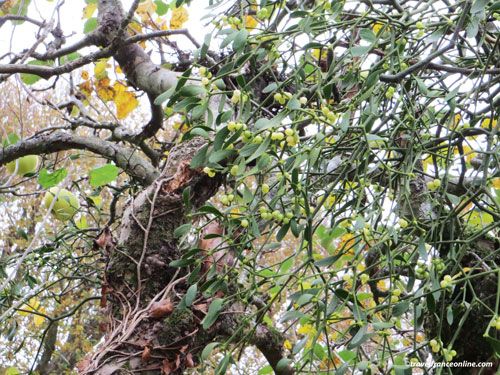
Alarmed by the prospect of her son’s death and fearing the disappearance of all life on earth, Frigga desperately tried to save Balder by seeking the protection of the four elements, air, water, fire and earth, as well as every living creature. However, in her haste, Frigga neglected the mistletoe, which grew neither on the ground nor underground, but on the branches of apple and oak trees.
Taking advantage of this negligence, Loki, the mischievous God of Evil, forged an arrow from mistletoe wood and conspired with Höder, the blind God of Winter. Tragically, Höder, deceived by Loki, fatally struck Balder with the enchanted arrow. For three days of agony, heaven and earth mourned the passing of the radiant God of the Summer Sun, their efforts to resurrect him remaining in vain.
Frigga’s tears fell upon the fallen mistletoe, transforming its berries into glittering white pearls, a poignant symbol of renewal and rebirth in the heart of darkness. Thus, from the depths of despair springs a glimmer of hope, a testament to the immutable cycle of life, death and rebirth that permeates Norse mythology.
Kiss me under the Mistletoe
The Romans also considered it a sacred plant and associated it with the Saturnalia, a festival in honour of Saturn, their God of Harvests and Fertility.
This ancient tradition was later adopted by the early Christians, who appropriated its mythological significance. Thus, couples who exchanged a kiss under the mistletoe were believed to be united in eternal love, a charming custom that has spanned the ages and been passed down from generation to generation and continues to thrive in many regions. Surprisingly, superstitions persist around the plant in some regions of France, where some still believe in its magical powers to ward off evil spirits, and thus decorate their houses with sprigs of mistletoe during the holidays.
Besides mistletoe, other traditional Christmas plants, such as poinsettias, holly and ivy, also take on special importance at the end of the year.