
Rue in history
Rue is nestled in a picturesque bend of the Maye River, along the Baie de Somme, and is the historic capital of Marquenterre, a natural region that was once part of the County of Ponthieu.

Founded in the 9th century by Vikings from Ry, in Jutland (mainland Danmark), Rue became a prosperous port and stronghold for the County of Ponthieu, situated amidst vast marshes between the English Channel and the Bay of Somme.
In 1101, Rue became a major pilgrimage site when a ship carrying the Crucifix of the Holy Spirit ran aground on its shores, attracting kings, queens, and people from all over the country who came to venerate the relic.
A century later, the Count of Ponthieu granted Rue a town charter, bestowing new freedoms upon its inhabitants.
The town suffered significant damage during the Hundred Years’ War due to its strategic importance, but was rebuilt at the end of the 15th century, and many of these buildings still stand. Rue took this opportunity to improve its fortifications with military works, such as lunettes and bastions, which protected it until 1670, when Colbert ordered their dismantling following the Treaty of Aix-la-Chapelle. You can discover the remains of these fortifications along marked trails.
Rue is home to several remarkable monuments, including the Chapelle du Saint-Esprit – Chapel of the Holy Spirit, which houses the enigmatic Holy Spirit Crucifix, the Chapelle de l’Hospice – Hospice Chapel, the belfry and the charming Church of Saint Wulphy.
The Miraculous Crucifix
The discovery of the miraculous crucifix naturally gave rise to a legend…
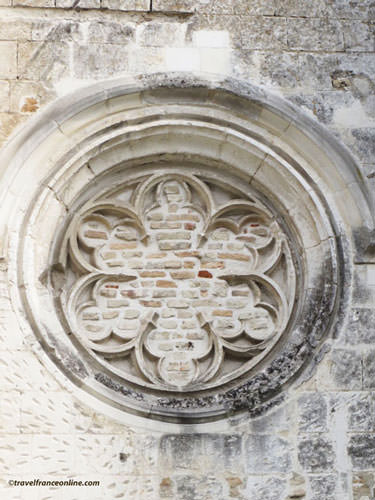
On the first Sunday of August in the year 1100, a ship mysteriously appeared off the coast of Rue and ran aground on the beach. This ship, without mast, sail, or rudder, carried a crucifix larger than life, said to have belonged to Nicodemus, one of Christ’s disciples.
The villagers interpreted the ship’s arrival as a sign of divine providence, guided by God at the request of Saint Wulphy, the revered first priest of Rue. The crucifix found its place in the Chapel of the Holy Spirit and quickly became a place of pilgrimage for the faithful who came from afar.
Later, the legend spread to the neighboring town of Abbeville, whose inhabitants coveted Rue’s prosperity and spiritual renown. Eager to possess the Crucifix, they petitioned the Parliament of Paris, hoping for a decree in their favour.
Yet, divine intervention occurred once again. As the cart carrying the Crucifix turned onto the road to Abbeville, the horses pulling it stopped abruptly, as if immobilised by an invisible force. In that miraculous moment, one thing became clear: the Crucifix was destined to remain in Rue!
Chapelle du Saint-Esprit
The Chapel of the Holy Spirit is a masterpiece of Flamboyant Gothic architecture.
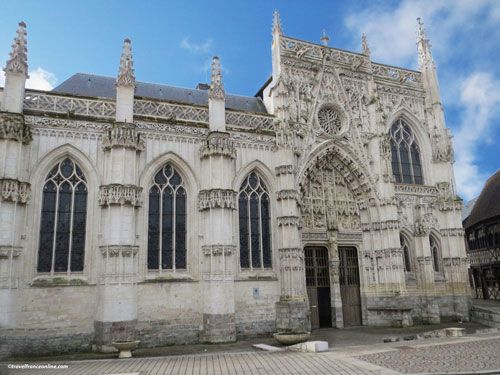
Built between 1440 and 1514, its purpose was to offer refuge to pilgrims who came to venerate the Crucifix of the Holy Spirit, which had found its place in Rue and attracted crowds ranging from royalty to humble seekers of faith.
This chapel was thus designed to be exceptional. The interior, the vaults, and the treasury bear witness to unparalleled artistic mastery, their delicate sculptures illustrating the pinnacle of the Flamboyant Gothic style. Every subtle curve and every meticulous detail reveal the skill and dedication of the artisans who crafted them.
Three canvases by the local painter Albert Siffait de Moncourt adorn the walls of the nave, bringing to life the legends surrounding the crucifix in Rue.
Chapelle de l’Hospice
The first Chapelle de l’Hospice was built around 1186 to accommodate the poor and pilgrims who came to Rue or were departing for Santiago de Compostela. The hospice and its chapel were destroyed during the Hundred Years’ War.

The chapel was rebuilt at the beginning of the 16th century, as evidenced by the inscription on the nave’s main beam: “En l’an quinze cent et sept fut fait ce chœur et l’an quinze cent douze fut cette nef faite” – “In the year 1507 this chancel was built, and in the year 1512 this nave was built.”
It boasts a painting depicting Saint Augustine writing his memoirs, which is placed above the high altar, and is attributed to Philippe de Champaigne.
The west facade, though, was rebuilt in brick at the end of the 19th century in a style reminiscent of Flemish architecture. The building suffered limited damage during the French Revolution, as it was converted into a barn, with a false ceiling that (unintentionally) protected the upper sections.
The chancel vault is a true architectural masterpiece, built in the shape of an inverted ship’s hull. However, it was not completed until 1755, as attested by the date engraved on one of the keystones.
The Chapelle de l’Hospice was listed as a historical monument in 1921.
Eglise Saint-Wulphy
The original Church of Saint-Wulphy was built in the 12th century. Dedicated to Saint Wulphy, the first priest of Rue in the 7th century, it reached a height of 44 metres, and its bell tower served as a lighthouse for sailors. This church was destroyed by a violent storm on February 21, 1798, but was rebuilt between 1828 and 1833 thanks to Charles Sordi, a resident of Rue. Several Romanesque features, which had been spared, were harmoniously integrated into its neoclassical architecture.
Beffroi
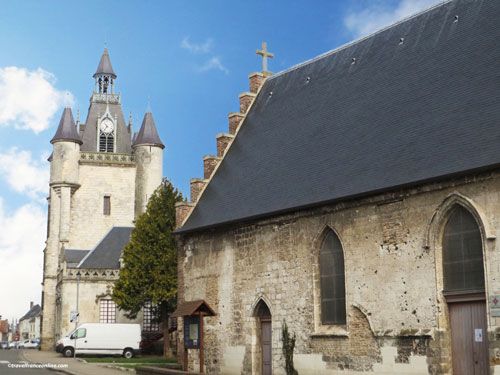
Rue, a charming town
Rue is not only a picturesque town; it is also one of four towns in Picardie awarded the “Green Holiday Resort” label. Despite its small size, it boasts a rich heritage, with numerous remarkable buildings and charming half-timbered houses adorning its medieval streets. Finally, aviation enthusiasts will be delighted to visit the Musée des Frères Caudron – Caudron Brothers Museum. In 1909, the two brothers, who lived in a neighboring village, achieved the feat of building a “flying machine”.
Department of Somme – Picardie
Coordinates: Lat 50.272480 – Long 1.667315


