
When Monet fell in love with Giverny
In 1883, Monet discovered Giverny by chance, a picturesque village that would soon become his haven of peace. Sadly, his wife and muse, Camille, had died in 1879, while the family was staying with their friend and patron, Ernest Hoschede, in the neighbouring village of Vétheuil. Ernest’s financial difficulties forced him to flee to Belgium that same year. His wife, Alice, who had remained in Giverny, moved with Monet and their two children to Paris, where she raised them alongside her own family.

They eventually moved to Vétheuil in 1880, and then to Poissy the following year, although Monet felt little affection for the latter village. It was during a train journey from Poissy to Vernon in 1883 that Monet first glimpsed the village of Giverny from his window.
Enchanted by its beauty, he immediately began searching for a modest house to rent in Giverny. This house, known as the Maison du Pressoir (Wine Press House), was nestled in the heart of a one-hectare enclosed property, complete with an orchard and a vegetable garden. In 1890, Monet’s financial situation allowed him to purchase the Maison du Pressoir, which later became the famous Maison Monet. Monet and Alice formalised their union with a marriage in 1892.
Creation of the Maison de Monet in Giverny
For the next 43 years, Monet lived in this house, where he created his most famous paintings until his death on December 5, 1926.

From the moment he acquired the property, he set about transforming it to accommodate both his professional activities and his family life. He enlarged the house and converted the adjoining barn into a studio, creating a small bedroom and a bathroom. Monet used his studio as a storage space for his works, but as a place to retouch his canvases, since he primarily painted outdoors.
He meticulously decorated each room of the Maison du Pressoir to create an atmosphere reminiscent of a painter’s palette. Thus, he painted the living room in shades of blue and the dining room in vibrant yellows.
But his creativity extended beyond the interior of his home. He had the facade painted a delicate pink and the shutters in green.

To better integrate his house with the surrounding gardens, he also had a pergola built at the front and embellished it with climbing roses.
Monet spared no expense in the design, landscaping, and embellishment of his gardens, particularly the Clos Normand (Flower Garden) and the Jardin Japonais (Water Garden). These meticulously curated spaces, adorned with a plethora of flowerbeds and water features, were an inexhaustible source of inspiration for him. He simply transformed the Maison de Giverny into a floral masterpiece.
But one would expect nothing less from such an artist!
Le Clos Normand
Monet transformed the orchard that stretched out in front of his house in Giverny into a magnificent flower garden, which he named the Clos Normand.
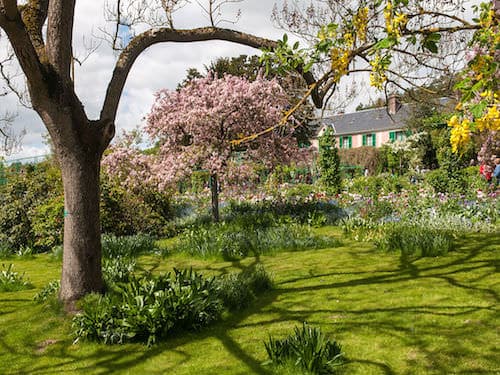
He meticulously created an ever-evolving floral masterpiece by planting a multitude of flowers for each season. He carefully arranged them, considering their sizes to play with volume and organised their colours to represent his palette.
He cultivated wildflowers alongside rare plants, ingeniously balancing the symmetry and dynamism of the flowerbeds by allowing the plants to self-seed naturally.
Over the years, Monet developed his passion for botany and exchanged rare plants and flowers with other artists and friends.
The Water Garden
In 1893, Monet acquired a plot of land opposite his property and traversed by a small branch of the Epte River, a location he considered ideal for creating his Jardin Japanais – Water Garden. This land, however, was not adjacent to his property, so an underground passage was built to access it.

He drew inspiration from the numerous Japanese prints he collected to create this garden. He had a pond dug and filled it with water lilies, which soon became his primary source of inspiration. During the last three decades of his life, Monet indeed produced approximately 250 oil paintings of water lilies, thus building a world-renowned collection.
He also had several bridges built, the most iconic of which is the Japanese Bridge with its lush wisteria, which spans the Water Lily Pond. He also had paths laid out that wound through lush vegetation and led to secluded retreats nestled among bamboo and weeping willow trees.
It was in this peaceful setting, sheltered from the outside world, that Monet found profound inspiration for his most famous paintings. The serene atmosphere of his water garden indeed deeply influenced his artistic style, as he tirelessly strove to capture the fleeting essence of mists and reflections. His brushstrokes thus evolved over the years, perhaps becoming more precise and detailed than ever, as he endeavoured to render the subtle nuances of light and atmosphere with unparalleled accuracy.
La Maison de Monet
Monet bequeathed his beloved home to his son Michel and his wife Blanche, also a painter. After Blanche’s death in 1947, Michel moved to another residence where he stored his father’s canvases.

Unfortunately, the Maison de Monet was severely damaged during the Second World War. Left exposed to the elements and overgrown with vegetation, the interior deteriorated rapidly.
In accordance with Monet’s wishes, Michel bequeathed Giverny to the Académie des Beaux-Arts – Academy of Fine Arts upon his death in 1966.
In the 1980s, for more than a decade, Monet’s gardens, house, furnishings, and orangery underwent meticulous restoration, made possible by the generosity of patrons. The Water Lily Pond was recreated and enlarged, the Japanese Bridge was meticulously reconstructed, and the Clos Normand was carefully replanted with flowers dear to Monet.
The result is truly sublime, and yet, it can be somewhat disconcerting to realise that it is all, in fact, only a faithful reproduction!

Monet is widely considered one of the founders of Impressionism, an influential art movement that emerged in the second half of the 19th century. However, the true precursor of Impressionism was Eugène Boudin, his lifelong friend and mentor. But, it was Monet’s painting, “Impression, Sunrise,” which he created in a single morning (in 1872-1873) in his hometown of Le Havre, that gave its name to the Impressionist movement.
Monet’s house, along with its remarkable gardens, is the property of the Académie des Beaux-Arts, but the property is managed and preserved by the Claude Monet Foundation, a non-profit organisation dedicated to preserving the artistic legacy of this great master.
How to get to Monet’s house in Giverny?
Department of Eure – 84 Rue Claude Monet – Giverny
Coordinates: 49.078214 – Long 1.533330
By car from Paris: 74kms with tolls – A14 and A13 to Bonnières-sur-Seine then D113 to Limetz-Villez and D201and D5
By train from Paris: Saint-Lazare station towards Rouen-Le Havre – get off at Vernon-Giverny 7kms from Monet’s house – You can pre-book a taxi or wait for the shuttle bus
N.B. 30kms farther along the Seine, you can visit the impressive ruins of Château-Gaillard, the mighty fortress built by Richard the Lion-heart, King of England, Duke of Normandy and vassal of the French King
Photos via Wikimedia Commons: Header and photo1 by Jean-Pierre Dalbéra CC BY 2.0 – House by Calips CC BY-SA 3.0 – Garden and arches and Clos Normand by Michal Osmenda CC BY 2.0 – Water lilies pond by World3000 CC BY-SA 4.0 – Blue kitchen and Nympheas by randreu CC BY 3.0 – Yellow dining room by Avi1111 dr. avishai teicher CC BY-SA 4.0


