Les Baux-de-Provence, a perched fortress
The imposing fortress of Les Baux-de-Provence was built in the 10th century atop a 250-m-high rocky spur commanding the rolling hills of the Alpilles hills.
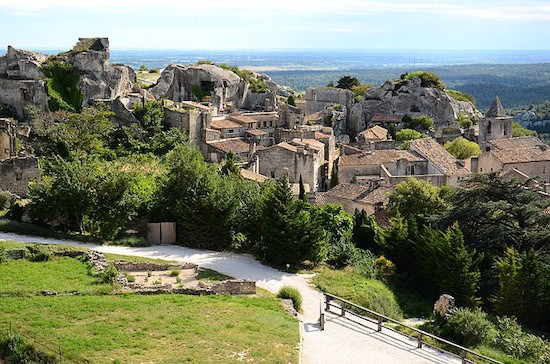
This strategic location is reflected in its name, where in the Provencal language, “bau” designates a escarpment.
This strategic location has been recognized by humankind since ancient times.
The first traces of human occupation indeed date back to the Neolithic period (around 6000 BC).
A small farming community had settled in the numerous rock shelters, and near a water source.The rocky spur overlooked deep, fertile valleys and a proto-historic trade route.

In the 2nd century BC, the Celts also recognised the strategic advantage of such a location when they arrived in the region, establishing their fort on the spur. Their oppidum was organised like a typical bastide, with narrow streets and stone houses nestled behind strong fortifications.
Les Baux-de-Provence remained a thriving stronghold until 800 BC when the Greeks founded their colonies in Arles, attracting the local population. Thus, the Alpilles mountains region gradually became deserted.
However, the Romans re-developed the stronghold, as it controlled a section of the Via Aurelia, a vital route linking Arles to Aix-en-Provence. They also developed trade, and improved the surrounding land routes, enabling the inhabitants of Les Baux de Provence to specialise in mining.
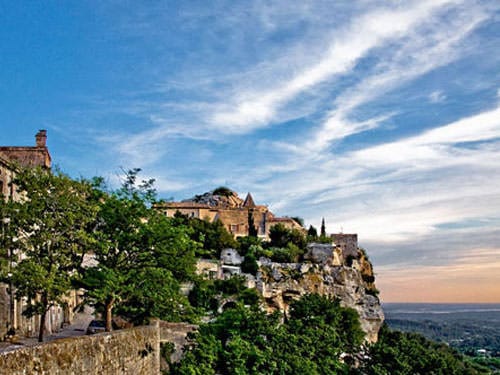
In the Middle Ages, Les Baux-de-Provence established itself as a bastion of local power, its fiercely ambitious princes exercising their domination over a vast domain encompassing 79 towns and villages in the region.
Provence, and therefore Les Baux, were attached to the French crown in the 15th century, but became a Protestant stronghold in the 17th century, rebelling against the King of France. However, in 1631, tired of the conflicts, the inhabitants negotiated with the king for the return of Les Baux to the French Crown and the right to dismantle the fortifications.
In 1642, Les Baux-de-Provence was given to Hercule de Grimaldi, Prince of Monaco, as a marquisate. The town is entirely French, but the title of Marquis of Les Baux is traditionally passed on to the heir to the throne of Monaco.
A picturesque perched village
Les Baux-de-Provence is one of the most visited villages in Provence.
Although the majestic fortress is now only ruins, its imposing remains are still quite impressive.
Perched above the vast Crau Plain, the village offers unobstructed views of the olive groves and vineyards below, and on a clear day, one can even see Nîmes the distance.
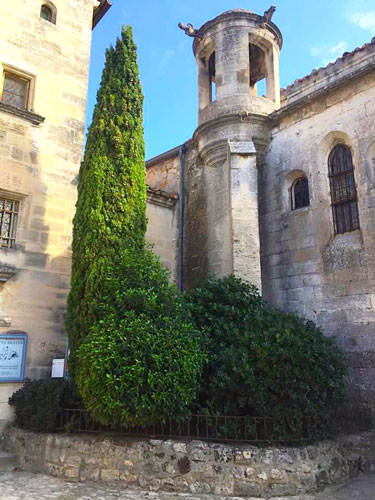
The village’s winding streets and charming courtyards are lined with sidewalk cafes and a multitude of shops offering a wide range of local specialities: wine, olive oil, soap, tablecloths, lavender and Provençal herbs. These charming streets lead to the small but remarkable 12th-century Church of Saint-Vincent, which was carved directly into the cliff face.
Finally, like any exceptional place, the origin of Les Baux-de-Provence is linked to a legend.
It is said that after the birth of Jesus, Balthazar, one of the three wise men, followed the Star of Bethlehem to Les Baux-de-Provence. The town thus claims this origin by displaying a sixteen-pointed star on its coat of arms and the motto “à l’asard Bautezar” (by the grace of Balthazar).
Department of Bouches-du-Rhône
Coordinates: Lat 43.743887 – Long 4.795495
Photos via Wikimedia Commons: Header and photo1 by BlueBreezeWiki CC BY-SA 3.0 – Commanding the surrounding countryside by Yuanhsueh CC BY-SA 3.0 – Others images are copyrighted to SheldonMcBride