
Château de Pirou, one of Normandy’s oldest castles
The Château de Pirou is one of the oldest castles in Normandy and a perfect example of medieval military architecture.
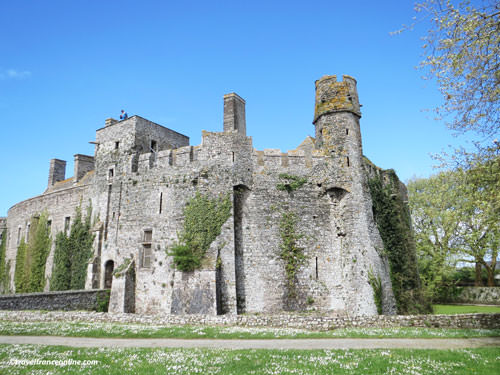
This historical gem can be visited on guided tours or independently. But, if you’re after a truly immersive experience, I recommend a visit during the Heritage Weekend, as the castle transforms into a lively medieval Norman village with reenactments of Viking battles.
Whatever the time of year, this remarkable fortress appeals to visitors of all ages. Children, in particular, love climbing the walkways and imagining themselves as guards or knights in shining armour.
In the mid-12th century, the Lords of Pirou built this stone fortress to replace the old wooden fort erected on a Viking site.
The Chateau de Pirou served as a protective bastion for the surrounding ponds, which provided a natural harbour for flat-bottomed boats and their cargo.

These barges sailed from the sea to the mouth of the Ay River and the port of Lessay, continuing their journey to Pirou through channels cut into the surrounding marshes.
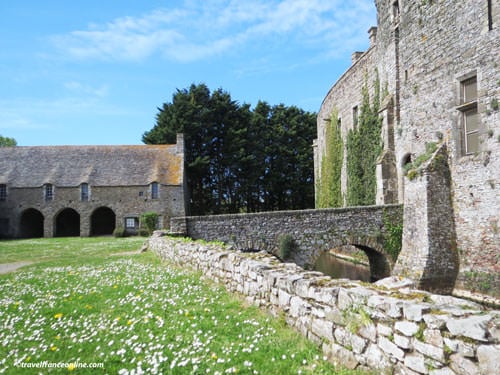
Located on an oval-shaped artificial island, the fortress was originally protected by three deep moats and five fortified gates, each defended by its own moat and drawbridge. Today, three of these gates remain: the Barbican (1st gate), the gatehouse (2nd gate), and the 4th gate.
The latter has entrances for pedestrians and vehicles, as well as a pedestrian walkway, and displays the coat of arms of Richard the Lionheart, Duke of Normandy.
With its formidable defences, the Château de Pirou was truly impregnable!
Pirou, a genuine fortress
Chapelle Saint-Laurent
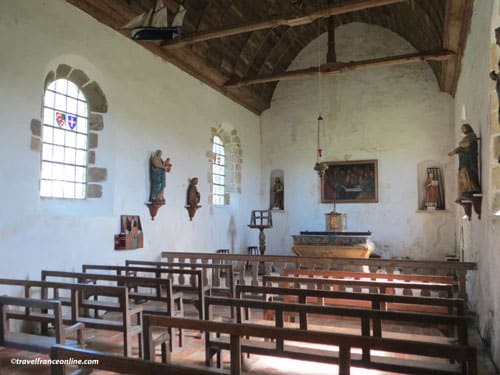
The Chapelle Saint-Laurent is understated yet boasts remarquable architectural elements, such as its ceiling in the shape of a boat hull and its Romanesque stone baptismal font, as well as an exquisite epitaph, sculpted in black marble and dedicated to Charles Bois, one of the lords of Pirou, on the back wall.
Its stained-glass windows are adorned with the coats of arms of the successive lords of Pirou, Pirou, Bois and Vassy, as well as those of Richard the Lionheart, Duke of Normandy, and of Abbot Lelégard, who contributed to the restoration of the castle.
Salle des Plaids and Tapestry of Pirou
The Salle des Plès (Plaids) is the former courtroom where the lords of Pirou dispensed justice.
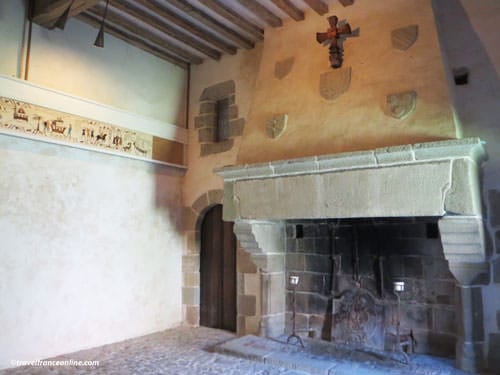
Today, this remarkable room, whose imposing fireplace remains intact, is home to the Tapisserie de Pirou (Tapestry) exhibition.
This 58 metres long contemporary tapestry is reminiscent of the Bayeux Tapestry, also known as The Queen Matilda’s Tapestry. It recounts the Viking saga, tracing their conquests from Normandy to Sicily around the year 1000.
Meticulously embroidered over sixteen years by the embroiderer Thérèse Ozenne, the tapestry is made with fabrics, wool, and embroidery techniques identical to those of the Bayeux Tapestry. The fineness of its details and the richness of its historical narrative are breathtaking.
From the Lords of Pirou to Abbot Lelégard
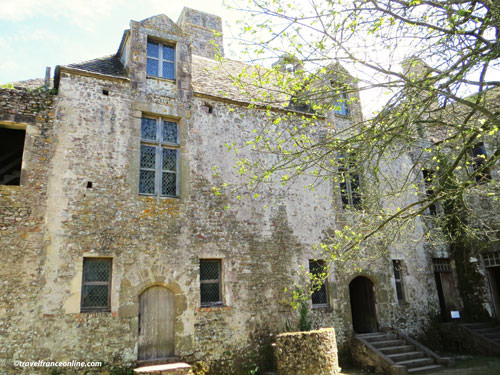
William the Conqueror granted the village of Stoke-Pero and its land in Somerset, in England, to one of the early lords of Pirou as a reward for his support during the conquest of England.
However, his direct descendants remained the owners of the Château de Pirou until the 15th century, when the property passed to the Bois family through marriage.
In the 17th century, another branch of the family, the Vassy family, inherited it and retained it until the French Revolution, when Huguet de Semonville acquired it and converted it into a farm.
Semonville neglected the buildings until 1833, when the Quesnel-Morinière family, wealthy residents of the nearby city of Coutances, purchased them with the intention of restoring them.
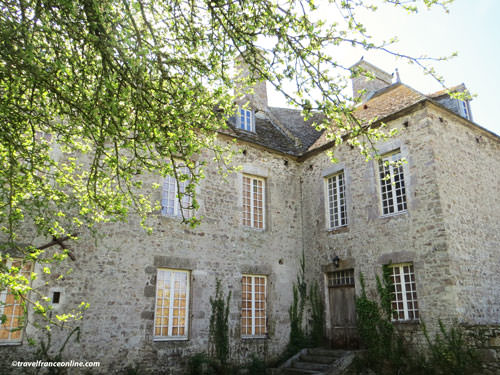
In 1966, Father Lelégard purchased the Château de Pirou, which was listed as a historical monument in 1968.
The priest devoted the next twenty years to the meticulous restoration of the château and its outbuildings, with the assistance of young volunteers and skilled craftsmen.
Then, in 1991, he bequeathed the property to the Abbaye de la Licerne Foundation, which has since then scrupulously overseen its upkeep.
The legend of the Geese of Pirou
A charming legend, The Legend of the Geese of Pirou, is associated with the old medieval fortress!
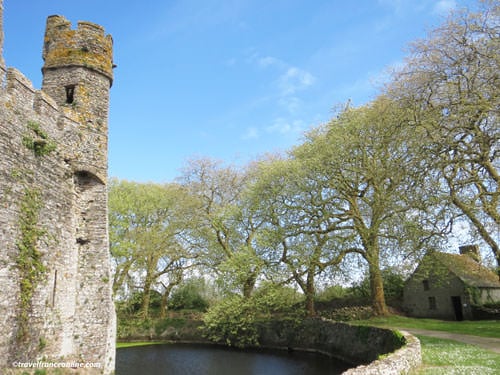
This legend, which dates back to the Norman invasions, offers a poetic explanation for the annual migration of Graylag geese to the region.
This is how it goes: Seeing that they would never be able to enter the formidable fortress, the Viking attackers decided to starve its inhabitants.
So, to escape undetected, the lord of Pirou sought the help of the village magician who used a grimoire to transform the lord and his family into geese.
Seeing a flock of greylag geese flying over the ramparts at dawn, the Normans suspected nothing.
But, when they finally broke into the fortress, they found it deserted, except for the old magician whom they forced to reveal the secret of the spell.
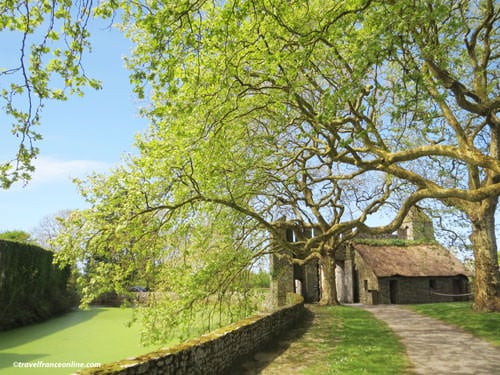
In retaliation, the attackers set fire to the castle and destroyed the grimoire.
Since then, the geese returned every year, hoping to find the lost magic formula. Alas, their searches are always in vain, and they leave empty-handed each autumn.
The legend has fascinated many people, including Robert de Pirou, who immortalised it by adding a goose’s neck to his family’s coat of arms in the 14th century.
Directions: Outskirts of the village of Pirou – Manche department – Cotentin Peninsula
Coordinates: Lat 49.161556 – Long -1.573496


