
Château de Chenonceau – Wonder of the Loire Valley
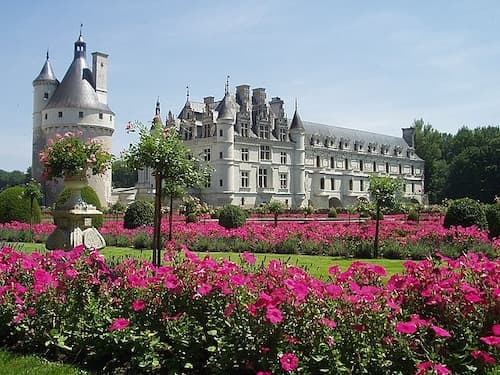
The Château de Chenonceau is renowned for its elegant gallery, which spans the Cher River, and is the château’s defining feature.
Chenonceau’s unique characteristic is that it was designed by a woman and owned and embellished exclusively by women, which rightfully earns it the name “Château des Dames – Ladies’ Château.”
Renowned for its elegant and refined architecture, Chenonceau also embodies the splendour of the French Renaissance.
Its fame is such that the French affectionately call it “La Merveille du Val-de-Loire – The Marvel of the Loire Valley.”
The Ladies of Chenonceau
Katherine Briçonnet
At the beginning of the 16th century, the Château de Chenonceau was merely a fortified manor house with a watermill. Thomas Bohier, chamberlain to Charles VIII, acquired the dilapidated buildings from the Lord of Marques in 1513, during the height of the French Renaissance.

Katherine Briçonnet, his wife, was the driving force behind the reconstruction of the Château de Chenonceau. She indeed oversaw it from 1513 to 1521 while her husband fought alongside the king in the Italian Wars. C
Katherine commissioned the construction of a pavilion flanked by four corner towers on the site of the mill, retaining only the well and the tower.
She also prioritised comfort and luxury, as evidenced by the monumental entrance, adorned with the coat of arms and initials of Thomas Bohier and Katherine (TBK) and surmounted by a salamander, the emblem of King Francis I. She also commissioned the construction of the first straight staircase in France!
However, in 1535, King Francis I seized the castle to recover the debts that her son owed to the crown, and transformed it into a hunting lodge.
Diane de Poitiers
Henri II succeeded his father, Francis I, in 1547 and entrusted the Château de Chenonceau to his young mistress, Diane de Poitiers.

A woman of remarkable talent and intelligence, as well as exquisite taste and a penchant for luxury, Diane took charge of Chenonceau brilliantly. She left an indelible mark on the château!
Diane indeed spearheaded the development of the vineyard and the farm, transforming them into thriving businesses. She also had the gardens laid out in the French style and a magnificent bridge built to span the Cher River.
Tragically, her time at Chenonceau came to an end in 1559 when Henri II was killed in a tournament.
Catherine de Medici
Upon the death of Henry II, his widow, Catherine de Medici, harboured resentment toward Diane de Poitiers. Knowing her attachment to the Château de Chenonceau, she took revenge and exiled her to the Château de Chaumont sur Loire.

Undeterred, Diane chose to retire to the Château d’Anet, another gift from the late king.
Catherine de Medici, however, seized the opportunity to leave her mark on Chenonceau and undoubtedly surpass Diane! She thus undertook significant renovations, including landscaping the park and constructing new buildings. But her most iconic achievement is the two-story gallery, in the Italian Renaissance style, that she had added to the bridge originally built by Diane.
Also known for her taste for luxury and splendour, Catherine de Medici imbued Chenonceau with an atmosphere of grandeur and festivity. The castle became a centre of social activity, hosting lavish parties, balls, banquets and fireworks, embodying the opulence of the Renaissance era.
Louise de Lorraine
The atmosphere at the château changed when Marie de Medici died in 1589 and her daughter-in-law, Louise of Lorraine, inherited it. Louise indeed learned of the assassination of her husband, Henry III, while staying at Chenonceau. She sank into a deep depression and spent the next 11 years wandering like a lost soul through the château’s corridors, whose tapestries had been covered with black cloths adorned with skulls at her request.
Françoise de Lorraine
Louise died in 1601, and her niece, Françoise de Lorraine, who was then six years old, inherited it. Françoise married the Duke of Vendôme, and Chenonceau remained the property of their descendants until 1720, when the Duke of Bourbon bought it and sold off its furnishings piece by piece, many of which ended up at the Palace of Versailles.
Madame Dupin
The financier Claude Dupin acquired Chenonceau in 1733. H

is wife, Louise, a cultured and intelligent woman, created a renowned literary salon that attracted some of the most brilliant minds of the Enlightenment, such as Voltaire, Montesquieu, and Jean-Jacques Rousseau.
Her charitable works earned her also the affection and respect of the villagers.
Louise Dupin thus saved the Château de Chenonceau from demolition during the French Revolution, arguing that the gallery-bridge was the only bridge for miles around, and therefore essential for trade and transportation! Truly a woman of great intelligence!
Madame Pelouze
Louise died in 1799, and her great-nephew, René-François Vallet de Villeneuve, inherited Chenonceau, which remained in his family for sixty-five years. In 1864, his children sold the château to Madame Marguerite Pelouze, a wealthy heiress who fell in love with it.
Determined to restore it to its former glory, she indeed lavishly spent to renovate the estate and restore its past grandeur. She commissioned the architect Roguet, a student of Viollet-le-Duc, for a gargantuan transformation. Once Chenonceau was completed, she founded an Academy of Arts and Letters in the château, and welcomed writers, historians, painters, sculptors and musicians of the time.
However, her brother, worried about the deteriorating state of her finances, sent her away for a few year , and in her absence, considerably reduced the château’s lifestyle and dispersed the literary salon. The debts eventually caught up with the wealthy heiress. In 1889, Chenonceau was acquired at auction by the Crédit Foncier, which in 1891 profitably resold it to Mr José Emilio Terry.
Menier family
The castle remained in his family until 1913, when it was again put up for public auction and bought by Henri Menier, an heir of the chocolate-making family. However, Henri died five months after acquiring the château. As he had no children, Chenonceau passed to his brother Gaston, who established a military hospital there during the First World War, and later engaged in a series of renovations. His grandson, Antoine, inherited the château in 1935.
Chenonceau was requisitioned by the French army at the beginning of the war and then occupied by the Germans, resulting in serious damage. The château is still in the Menier family. The last restoration dates from 2009, and in 2013, the Château de Chenonceau celebrated five centuries of history as well as the centenary of the acquisition by the Menier family!
Château de Chenonceau
The elegant facade of the Château de Chenonceau and its picturesque gallery spanning the Cher River attract thousands of visitors from around the world each year. Its interior mirrors its exterior: elegant, refined, and luxurious.!

The Guard Room houses a magnificent 16th-century fireplace and superb Flemish tapestries. The chapel lost its original stained-glass windows during the Second World War, but was carefully restored in 1954.
Diane’s bedroom offers a glimpse into the world of Henry II’s favourite. Decorated with 16th-century Flemish tapestries, it serves for the château’s archives, which include copies of Diane’s and Bohier’s signatures displayed in a glass case.
The Library and the Bureau Vert (Green Office) contain a rich collection of paintings and tapestries, while Francis I’s bedroom boasts opulent decor, with 15th- and 16th-century furniture and a remarkable Renaissance fireplace bearing Thomas Bohier’s motto.
Katherine Brionconnet’s impressive straight staircase leads to the rooms of César de Vendôme, and Gabrielle d’Estrées, and, of course, to the Chamber of the Five Queens, so named in honour of Catherine de Medici’s two daughters and three daughters-in-law. This room is adorned with Flemish tapestries and masterpieces by Rubens and Mignard.
Grande Galerie

The Grande Galerie, a 60-metre-long and two-levels gallery spans the Cher River.
It is Chenonceau’s most iconic architectural feature!
It served as a hospital during the First World War and symbolised the border between Free France and occupied France during the Second World War.
Finally, if you can discover the rich history of the château and its inhabitants at the Musée de Cire (Wax Museum), which is open year-round.
Department of Indre-et-Loire
Coordinates: Lat 47.324870 – Long 1.070301
Photos via Wikimedia Commons: Tour Marques by Frank K. CC BY 2.0 – Chambre des cinq reines by assumed LonganimE CC BY-SA 2.5 – Castle and formal gardens by fr:User:Bilbo Public domain – Renaissance entrance by AlMare CC BY-SA 2.5 – Grande Galerie and castle and gardens by Tim Sackton CC BY-SA 2.0


